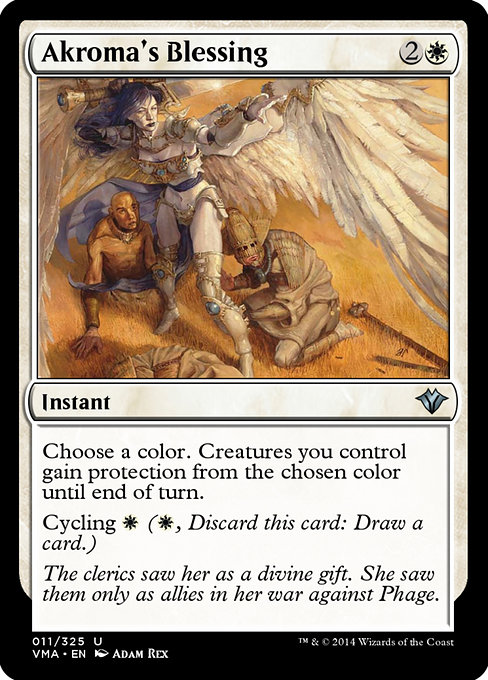
Instant
Choose a color. Creatures you control gain protectionProtection is a static ability, written “Protection from [quality].” This quality is usually a color (as in “protection from black”) but can be any characteristic value or information. If the quality happens to be a card name, it is treated as such only if the protection ability specifies that the quality is a name. If the quality is a card type, subtype, or supertype, the ability applies to sources that are permanents with that card type, subtype, or supertype and to any sources not on the battlefield that are of that card type, subtype, or supertype. This is an exception to rule 109.2.
A permanent or player with protection can’t be targeted by spells with the stated quality and can’t be targeted by abilities from a source with the stated quality.
A permanent or player with protection can’t be enchanted by Auras that have the stated quality. Such Auras attached to the permanent or player with protection will be put into their owners’ graveyards as a state-based action. (See rule 704, “State-Based Actions.”)
A permanent with protection can’t be equipped by Equipment that have the stated quality or fortified by Fortifications that have the stated quality. Such Equipment or Fortifications become unattached from that permanent as a state-based action, but remain on the battlefield. (See rule 704, “State-Based Actions.”)
Any damage that would be dealt by sources that have the stated quality to a permanent or player with protection is prevented.
Attacking creatures with protection can’t be blocked by creatures that have the stated quality.
“Protection from [quality A] and from [quality B]” is shorthand for “protection from [quality A]” and “protection from [quality B]”; it behaves as two separate protection abilities.
“Protection from each [characteristic]” is shorthand for “protection from [quality A],” “protection from [quality B],” and so on for each possible quality the listed characteristic could have; it behaves as multiple separate protection abilities.
“Protection from each [set of characteristics, qualities, or players]” is shorthand for “protection from [A],” “protection from [B],” and so on for each characteristic, quality, or player in the set. It behaves as multiple separate protection abilities.
“Protection from everything” is a variant of the protection ability. A permanent or player with protection from everything has protection from each object regardless of that object’s characteristic values. Such a permanent or player can’t be targeted by spells or abilities and can’t be enchanted by Auras. Such a permanent can’t be equipped by Equipment, fortified by Fortifications, or blocked by creatures. All damage that would be dealt to such a permanent or player is prevented.
“Protection from [a player]” is a variant of the protection ability. A permanent or player with protection from a specific player has protection from each object that player controls and protection from each object that player owns not controlled by another player, regardless of that object’s characteristic values. Such a permanent or player can’t be targeted by spells or abilities the specified player controls and can’t be enchanted by Auras that player controls. Such a permanent can’t be equipped by Equipment that player controls, fortified by Fortifications that player controls, or blocked by creatures that player controls. All damage that would be dealt to such a permanent or player by sources controlled by the specified player or owned by that player but not controlled by another player is prevented.
Multiple instances of protection from the same quality on the same permanent or player are redundant.
Some Auras both give the enchanted creature protection from a quality and say “this effect doesn’t remove” either that specific Aura or all Auras. This means that the specified Auras aren’t put into their owners’ graveyards as a state-based action. If the creature has other instances of protection from the same quality, those instances affect Auras as normal.
One Aura (Benevolent Blessing) gives the enchanted creature protection from a quality and says the effect doesn’t remove certain permanents that are “already attached to” that creature. This means that, when the protection effect starts to apply, any objects with the stated quality that are already attached to that creature (including the Aura giving that creature protection) will not be put into their owners’ graveyards as a state-based action. Other permanents with the stated quality can’t become attached to the creature. If the creature has other instances of protection from the same quality, those instances affect attached permanents as normal. (CR 702.16) from the chosen color until end of turn.
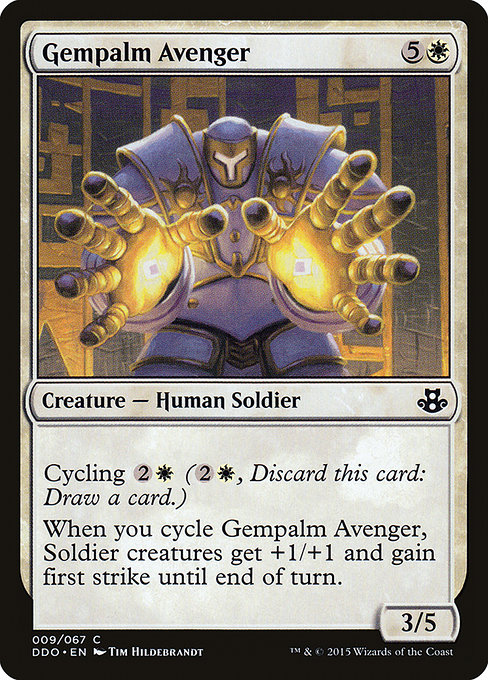
CyclingCycling is an activated ability that functions only while the card with cycling is in a player’s hand. “Cycling [cost]” means “[Cost], Discard this card: Draw a card.”
Although the cycling ability can be activated only if the card is in a player’s hand, it continues to exist while the object is on the battlefield and in all other zones. Therefore objects with cycling will be affected by effects that depend on objects having one or more activated abilities.
Some cards with cycling have abilities that trigger when they’re cycled. “When you cycle this card” means “When you discard this card to pay an activation cost of a cycling ability.” These abilities trigger from whatever zone the card winds up in after it’s cycled.
Some cards have abilities that trigger whenever a player “cycles or discards” a card. These abilities trigger only once when a card is cycled.
Typecycling is a variant of the cycling ability. “[Type]cycling [cost]” means “[Cost], Discard this card: Search your library for a [type] card, reveal it, and put it into your hand. Then shuffle your library.” This type is usually a subtype (as in “mountaincycling”) but can be any card type, subtype, supertype, or combination thereof (as in “basic landcycling”).
Typecycling abilities are cycling abilities, and typecycling costs are cycling costs. Any cards that trigger when a player cycles a card will trigger when a card is discarded to pay an activation cost of a typecycling ability. Any effect that stops players from cycling cards will stop players from activating cards’ typecycling abilities. Any effect that increases or reduces a cycling cost will increase or reduce a typecycling cost. Any effect that looks for a card with cycling will find a card with typecycling. (CR 702.29) (, DiscardTo discard a card, move it from its owner’s hand to that player’s graveyard.
By default, effects that cause a player to discard a card allow the affected player to choose which card to discard. Some effects, however, require a random discard or allow another player to choose which card is discarded.
If a card is discarded, but an effect causes it to be put into a hidden zone instead of into its owner’s graveyard without being revealed, all values of that card’s characteristics are considered to be undefined. If a card is discarded this way to pay a cost that specifies a characteristic about the discarded card, that cost payment is illegal; the game returns to the moment before the cost was paid (see rule 733, “Handling Illegal Actions”). (CR 701.9) this card: Draw a card.)
Price unavailable
Commander: LegalModern: Not legal
Save this card
Log in to save cards to your lists.
Start a deck with this cardTags and classifications
Card attributes are distinct from extracted ability facts and inferred themes. AI themes and predicted tags are suggestions, not rules text.
Ability tags
Mana costs
Color identity
Keyword tags
Mana value
Timing tags
Type tags
Predicted tags are currently unavailable.