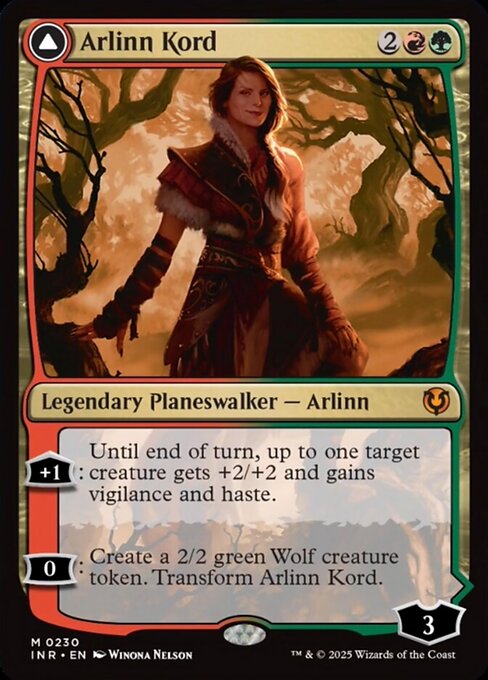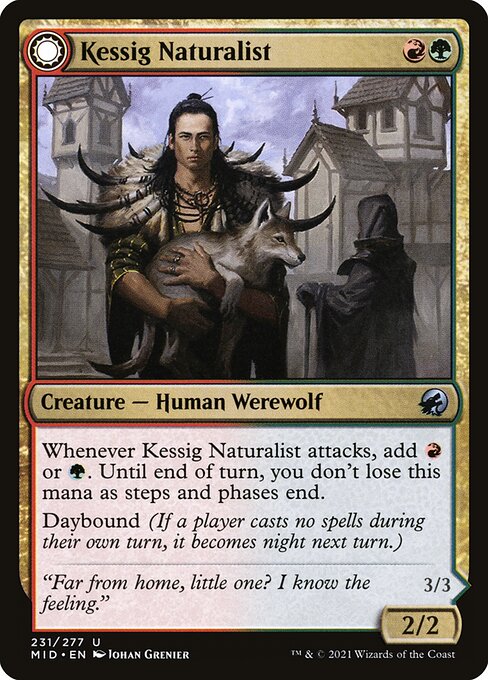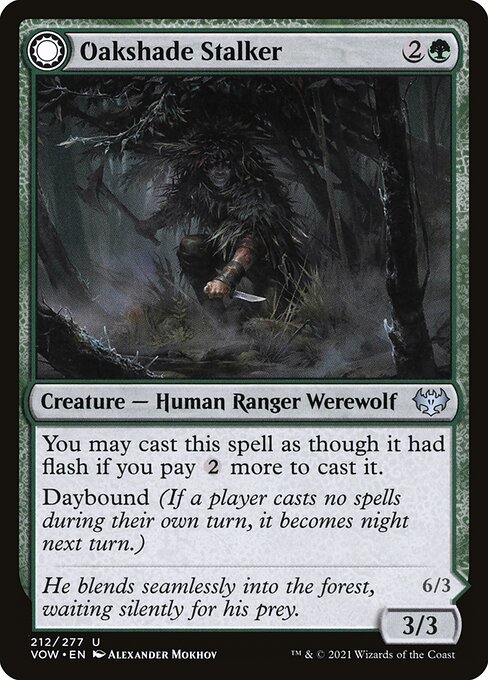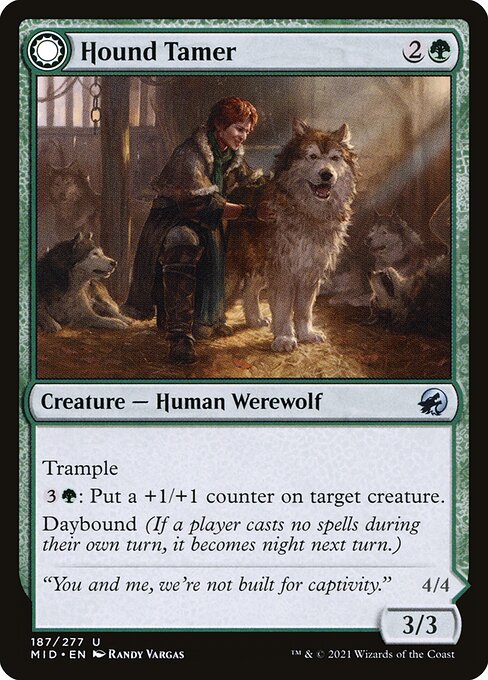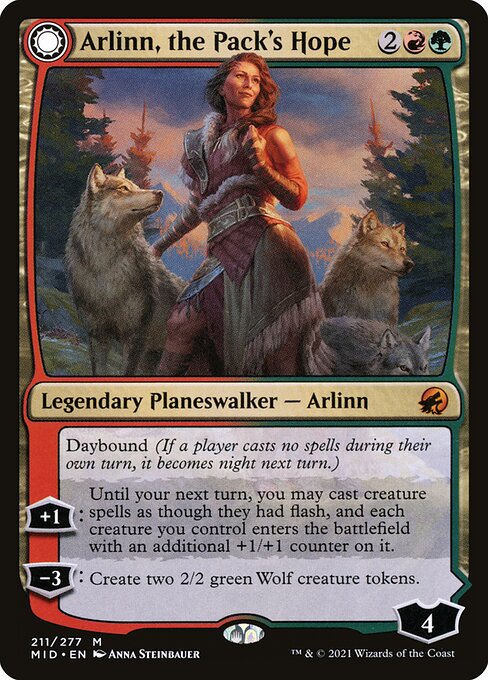
Legendary Planeswalker — Arlinn // Legendary Planeswalker — Arlinn
DayboundDaybound and nightbound are found on opposite faces of some double-faced cards (see rule 712, “Double-Faced Cards”).
Daybound is found on the front faces of some double-faced cards and represents three static abilities. “Daybound” means “If it is night and this permanent is represented by a double-faced card, it enters transformed,” “As it becomes night, if this permanent is front face up, transform it,” and “This permanent can’t transform except due to its daybound ability.” See rule 731, “Day and Night.”
Any time a player controls a permanent that is front face up with daybound and it’s night, that player transforms that permanent. This happens immediately and isn’t a state-based action.
Any time a player controls a permanent with daybound, if it’s neither day nor night, it becomes day.
Nightbound is found on the back faces of some double-faced cards and represents two static abilities. “Nightbound” means “As it becomes day, if this permanent is back face up, transform it” and “This permanent can’t transform except due to its nightbound ability.”
Any time a player controls a permanent that is back face up with nightbound and it’s day, that player transforms that permanent. This happens immediately and isn’t a state-based action.
Any time a player controls a permanent with nightbound, if it’s neither day nor night and there are no permanents with daybound on the battlefield, it becomes night. (CR 702.145) (If a player casts no spells during their own turn, it becomes nightIf it’s night, and previous turn’s active player cast two or more spells during the previous turn, it becomes day. Multiplayer games using the shared team turns option (see rule 805) use a modified rule: if it’s night and any player from the previous turn’s active team cast two or more spells during that turn, it becomes day. (CR 731.2b) next turn.)
+1: Until your next turn, you may castTo cast a spell is to take it from the zone it’s in (usually the hand), put it on the stack, and pay its costs, so that it will eventually resolve and have its effect. A player may cast a spell if they have priority. See rule 601, “Casting Spells.”
To cast a card is to cast it as a spell. (CR 701.5) creature spells as though they had flashFlash is a static ability that functions in any zone from which you could play the card it’s on. “Flash” means “You may play this card any time you could cast an instant.”
Multiple instances of flash on the same object are redundant. (CR 702.8), and each creature you control enters with an additional +1/+1 counterTo counter a spell or ability is to cancel it: remove it from the stack without resolving it. A counter on an object or player is instead a marker that changes characteristics or interacts with rules or abilities; for example, a +1/+1 counter modifies a creature’s power and toughness. (CR 701.6; 122.1) on it.
−3: CreateTo create one or more tokens with certain characteristics, put the specified number of tokens with the specified characteristics onto the battlefield.
If a replacement effect applies to a token being created, that effect applies before considering any continuous effects that will modify the characteristics of that token. If a replacement effect applies to a token entering the battlefield, that effect applies after considering any continuous effects that will modify the characteristics of that token.
Previously, an effect that created tokens instructed a player to “put [those tokens] onto the battlefield.” Cards that were printed with that text have received errata in the Oracle card reference so they now “create” those tokens. (CR 701.7) two 2/2 green Wolf creature tokens. // NightboundDaybound and nightbound are found on opposite faces of some double-faced cards (see rule 712, “Double-Faced Cards”).
Daybound is found on the front faces of some double-faced cards and represents three static abilities. “Daybound” means “If it is night and this permanent is represented by a double-faced card, it enters transformed,” “As it becomes night, if this permanent is front face up, transform it,” and “This permanent can’t transform except due to its daybound ability.” See rule 731, “Day and Night.”
Any time a player controls a permanent that is front face up with daybound and it’s night, that player transforms that permanent. This happens immediately and isn’t a state-based action.
Any time a player controls a permanent with daybound, if it’s neither day nor night, it becomes day.
Nightbound is found on the back faces of some double-faced cards and represents two static abilities. “Nightbound” means “As it becomes day, if this permanent is back face up, transform it” and “This permanent can’t transform except due to its nightbound ability.”
Any time a player controls a permanent that is back face up with nightbound and it’s day, that player transforms that permanent. This happens immediately and isn’t a state-based action.
Any time a player controls a permanent with nightbound, if it’s neither day nor night and there are no permanents with daybound on the battlefield, it becomes night. (CR 702.145) (If a player casts at least two spells during their own turn, it becomes dayIf it’s day and the previous turn’s active player didn’t cast any spells during that turn, it becomes night. Multiplayer games using the shared team turns option (see rule 805) use a modified rule: if it’s day and no player from the previous turn’s active team cast a spell during that turn, it becomes night. (CR 731.2a) next turn.)
+2: Add .
0: Until end of turn, Arlinn becomes a 5/5 Werewolf creature with trampleTrample is a static ability that modifies the rules for assigning an attacking creature’s combat damage. The ability has no effect when a creature with trample is blocking or is dealing noncombat damage. (See rule 510, “Combat Damage Step.”)
The controller of an attacking creature with trample first assigns damage to the creature(s) blocking it. Once all those blocking creatures are assigned lethal damage, any excess damage is assigned as its controller chooses among those blocking creatures and the player, planeswalker, or battle the creature is attacking. When checking for assigned lethal damage, take into account damage already marked on the creature and damage from other creatures that’s being assigned during the same combat damage step, but not any abilities or effects that might change the amount of damage that’s actually dealt. The attacking creature’s controller need not assign lethal damage to all those blocking creatures but in that case can’t assign any damage to the player or planeswalker it’s attacking.
Trample over planeswalkers is a variant of trample that modifies the rules for assigning combat damage to planeswalkers. The controller of a creature with trample over planeswalkers assigns that creature’s combat damage as described in rule 702.19b, with one exception. If that creature is attacking a planeswalker, after lethal damage is assigned to all blocking creatures and damage at least equal to the loyalty of the planeswalker the creature is attacking is assigned to that planeswalker, further excess damage may be assigned as the attacking creature’s controller chooses among those blocking creatures, that planeswalker, and that planeswalker’s controller. When checking for assigned damage equal to a planeswalker’s loyalty, take into account damage from other creatures that’s being assigned during the same combat damage step, but not any abilities or effects that might change the amount of damage that’s actually dealt.
If an attacking creature with trample or trample over planeswalkers is blocked, but there are no creatures blocking it when damage is assigned, its damage is assigned to the defending player and/or planeswalker as though all blocking creatures have been assigned lethal damage.
If a creature with trample over planeswalkers is attacking a planeswalker and that planeswalker is removed from combat, the creature’s damage may be assigned to the defending player once all blocking creatures have been dealt lethal damage or, if there are no blocking creatures when damage is assigned, all its damage is assigned to the defending player. This is an exception to rule 506.4c, and it does not cause the creature to be attacking that player.
If a creature without trample over planeswalkers is attacking a planeswalker, none of its combat damage can be assigned to the defending player, even if that planeswalker has been removed from combat or the damage the attacking creature could assign is greater than the planeswalker’s loyalty.
Multiple instances of trample on the same creature are redundant. Multiple instances of trample over planeswalkers on the same creature are redundant. (CR 702.19), indestructibleIndestructible is a static ability.
A permanent with indestructible can’t be destroyed. Such permanents aren’t destroyed by lethal damage, and they ignore the state-based action that checks for lethal damage (see rule 704.5g).
Multiple instances of indestructible on the same permanent are redundant. (CR 702.12), and hasteHaste is a static ability.
If a creature has haste, it can attack even if it hasn’t been controlled by its controller continuously since their most recent turn began. (See rule 302.6.)
If a creature has haste, its controller can activate its activated abilities whose cost includes the tap symbol or the untap symbol even if that creature hasn’t been controlled by that player continuously since their most recent turn began. (See rule 302.6.)
Multiple instances of haste on the same creature are redundant. (CR 702.10).
$3.12
Commander: LegalModern: Legal
Save this card
Log in to save cards to your lists.
Start a deck with this cardTags and classifications
Card attributes are distinct from extracted ability facts and inferred themes. AI themes and predicted tags are suggestions, not rules text.
Ability tags
Mana costs
Color identity
Keyword tags
Mana value
Timing tags
Type tags
Predicted tags are currently unavailable.