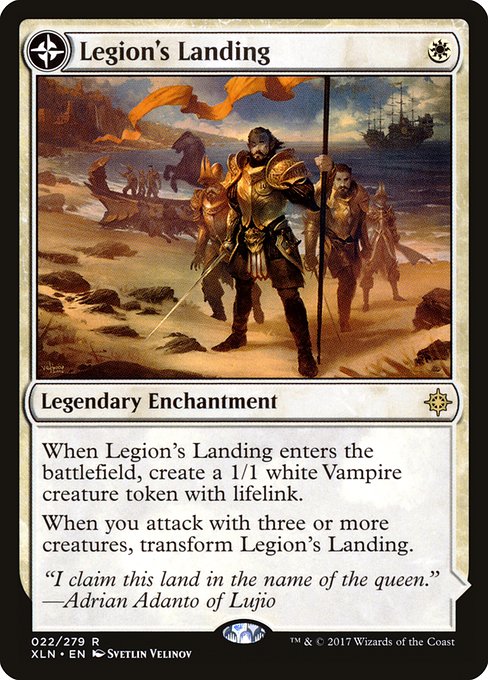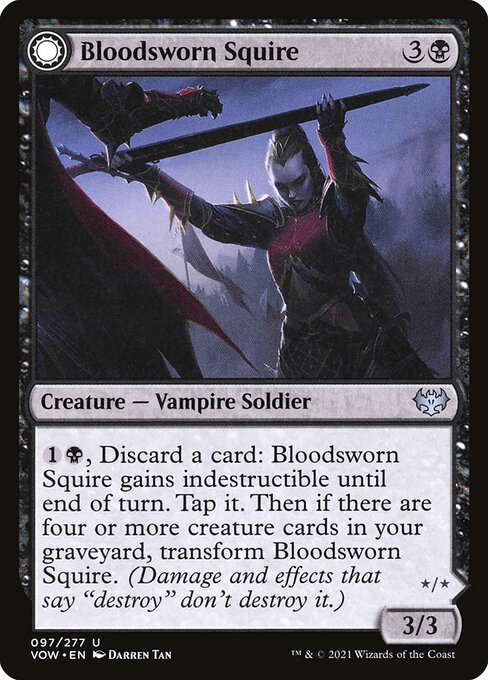
Creature — Vampire Soldier // Creature — Vampire Knight
, DiscardTo discard a card, move it from its owner’s hand to that player’s graveyard.
By default, effects that cause a player to discard a card allow the affected player to choose which card to discard. Some effects, however, require a random discard or allow another player to choose which card is discarded.
If a card is discarded, but an effect causes it to be put into a hidden zone instead of into its owner’s graveyard without being revealed, all values of that card’s characteristics are considered to be undefined. If a card is discarded this way to pay a cost that specifies a characteristic about the discarded card, that cost payment is illegal; the game returns to the moment before the cost was paid (see rule 733, “Handling Illegal Actions”). (CR 701.9) a card: This creature gains indestructibleIndestructible is a static ability.
A permanent with indestructible can’t be destroyed. Such permanents aren’t destroyed by lethal damage, and they ignore the state-based action that checks for lethal damage (see rule 704.5g).
Multiple instances of indestructible on the same permanent are redundant. (CR 702.12) until end of turn. TapTo tap a permanent, turn it sideways from an upright position. Only untapped permanents can be tapped. (CR 701.26) it. Then if there are four or more creature cards in your graveyard, transformTo transform a permanent, turn it over so that its other face is up. Only permanents represented by double-faced tokens and double-faced cards can transform. (See rule 712, “Double-Faced Cards.”)
Although transforming a permanent uses the same physical action as turning a permanent face up or face down, they are different game actions. Abilities that trigger when a permanent is turned face down won’t trigger when that permanent transforms, and so on.
If a spell or ability instructs a player to transform a permanent that isn’t represented by a double-faced token or a double-faced card, nothing happens.
If a spell or ability instructs a player to transform a permanent, and the face that permanent would transform into is an instant or sorcery face nothing happens.
Some triggered abilities trigger when an object “transforms into” an object with a specified characteristic. Such an ability triggers if the object either transforms or converts (see rule 701.28) and has the specified characteristic immediately after it does so.
If an activated or triggered ability of a permanent that isn’t a delayed triggered ability of that permanent tries to transform it, the permanent does so only if it hasn’t transformed or converted since the ability was put onto the stack. If a delayed triggered ability of a permanent tries to transform that permanent, the permanent does so only if it hasn’t transformed or converted since that delayed triggered ability was created. In both cases, if the permanent has already transformed or converted, an instruction to do either is ignored.
Some spells and abilities refer to a “transformed permanent.” This phrase refers to a double-faced permanent on the battlefield with its back face up. A permanent with its front face up is never considered a transformed permanent, even if it had its back face up previously. Similarly, an object represented by more than one card, such as a melded or merged permanent, is never considered a transformed permanent, even if it has components that are back face up. See rules 701.42, “Meld,” and 730, “Merging with Permanents.” (CR 701.27) this creature. (Damage and effects that say "destroyThe only ways a permanent can be destroyed are as a result of an effect that uses the word “destroy” or as a result of the state-based actions that check for lethal damage (see rule 704.5g) or damage from a source with deathtouch (see rule 704.5h). If a permanent is put into its owner’s graveyard for any other reason, it hasn’t been “destroyed.”
A regeneration effect replaces a destruction event. See rule 701.19, “Regenerate.” (CR 701.8)" don't destroyThe only ways a permanent can be destroyed are as a result of an effect that uses the word “destroy” or as a result of the state-based actions that check for lethal damage (see rule 704.5g) or damage from a source with deathtouch (see rule 704.5h). If a permanent is put into its owner’s graveyard for any other reason, it hasn’t been “destroyed.”
A regeneration effect replaces a destruction event. See rule 701.19, “Regenerate.” (CR 701.8) it.) // Bloodsworn Knight's power and toughness are each equal to the number of creature cards in your graveyard.
, DiscardTo discard a card, move it from its owner’s hand to that player’s graveyard.
By default, effects that cause a player to discard a card allow the affected player to choose which card to discard. Some effects, however, require a random discard or allow another player to choose which card is discarded.
If a card is discarded, but an effect causes it to be put into a hidden zone instead of into its owner’s graveyard without being revealed, all values of that card’s characteristics are considered to be undefined. If a card is discarded this way to pay a cost that specifies a characteristic about the discarded card, that cost payment is illegal; the game returns to the moment before the cost was paid (see rule 733, “Handling Illegal Actions”). (CR 701.9) a card: This creature gains indestructibleIndestructible is a static ability.
A permanent with indestructible can’t be destroyed. Such permanents aren’t destroyed by lethal damage, and they ignore the state-based action that checks for lethal damage (see rule 704.5g).
Multiple instances of indestructible on the same permanent are redundant. (CR 702.12) until end of turn. TapTo tap a permanent, turn it sideways from an upright position. Only untapped permanents can be tapped. (CR 701.26) it. (Damage and effects that say "destroyThe only ways a permanent can be destroyed are as a result of an effect that uses the word “destroy” or as a result of the state-based actions that check for lethal damage (see rule 704.5g) or damage from a source with deathtouch (see rule 704.5h). If a permanent is put into its owner’s graveyard for any other reason, it hasn’t been “destroyed.”
A regeneration effect replaces a destruction event. See rule 701.19, “Regenerate.” (CR 701.8)" don't destroyThe only ways a permanent can be destroyed are as a result of an effect that uses the word “destroy” or as a result of the state-based actions that check for lethal damage (see rule 704.5g) or damage from a source with deathtouch (see rule 704.5h). If a permanent is put into its owner’s graveyard for any other reason, it hasn’t been “destroyed.”
A regeneration effect replaces a destruction event. See rule 701.19, “Regenerate.” (CR 701.8) it.)
$0.19
Commander: LegalModern: Legal
Save this card
Log in to save cards to your lists.
Start a deck with this cardTags and classifications
Card attributes are distinct from extracted ability facts and inferred themes. AI themes and predicted tags are suggestions, not rules text.
Ability tags
Mana costs
Classes and roles
Creature kinds
Color identity
Keyword tags
Mana value
Timing tags
Type tags
Predicted tags are currently unavailable.