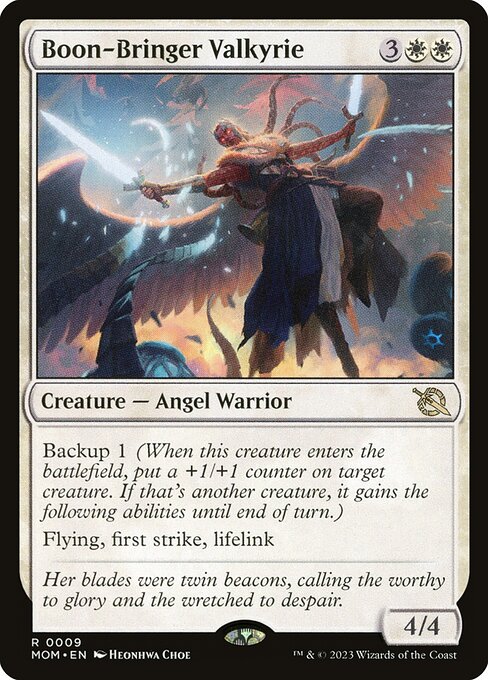
Creature — Angel Warrior
BackupBackup is a triggered ability. “Backup N” means “When this creature enters, put N +1/+1 counters on target creature. If that’s another creature, it also gains the non-backup abilities of this creature printed below this one until end of turn.” Cards with backup have one or more abilities printed after the backup ability. (Some cards with backup also have abilities printed before the backup ability.)
If a permanent enters the battlefield as a copy of a permanent with a backup ability or a token is created that is a copy of that permanent, the order of abilities printed on it is maintained.
Only abilities printed on the object with backup are granted by its backup ability. Any abilities gained by a permanent, whether due to a copy effect, an effect that grants an ability to a permanent, or an effect that creates a token with certain abilities, are not granted by a backup ability.
The abilities that a backup ability grants are determined as the ability is put on the stack. They won’t change if the permanent with backup loses any abilities after the ability is put on the stack but before it resolves. (CR 702.165) 1 (When this creature enters, put a +1/+1 counterTo counter a spell or ability is to cancel it: remove it from the stack without resolving it. A counter on an object or player is instead a marker that changes characteristics or interacts with rules or abilities; for example, a +1/+1 counter modifies a creature’s power and toughness. (CR 701.6; 122.1) on target creature. If that's another creature, it gains the following abilities until end of turn.)
FlyingFlying is an evasion ability.
A creature with flying can’t be blocked except by creatures with flying and/or reach. A creature with flying can block a creature with or without flying. (See rule 509, “Declare Blockers Step,” and rule 702.17, “Reach.”)
Multiple instances of flying on the same creature are redundant. (CR 702.9), first strikeFirst strike is a static ability that modifies the rules for the combat damage step. (See rule 510, “Combat Damage Step.”)
If at least one attacking or blocking creature has first strike or double strike (see rule 702.4) as the combat damage step begins, the only creatures that assign combat damage in that step are those with first strike or double strike. After that step, instead of proceeding to the end of combat step, the phase gets a second combat damage step. The only creatures that assign combat damage in that step are the remaining attackers and blockers that had neither first strike nor double strike as the first combat damage step began, as well as the remaining attackers and blockers that currently have double strike. After that step, the phase proceeds to the end of combat step.
Giving first strike to a creature without it after combat damage has already been dealt in the first combat damage step won’t preclude that creature from assigning combat damage in the second combat damage step. Removing first strike from a creature after it has already dealt combat damage in the first combat damage step won’t allow it to also assign combat damage in the second combat damage step (unless the creature has double strike).
Multiple instances of first strike on the same creature are redundant. (CR 702.7), lifelinkLifelink is a static ability.
Damage dealt by a source with lifelink causes that source’s controller, or its owner if it has no controller, to gain that much life (in addition to any other results that damage causes). See rule 120.3.
If an object is no longer in the zone it’s expected to be in as an effect causes it to deal damage, its last known information is used to determine whether it had lifelink.
The lifelink rules function no matter what zone an object with lifelink deals damage from.
If multiple sources with lifelink deal damage at the same time, they cause separate life gain events (see rules 119.9–10).
Multiple instances of lifelink on the same object are redundant. (CR 702.15)
$0.61
Commander: LegalModern: Legal
Save this card
Log in to save cards to your lists.
Start a deck with this cardTags and classifications
Card attributes are distinct from extracted ability facts and inferred themes. AI themes and predicted tags are suggestions, not rules text.
Ability tags
Mana costs
Creature kinds
Classes and roles
Color identity
Keyword tags
Mana value
Theme tags
Timing tags
Type tags
Predicted tags are currently unavailable.