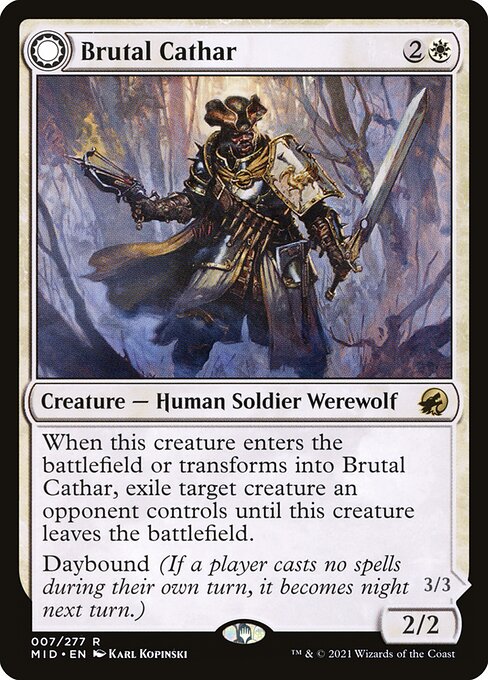
Creature — Human Soldier Werewolf // Creature — Werewolf
Whenever this creature enters or transforms into Brutal Cathar, exileTo exile an object, move it to the exile zone from wherever it is. See rule 406, “Exile.” (CR 701.13) target creature an opponent controls until this creature leaves the battlefield.
DayboundDaybound and nightbound are found on opposite faces of some double-faced cards (see rule 712, “Double-Faced Cards”).
Daybound is found on the front faces of some double-faced cards and represents three static abilities. “Daybound” means “If it is night and this permanent is represented by a double-faced card, it enters transformed,” “As it becomes night, if this permanent is front face up, transform it,” and “This permanent can’t transform except due to its daybound ability.” See rule 731, “Day and Night.”
Any time a player controls a permanent that is front face up with daybound and it’s night, that player transforms that permanent. This happens immediately and isn’t a state-based action.
Any time a player controls a permanent with daybound, if it’s neither day nor night, it becomes day.
Nightbound is found on the back faces of some double-faced cards and represents two static abilities. “Nightbound” means “As it becomes day, if this permanent is back face up, transform it” and “This permanent can’t transform except due to its nightbound ability.”
Any time a player controls a permanent that is back face up with nightbound and it’s day, that player transforms that permanent. This happens immediately and isn’t a state-based action.
Any time a player controls a permanent with nightbound, if it’s neither day nor night and there are no permanents with daybound on the battlefield, it becomes night. (CR 702.145) (If a player casts no spells during their own turn, it becomes nightIf it’s night, and previous turn’s active player cast two or more spells during the previous turn, it becomes day. Multiplayer games using the shared team turns option (see rule 805) use a modified rule: if it’s night and any player from the previous turn’s active team cast two or more spells during that turn, it becomes day. (CR 731.2b) next turn.) // First strikeFirst strike is a static ability that modifies the rules for the combat damage step. (See rule 510, “Combat Damage Step.”)
If at least one attacking or blocking creature has first strike or double strike (see rule 702.4) as the combat damage step begins, the only creatures that assign combat damage in that step are those with first strike or double strike. After that step, instead of proceeding to the end of combat step, the phase gets a second combat damage step. The only creatures that assign combat damage in that step are the remaining attackers and blockers that had neither first strike nor double strike as the first combat damage step began, as well as the remaining attackers and blockers that currently have double strike. After that step, the phase proceeds to the end of combat step.
Giving first strike to a creature without it after combat damage has already been dealt in the first combat damage step won’t preclude that creature from assigning combat damage in the second combat damage step. Removing first strike from a creature after it has already dealt combat damage in the first combat damage step won’t allow it to also assign combat damage in the second combat damage step (unless the creature has double strike).
Multiple instances of first strike on the same creature are redundant. (CR 702.7)
WardWard is a triggered ability. Ward [cost] means “Whenever this permanent becomes the target of a spell or ability an opponent controls, counter that spell or ability unless that player pays [cost].”
Some ward abilities include an X in their cost and state what X is equal to. This value is determined at the time the ability resolves, not locked in as the ability triggers. (CR 702.21)—Pay 3 life.
NightboundDaybound and nightbound are found on opposite faces of some double-faced cards (see rule 712, “Double-Faced Cards”).
Daybound is found on the front faces of some double-faced cards and represents three static abilities. “Daybound” means “If it is night and this permanent is represented by a double-faced card, it enters transformed,” “As it becomes night, if this permanent is front face up, transform it,” and “This permanent can’t transform except due to its daybound ability.” See rule 731, “Day and Night.”
Any time a player controls a permanent that is front face up with daybound and it’s night, that player transforms that permanent. This happens immediately and isn’t a state-based action.
Any time a player controls a permanent with daybound, if it’s neither day nor night, it becomes day.
Nightbound is found on the back faces of some double-faced cards and represents two static abilities. “Nightbound” means “As it becomes day, if this permanent is back face up, transform it” and “This permanent can’t transform except due to its nightbound ability.”
Any time a player controls a permanent that is back face up with nightbound and it’s day, that player transforms that permanent. This happens immediately and isn’t a state-based action.
Any time a player controls a permanent with nightbound, if it’s neither day nor night and there are no permanents with daybound on the battlefield, it becomes night. (CR 702.145) (If a player casts at least two spells during their own turn, it becomes dayIf it’s day and the previous turn’s active player didn’t cast any spells during that turn, it becomes night. Multiplayer games using the shared team turns option (see rule 805) use a modified rule: if it’s day and no player from the previous turn’s active team cast a spell during that turn, it becomes night. (CR 731.2a) next turn.)
$0.29
Commander: LegalModern: Legal
Save this card
Log in to save cards to your lists.
Start a deck with this cardTags and classifications
Card attributes are distinct from extracted ability facts and inferred themes. AI themes and predicted tags are suggestions, not rules text.
Ability tags
Mana costs
Creature kinds
Classes and roles
Color identity
Keyword tags
Mana value
Timing tags
Type tags
Predicted tags are currently unavailable.