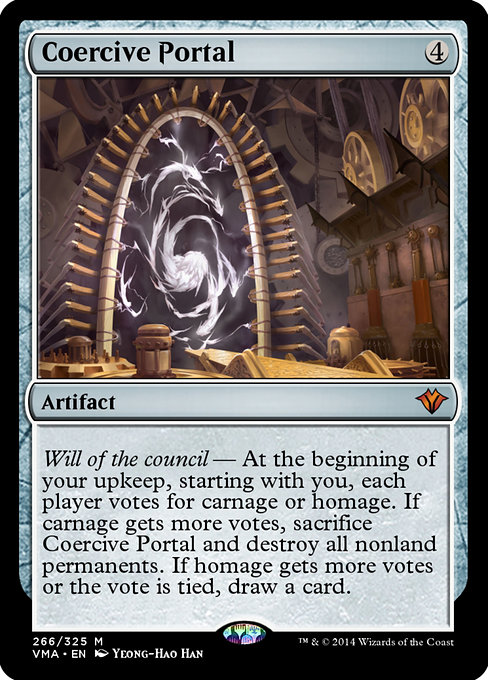
Artifact
Will of the councilAn ability word has no rules meaning of its own. It groups abilities with similar themes; the text following it explains this card’s effect. (CR 207.2c) — At the beginning of your upkeep, starting with you, each player votes for carnage or homage. If carnage gets more votes, sacrificeTo sacrifice a permanent, its controller moves it from the battlefield directly to its owner’s graveyard. A player can’t sacrifice something that isn’t a permanent, or something that’s a permanent they don’t control. Sacrificing a permanent doesn’t destroy it, so regeneration or other effects that replace destruction can’t affect this action. (CR 701.21) this artifact and destroyThe only ways a permanent can be destroyed are as a result of an effect that uses the word “destroy” or as a result of the state-based actions that check for lethal damage (see rule 704.5g) or damage from a source with deathtouch (see rule 704.5h). If a permanent is put into its owner’s graveyard for any other reason, it hasn’t been “destroyed.”
A regeneration effect replaces a destruction event. See rule 701.19, “Regenerate.” (CR 701.8) all nonland permanents. If homage gets more votes or the voteSome spells and abilities instruct players to vote for one choice from a list of options to determine some aspect of the effect of that spell or ability. To vote, each player, starting with a specified player and proceeding in turn order, chooses one of those choices.
The listed choices may be objects, words with no rules meaning that are each connected to a different effect, or other variables relevant to the resolution of the spell or ability.
If the text of a spell or ability refers to “voting,” it refers only to an actual vote, not to any spell or ability that involves the players making choices or decisions without using the word “vote.”
If an effect gives a player multiple votes, those votes all happen at the same time the player would otherwise have voted. (CR 701.38) is tied, draw a card.
Price unavailable
Commander: LegalModern: Not legal
Save this card
Log in to save cards to your lists.
Start a deck with this cardTags and classifications
Card attributes are distinct from extracted ability facts and inferred themes. AI themes and predicted tags are suggestions, not rules text.
Ability tags
Mana costs
Hates tags
Keyword tags
Mana value
Theme tags
Timing tags
Type tags
Predicted tags are currently unavailable.