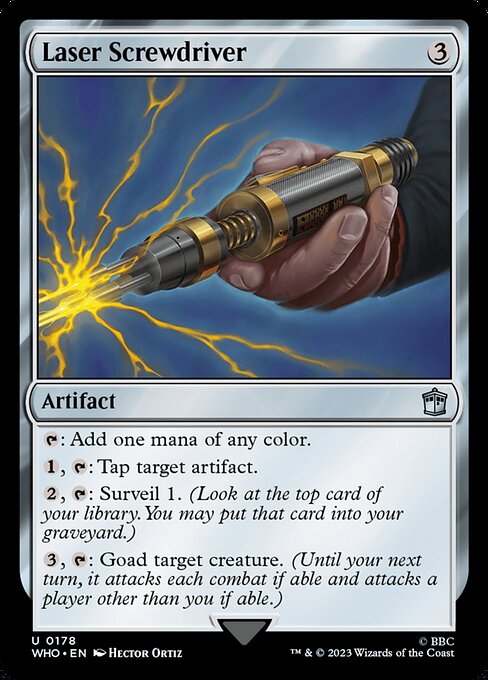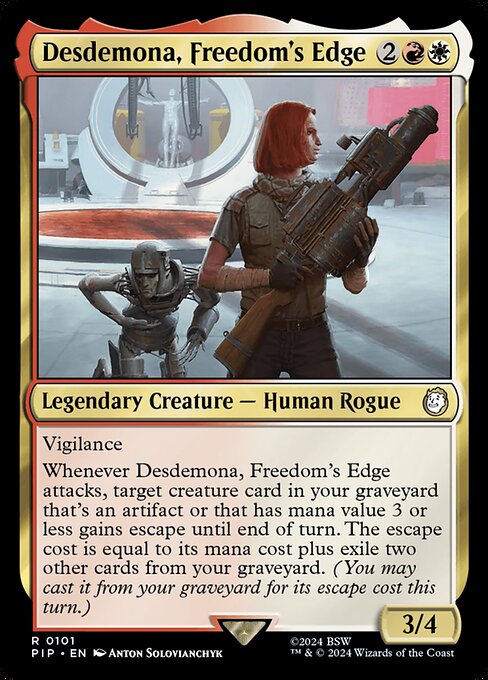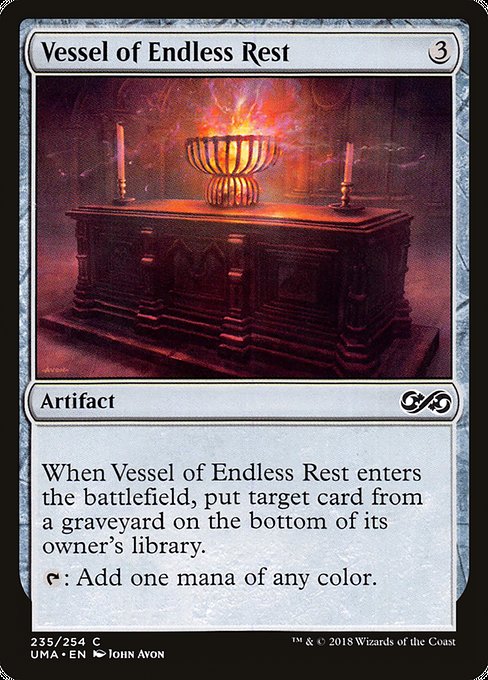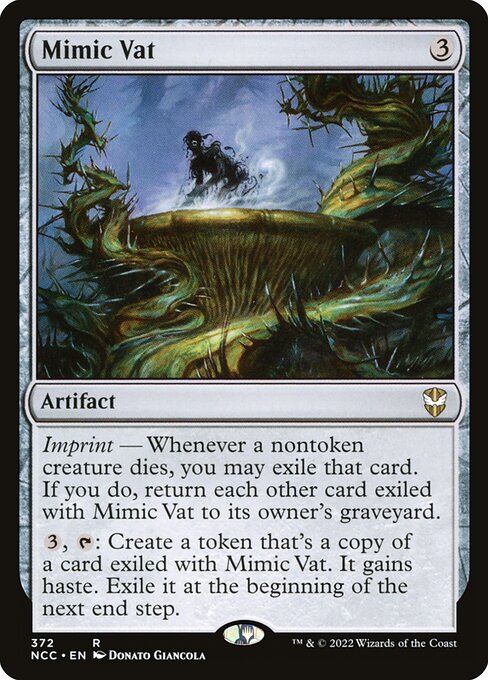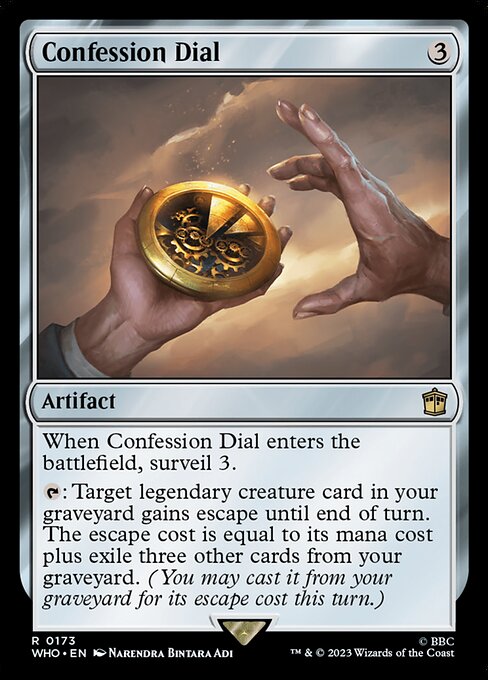
Artifact
When this artifact enters, surveilTo “surveil N” means to look at the top N cards of your library, then put any number of them into your graveyard and the rest on top of your library in any order.
If an effect allows you to look at additional cards while you surveil, those cards are included among the cards you may put into your graveyard and on top of your library in any order.
If a player is instructed to surveil 0, no surveil event occurs. Abilities that trigger whenever a player surveils won’t trigger.
An ability that triggers whenever a player surveils triggers after the process described in rule 701.25a is complete, even if some or all of those actions were impossible. (CR 701.25) 3.
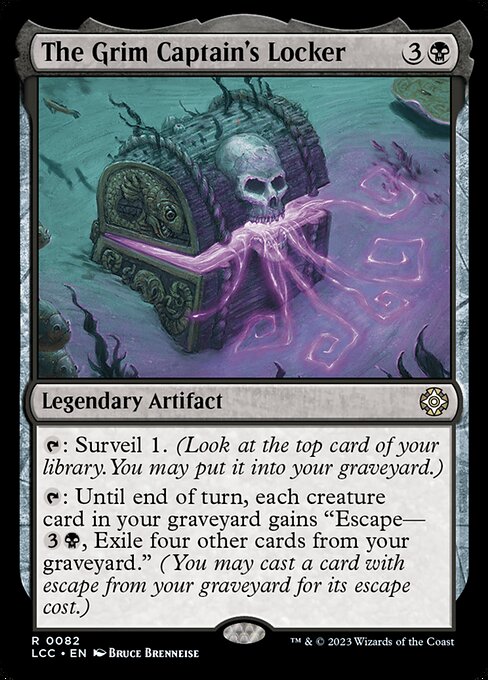
: Target legendary creature card in your graveyard gains escapeEscape represents a static ability that functions while the card with escape is in a player’s graveyard. “Escape [cost]” means “You may cast this card from your graveyard by paying [cost] rather than paying its mana cost.” Casting a spell using its escape ability follows the rules for paying alternative costs in rules 601.2b and 601.2f–h.
A spell or permanent “escaped” if that spell or the spell that became that permanent as it resolved was cast from a graveyard with an escape ability.
An ability that reads “[This permanent] escapes with [one or more of a kind of counter]” means “If this permanent escaped, it enters with [those counters]” That ability may have a triggered ability linked to it that triggers “When it enters this way.” (See rule 603.11.) Such a triggered ability triggers when that permanent enters the battlefield after its replacement effect was applied, even if that replacement effect had no effect.
An ability that reads “[This permanent] escapes with [ability]” means “If this permanent escaped, it has [ability].” (CR 702.138) until end of turn. The escapeEscape represents a static ability that functions while the card with escape is in a player’s graveyard. “Escape [cost]” means “You may cast this card from your graveyard by paying [cost] rather than paying its mana cost.” Casting a spell using its escape ability follows the rules for paying alternative costs in rules 601.2b and 601.2f–h.
A spell or permanent “escaped” if that spell or the spell that became that permanent as it resolved was cast from a graveyard with an escape ability.
An ability that reads “[This permanent] escapes with [one or more of a kind of counter]” means “If this permanent escaped, it enters with [those counters]” That ability may have a triggered ability linked to it that triggers “When it enters this way.” (See rule 603.11.) Such a triggered ability triggers when that permanent enters the battlefield after its replacement effect was applied, even if that replacement effect had no effect.
An ability that reads “[This permanent] escapes with [ability]” means “If this permanent escaped, it has [ability].” (CR 702.138) cost is equal to its mana cost plus exileTo exile an object, move it to the exile zone from wherever it is. See rule 406, “Exile.” (CR 701.13) three other cards from your graveyard. (You may castTo cast a spell is to take it from the zone it’s in (usually the hand), put it on the stack, and pay its costs, so that it will eventually resolve and have its effect. A player may cast a spell if they have priority. See rule 601, “Casting Spells.”
To cast a card is to cast it as a spell. (CR 701.5) it from your graveyard for its escapeEscape represents a static ability that functions while the card with escape is in a player’s graveyard. “Escape [cost]” means “You may cast this card from your graveyard by paying [cost] rather than paying its mana cost.” Casting a spell using its escape ability follows the rules for paying alternative costs in rules 601.2b and 601.2f–h.
A spell or permanent “escaped” if that spell or the spell that became that permanent as it resolved was cast from a graveyard with an escape ability.
An ability that reads “[This permanent] escapes with [one or more of a kind of counter]” means “If this permanent escaped, it enters with [those counters]” That ability may have a triggered ability linked to it that triggers “When it enters this way.” (See rule 603.11.) Such a triggered ability triggers when that permanent enters the battlefield after its replacement effect was applied, even if that replacement effect had no effect.
An ability that reads “[This permanent] escapes with [ability]” means “If this permanent escaped, it has [ability].” (CR 702.138) cost this turn.)
$0.27
Commander: LegalModern: Not legal
Save this card
Log in to save cards to your lists.
Start a deck with this cardTags and classifications
Card attributes are distinct from extracted ability facts and inferred themes. AI themes and predicted tags are suggestions, not rules text.
Ability tags
Mana costs
Keyword tags
Mana value
Theme tags
Timing tags
Type tags
Predicted tags are currently unavailable.