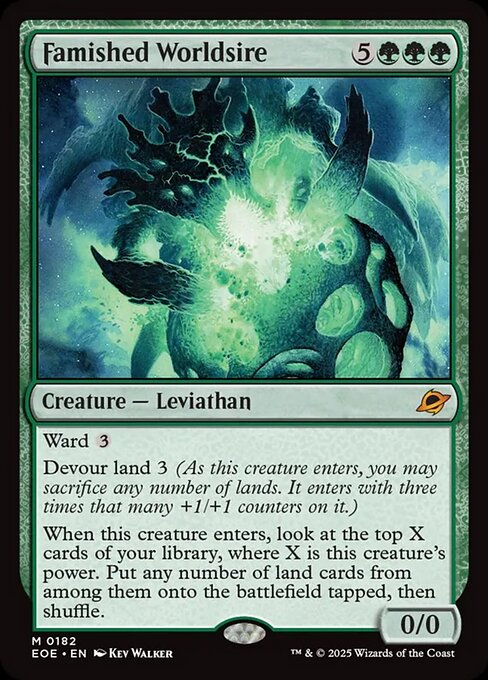
Creature — Leviathan
Ward Ward is a triggered ability. Ward [cost] means “Whenever this permanent becomes the target of a spell or ability an opponent controls, counter that spell or ability unless that player pays [cost].”
Some ward abilities include an X in their cost and state what X is equal to. This value is determined at the time the ability resolves, not locked in as the ability triggers. (CR 702.21)
DevourDevour is a static ability. “Devour N” means “As this object enters, you may sacrifice any number of creatures. This permanent enters with N +1/+1 counters on it for each creature sacrificed this way.”
Some objects have abilities that refer to the number of creatures the permanent devoured. “It devoured” means “sacrificed as a result of its devour ability as it entered the battlefield.”
Devour [quality] is a variant of devour. “Devour [quality] N” means “As this object enters, you may sacrifice any number of [quality] permanents. This permanent enters with N +1/+1 counters on it for each permanent sacrificed this way.” (CR 702.82) land 3 (As this creature enters, you may sacrificeTo sacrifice a permanent, its controller moves it from the battlefield directly to its owner’s graveyard. A player can’t sacrifice something that isn’t a permanent, or something that’s a permanent they don’t control. Sacrificing a permanent doesn’t destroy it, so regeneration or other effects that replace destruction can’t affect this action. (CR 701.21) any number of lands. It enters with three times that many +1/+1 countersTo counter a spell or ability is to cancel it: remove it from the stack without resolving it. A counter on an object or player is instead a marker that changes characteristics or interacts with rules or abilities; for example, a +1/+1 counter modifies a creature’s power and toughness. (CR 701.6; 122.1) on it.)
When this creature enters, look at the top X cards of your library, where X is this creature's power. Put any number of land cards from among them onto the battlefield tapped, then shuffleTo shuffle a library or a face-down pile of cards, randomize the cards within it so that no player knows their order.
Some effects cause a player to search a library for a card or cards, shuffle that library, then put some or all of the found cards into a different zone or in a certain position in that library. In such cases, the found cards aren’t included in the shuffle, even though they remain in the library at that time. Rather, all the cards in that library except those are shuffled. Abilities that trigger when a library is shuffled will still trigger. See also rule 401, “Library.”
If an effect would cause a player to shuffle one or more specific objects into a library, that library is shuffled even if none of those objects are in the zone they’re expected to be in or an effect causes all of those objects to be moved to another zone or remain in their current zone.
If an effect would cause a player to shuffle a set of objects into a library, that library is shuffled even if there are no objects in that set.
If an effect causes a player to shuffle a library containing zero or one cards, abilities that trigger when a library is shuffled will still trigger.
If two or more effects cause a library to be shuffled multiple times simultaneously, abilities that trigger when that library is shuffled will trigger that many times.
If an effect would cause a player to shuffle a library at the same time that an object would be put into a certain position in that library, the result is a shuffled library that’s randomized except that the object is in the specified position. (CR 701.24).
$3.16
Commander: LegalModern: Legal
Save this card
Log in to save cards to your lists.
Start a deck with this cardTags and classifications
Card attributes are distinct from extracted ability facts and inferred themes. AI themes and predicted tags are suggestions, not rules text.
Ability tags
Mana costs
Creature kinds
Color identity
Keyword tags
Mana value
Timing tags
Type tags
Predicted tags are currently unavailable.