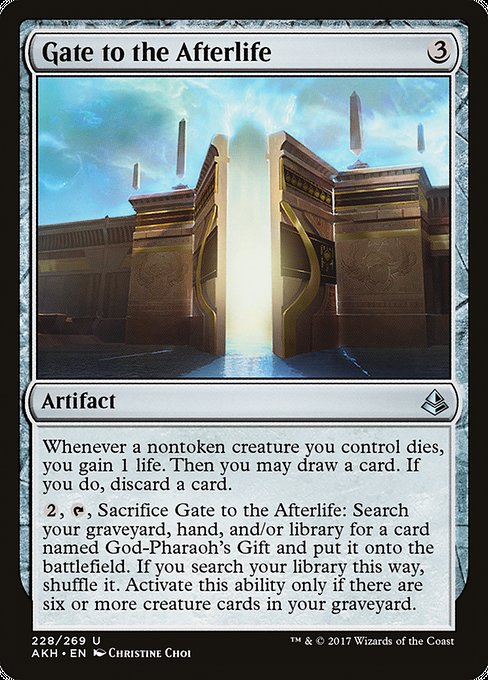
Artifact
Whenever a nontoken creature you control diesIs put into a graveyard from the battlefield. (CR 700.4), you gain 1 life. Then you may draw a card. If you do, discardTo discard a card, move it from its owner’s hand to that player’s graveyard.
By default, effects that cause a player to discard a card allow the affected player to choose which card to discard. Some effects, however, require a random discard or allow another player to choose which card is discarded.
If a card is discarded, but an effect causes it to be put into a hidden zone instead of into its owner’s graveyard without being revealed, all values of that card’s characteristics are considered to be undefined. If a card is discarded this way to pay a cost that specifies a characteristic about the discarded card, that cost payment is illegal; the game returns to the moment before the cost was paid (see rule 733, “Handling Illegal Actions”). (CR 701.9) a card.
, , SacrificeTo sacrifice a permanent, its controller moves it from the battlefield directly to its owner’s graveyard. A player can’t sacrifice something that isn’t a permanent, or something that’s a permanent they don’t control. Sacrificing a permanent doesn’t destroy it, so regeneration or other effects that replace destruction can’t affect this action. (CR 701.21) this artifact: SearchTo search for a card in a zone, look at all cards in that zone (even if it’s a hidden zone) and find a card that matches the given description.
If a player is searching a hidden zone for cards with a stated quality, such as a card with a certain card type or color, that player isn’t required to find some or all of those cards even if they’re present in that zone.
If a player is instructed to search a hidden zone for cards that match an undefined quality, that player may still search that zone but can’t find any cards.
If a player is searching a hidden zone simply for a quantity of cards, such as “a card” or “three cards,” that player must find that many cards (or as many as possible, if the zone doesn’t contain enough cards).
If the effect that contains the search instruction doesn’t also contain instructions to reveal the found card(s), then they’re not revealed.
If searching a zone is replaced with searching a portion of that zone, any other instructions that refer to searching the zone still apply. Any abilities that trigger on a library being searched will trigger.
If an effect offers a player a choice to search a zone and take additional actions with the cards found, that player may choose to search even if the additional actions are illegal or impossible.
An effect may instruct a player to search a library for one or more cards more than once before instructing a player to shuffle that library. This is the same as a single instruction for that player to search that library for all those cards. The player searches that library only once.
If multiple players search at once, each of those players looks at the appropriate cards at the same time, then those players decide in APNAP order (see rule 101.4) which card to find.
If an effect instructs a player to search outside the game for a card, that player may choose an appropriate card they own from outside the game. (CR 701.23) your graveyard, hand, and/or library for a card named God-Pharaoh's GiftGift is a keyword that represents two abilities. It is written “Gift a [something].” The first ability is a static ability that functions while the card with gift is on the stack, and the second is either an ability that functions while the card with gift is on the stack or a triggered ability that functions while the card with gift is on the battlefield. The first ability is always “As an additional cost to cast this spell, you may choose an opponent.” Paying a spell’s gift cost follows the rules for paying additional costs in rules 601.2b and 601.2f–h. The second ability depends on the [something] listed as well as whether the object with the ability is a permanent or an instant or sorcery spell.
On a permanent, the second ability represented by gift is “When this permanent enters, if its gift cost was paid, [effect].” On an instant or sorcery spell, the second ability represented by gift is “If this spell’s gift cost was paid, [effect].” The specific effect is defined by the [something] listed.
Some effects trigger whenever a player gives a gift. Such an ability triggers whenever an instant or sorcery spell that player controls whose gift cost was paid resolves. It also triggers whenever the gift triggered ability of a permanent that player controls resolves.
“Gift a Food” means the effect is “The chosen player creates a Food token.”
“Gift a card” means the effect is “The chosen player draws a card.”
“Gift a tapped Fish” means the effect is “The chosen player creates a tapped 1/1 blue Fish creature token.”
“Gift an extra turn” means the effect is “The chosen player takes an extra turn after this one.”
“Gift a Treasure” means the effect is “The chosen player creates a Treasure token.”
“Gift an Octopus” means the effect is “The chosen player creates an 8/8 blue Octopus creature token.”
For instant and sorcery spells, the effect of a gift ability always happens before any other spell abilities of the card. If the spell is countered or otherwise leaves the stack before resolving, the gift effect doesn’t happen.
If a spell’s controller declares the intention to pay a spell’s gift cost, that spell’s gift was promised.
If part of a spell’s ability has its effect only if its gift was promised, and that part of the ability includes any targets, the spell’s controller chooses those targets only if the gift was promised. (CR 702.174) and put it onto the battlefield. If you searchTo search for a card in a zone, look at all cards in that zone (even if it’s a hidden zone) and find a card that matches the given description.
If a player is searching a hidden zone for cards with a stated quality, such as a card with a certain card type or color, that player isn’t required to find some or all of those cards even if they’re present in that zone.
If a player is instructed to search a hidden zone for cards that match an undefined quality, that player may still search that zone but can’t find any cards.
If a player is searching a hidden zone simply for a quantity of cards, such as “a card” or “three cards,” that player must find that many cards (or as many as possible, if the zone doesn’t contain enough cards).
If the effect that contains the search instruction doesn’t also contain instructions to reveal the found card(s), then they’re not revealed.
If searching a zone is replaced with searching a portion of that zone, any other instructions that refer to searching the zone still apply. Any abilities that trigger on a library being searched will trigger.
If an effect offers a player a choice to search a zone and take additional actions with the cards found, that player may choose to search even if the additional actions are illegal or impossible.
An effect may instruct a player to search a library for one or more cards more than once before instructing a player to shuffle that library. This is the same as a single instruction for that player to search that library for all those cards. The player searches that library only once.
If multiple players search at once, each of those players looks at the appropriate cards at the same time, then those players decide in APNAP order (see rule 101.4) which card to find.
If an effect instructs a player to search outside the game for a card, that player may choose an appropriate card they own from outside the game. (CR 701.23) your library this way, shuffleTo shuffle a library or a face-down pile of cards, randomize the cards within it so that no player knows their order.
Some effects cause a player to search a library for a card or cards, shuffle that library, then put some or all of the found cards into a different zone or in a certain position in that library. In such cases, the found cards aren’t included in the shuffle, even though they remain in the library at that time. Rather, all the cards in that library except those are shuffled. Abilities that trigger when a library is shuffled will still trigger. See also rule 401, “Library.”
If an effect would cause a player to shuffle one or more specific objects into a library, that library is shuffled even if none of those objects are in the zone they’re expected to be in or an effect causes all of those objects to be moved to another zone or remain in their current zone.
If an effect would cause a player to shuffle a set of objects into a library, that library is shuffled even if there are no objects in that set.
If an effect causes a player to shuffle a library containing zero or one cards, abilities that trigger when a library is shuffled will still trigger.
If two or more effects cause a library to be shuffled multiple times simultaneously, abilities that trigger when that library is shuffled will trigger that many times.
If an effect would cause a player to shuffle a library at the same time that an object would be put into a certain position in that library, the result is a shuffled library that’s randomized except that the object is in the specified position. (CR 701.24). ActivateTo activate an activated ability is to put it onto the stack and pay its costs, so that it will eventually resolve and have its effect. Only an object’s controller (or its owner, if it doesn’t have a controller) can activate its activated ability unless the object specifically says otherwise. A player may activate an ability if they have priority. See rule 602, “Activating Activated Abilities.” (CR 701.2) only if there are six or more creature cards in your graveyard.
$0.25
Commander: LegalModern: Legal
Save this card
Log in to save cards to your lists.
Start a deck with this cardTags and classifications
Card attributes are distinct from extracted ability facts and inferred themes. AI themes and predicted tags are suggestions, not rules text.
Ability tags
Mana costs
Mana value
Theme tags
Timing tags
Type tags
Predicted tags are currently unavailable.