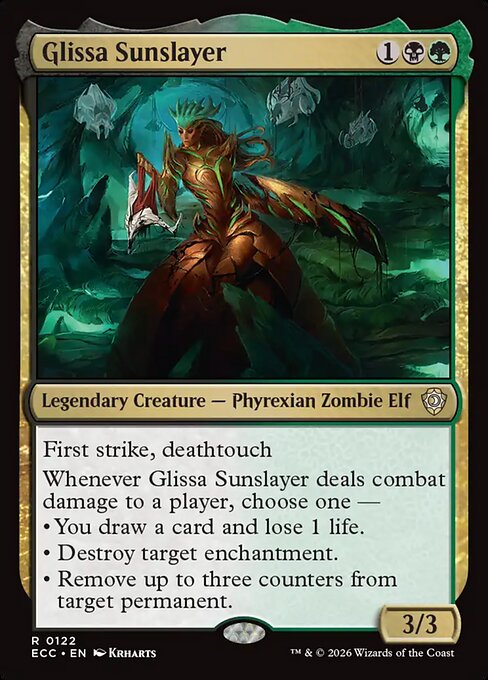
Legendary Creature — Phyrexian Zombie Elf
First strikeFirst strike is a static ability that modifies the rules for the combat damage step. (See rule 510, “Combat Damage Step.”)
If at least one attacking or blocking creature has first strike or double strike (see rule 702.4) as the combat damage step begins, the only creatures that assign combat damage in that step are those with first strike or double strike. After that step, instead of proceeding to the end of combat step, the phase gets a second combat damage step. The only creatures that assign combat damage in that step are the remaining attackers and blockers that had neither first strike nor double strike as the first combat damage step began, as well as the remaining attackers and blockers that currently have double strike. After that step, the phase proceeds to the end of combat step.
Giving first strike to a creature without it after combat damage has already been dealt in the first combat damage step won’t preclude that creature from assigning combat damage in the second combat damage step. Removing first strike from a creature after it has already dealt combat damage in the first combat damage step won’t allow it to also assign combat damage in the second combat damage step (unless the creature has double strike).
Multiple instances of first strike on the same creature are redundant. (CR 702.7), deathtouchDeathtouch is a static ability.
A creature with toughness greater than 0 that’s been dealt damage by a source with deathtouch since the last time state-based actions were checked is destroyed as a state-based action. See rule 704.
Any nonzero amount of combat damage assigned to a creature by a source with deathtouch is considered to be lethal damage for the purposes of determining if excess damage is being dealt.
The deathtouch rules function no matter what zone an object with deathtouch deals damage from.
If an object is no longer in the zone it’s expected to be in as an effect causes it to deal damage, its last known information is used to determine whether it had deathtouch.
Multiple instances of deathtouch on the same object are redundant. (CR 702.2)
Whenever Glissa Sunslayer deals combat damage to a player, choose one —
• You draw a card and lose 1 life.
• DestroyThe only ways a permanent can be destroyed are as a result of an effect that uses the word “destroy” or as a result of the state-based actions that check for lethal damage (see rule 704.5g) or damage from a source with deathtouch (see rule 704.5h). If a permanent is put into its owner’s graveyard for any other reason, it hasn’t been “destroyed.”
A regeneration effect replaces a destruction event. See rule 701.19, “Regenerate.” (CR 701.8) target enchantment.
• Remove up to three countersTo counter a spell or ability is to cancel it: remove it from the stack without resolving it. A counter on an object or player is instead a marker that changes characteristics or interacts with rules or abilities; for example, a +1/+1 counter modifies a creature’s power and toughness. (CR 701.6; 122.1) from target permanent.
$0.62
Commander: LegalModern: Legal
Save this card
Log in to save cards to your lists.
Start a deck with this cardTags and classifications
Card attributes are distinct from extracted ability facts and inferred themes. AI themes and predicted tags are suggestions, not rules text.
Ability tags
Mana costs
Creature kinds
Color identity
Keyword tags
Mana value
Theme tags
Timing tags
Type tags
Predicted tags are currently unavailable.