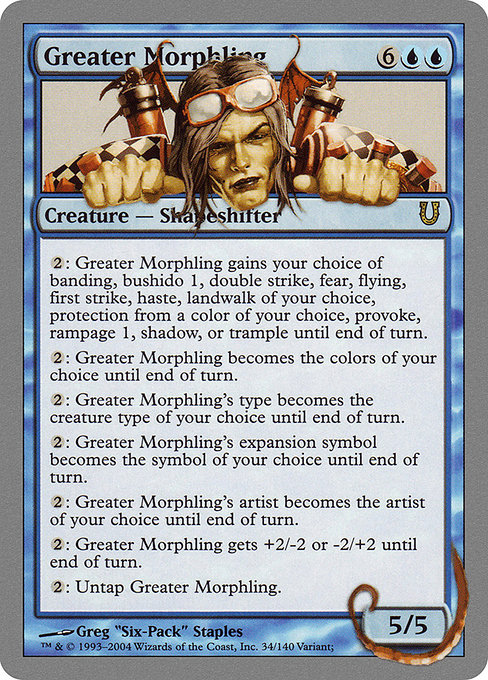
Creature — Shapeshifter
: This creature gains your choice of bandingBanding is a static ability that modifies the rules for combat.
“Bands with other” is a special form of banding. If an effect causes a permanent to lose banding, the permanent loses all “bands with other” abilities as well.
As a player declares attackers, they may declare that one or more attacking creatures with banding and up to one attacking creature without banding (even if it has “bands with other”) are all in a “band.” They may also declare that one or more attacking [quality] creatures with “bands with other [quality]” and any number of other attacking [quality] creatures are all in a band. A player may declare as many attacking bands as they want, but each creature may be a member of only one of them. (Defending players can’t declare bands but may use banding in a different way; see rule 702.22j.)
All creatures in an attacking band must attack the same player, planeswalker, or battle.
Once an attacking band has been announced, it lasts for the rest of combat, even if something later removes banding or “bands with other” from one or more of the creatures in the band.
An attacking creature that’s removed from combat is also removed from the band it was in.
Banding doesn’t cause attacking creatures to share abilities, nor does it remove any abilities. The attacking creatures in a band are separate permanents.
If an attacking creature becomes blocked by a creature, each other creature in the same band as the attacking creature becomes blocked by that same blocking creature.
If one member of a band would become blocked due to an effect, the entire band becomes blocked.
During the combat damage step, if an attacking creature is being blocked by a creature with banding, or by both a [quality] creature with “bands with other [quality]” and another [quality] creature, the defending player (rather than the active player) chooses how the attacking creature’s damage is assigned. That player can divide that creature’s combat damage as they choose among any creatures blocking it. This is an exception to the procedure described in rule 510.1c.
During the combat damage step, if a blocking creature is blocking a creature with banding, or both a [quality] creature with “bands with other [quality]” and another [quality] creature, the active player (rather than the defending player) chooses how the blocking creature’s damage is assigned. That player can divide that creature’s combat damage as they choose among any creatures it’s blocking. This is an exception to the procedure described in rule 510.1d.
Multiple instances of banding on the same creature are redundant. Multiple instances of “bands with other” of the same kind on the same creature are redundant. (CR 702.22), bushidoBushido is a triggered ability. “Bushido N” means “Whenever this creature blocks or becomes blocked, it gets +N/+N until end of turn.” (See rule 509, “Declare Blockers Step.”)
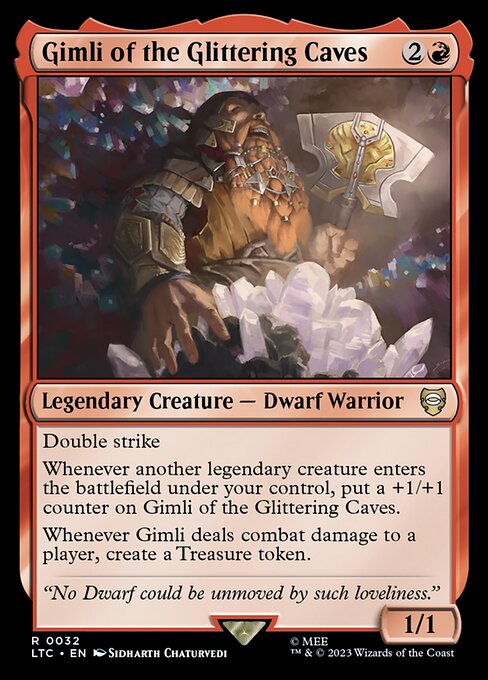
If a creature has multiple instances of bushido, each triggers separately. (CR 702.45) 1, double strikeDouble strike is a static ability that modifies the rules for the combat damage step. (See rule 510, “Combat Damage Step.”)
If at least one attacking or blocking creature has first strike (see rule 702.7) or double strike as the combat damage step begins, the only creatures that assign combat damage in that step are those with first strike or double strike. After that step, instead of proceeding to the end of combat step, the phase gets a second combat damage step. The only creatures that assign combat damage in that step are the remaining attackers and blockers that had neither first strike nor double strike as the first combat damage step began, as well as the remaining attackers and blockers that currently have double strike. After that step, the phase proceeds to the end of combat step.
Removing double strike from a creature during the first combat damage step will stop it from assigning combat damage in the second combat damage step.
Giving double strike to a creature with first strike after it has already dealt combat damage in the first combat damage step will allow the creature to assign combat damage in the second combat damage step.
Multiple instances of double strike on the same creature are redundant. (CR 702.4), fearFear is an evasion ability.
A creature with fear can’t be blocked except by artifact creatures and/or black creatures. (See rule 509, “Declare Blockers Step.”)
Multiple instances of fear on the same creature are redundant. (CR 702.36), flyingFlying is an evasion ability.
A creature with flying can’t be blocked except by creatures with flying and/or reach. A creature with flying can block a creature with or without flying. (See rule 509, “Declare Blockers Step,” and rule 702.17, “Reach.”)
Multiple instances of flying on the same creature are redundant. (CR 702.9), first strikeFirst strike is a static ability that modifies the rules for the combat damage step. (See rule 510, “Combat Damage Step.”)
If at least one attacking or blocking creature has first strike or double strike (see rule 702.4) as the combat damage step begins, the only creatures that assign combat damage in that step are those with first strike or double strike. After that step, instead of proceeding to the end of combat step, the phase gets a second combat damage step. The only creatures that assign combat damage in that step are the remaining attackers and blockers that had neither first strike nor double strike as the first combat damage step began, as well as the remaining attackers and blockers that currently have double strike. After that step, the phase proceeds to the end of combat step.
Giving first strike to a creature without it after combat damage has already been dealt in the first combat damage step won’t preclude that creature from assigning combat damage in the second combat damage step. Removing first strike from a creature after it has already dealt combat damage in the first combat damage step won’t allow it to also assign combat damage in the second combat damage step (unless the creature has double strike).
Multiple instances of first strike on the same creature are redundant. (CR 702.7), hasteHaste is a static ability.
If a creature has haste, it can attack even if it hasn’t been controlled by its controller continuously since their most recent turn began. (See rule 302.6.)
If a creature has haste, its controller can activate its activated abilities whose cost includes the tap symbol or the untap symbol even if that creature hasn’t been controlled by that player continuously since their most recent turn began. (See rule 302.6.)
Multiple instances of haste on the same creature are redundant. (CR 702.10), landwalkLandwalk is a generic term that appears within an object’s rules text as “[type]walk,” where [type] is usually a land type, but it can also be the card type land plus any combination of land types, card types, and/or supertypes.
Landwalk is an evasion ability.
A creature with landwalk can’t be blocked as long as the defending player controls at least one land with the specified land type (as in “islandwalk”), with the specified type or supertype (as in “artifact landwalk”), without the specified type or supertype (as in “nonbasic landwalk”), or with both the specified type or supertype and the specified subtype (as in “snow swampwalk”). (See rule 509, “Declare Blockers Step.”)
Landwalk abilities don’t “cancel” one another.
Multiple instances of the same kind of landwalk on the same creature are redundant. (CR 702.14) of your choice, protectionProtection is a static ability, written “Protection from [quality].” This quality is usually a color (as in “protection from black”) but can be any characteristic value or information. If the quality happens to be a card name, it is treated as such only if the protection ability specifies that the quality is a name. If the quality is a card type, subtype, or supertype, the ability applies to sources that are permanents with that card type, subtype, or supertype and to any sources not on the battlefield that are of that card type, subtype, or supertype. This is an exception to rule 109.2.
A permanent or player with protection can’t be targeted by spells with the stated quality and can’t be targeted by abilities from a source with the stated quality.
A permanent or player with protection can’t be enchanted by Auras that have the stated quality. Such Auras attached to the permanent or player with protection will be put into their owners’ graveyards as a state-based action. (See rule 704, “State-Based Actions.”)
A permanent with protection can’t be equipped by Equipment that have the stated quality or fortified by Fortifications that have the stated quality. Such Equipment or Fortifications become unattached from that permanent as a state-based action, but remain on the battlefield. (See rule 704, “State-Based Actions.”)
Any damage that would be dealt by sources that have the stated quality to a permanent or player with protection is prevented.
Attacking creatures with protection can’t be blocked by creatures that have the stated quality.
“Protection from [quality A] and from [quality B]” is shorthand for “protection from [quality A]” and “protection from [quality B]”; it behaves as two separate protection abilities.
“Protection from each [characteristic]” is shorthand for “protection from [quality A],” “protection from [quality B],” and so on for each possible quality the listed characteristic could have; it behaves as multiple separate protection abilities.
“Protection from each [set of characteristics, qualities, or players]” is shorthand for “protection from [A],” “protection from [B],” and so on for each characteristic, quality, or player in the set. It behaves as multiple separate protection abilities.
“Protection from everything” is a variant of the protection ability. A permanent or player with protection from everything has protection from each object regardless of that object’s characteristic values. Such a permanent or player can’t be targeted by spells or abilities and can’t be enchanted by Auras. Such a permanent can’t be equipped by Equipment, fortified by Fortifications, or blocked by creatures. All damage that would be dealt to such a permanent or player is prevented.
“Protection from [a player]” is a variant of the protection ability. A permanent or player with protection from a specific player has protection from each object that player controls and protection from each object that player owns not controlled by another player, regardless of that object’s characteristic values. Such a permanent or player can’t be targeted by spells or abilities the specified player controls and can’t be enchanted by Auras that player controls. Such a permanent can’t be equipped by Equipment that player controls, fortified by Fortifications that player controls, or blocked by creatures that player controls. All damage that would be dealt to such a permanent or player by sources controlled by the specified player or owned by that player but not controlled by another player is prevented.
Multiple instances of protection from the same quality on the same permanent or player are redundant.
Some Auras both give the enchanted creature protection from a quality and say “this effect doesn’t remove” either that specific Aura or all Auras. This means that the specified Auras aren’t put into their owners’ graveyards as a state-based action. If the creature has other instances of protection from the same quality, those instances affect Auras as normal.
One Aura (Benevolent Blessing) gives the enchanted creature protection from a quality and says the effect doesn’t remove certain permanents that are “already attached to” that creature. This means that, when the protection effect starts to apply, any objects with the stated quality that are already attached to that creature (including the Aura giving that creature protection) will not be put into their owners’ graveyards as a state-based action. Other permanents with the stated quality can’t become attached to the creature. If the creature has other instances of protection from the same quality, those instances affect attached permanents as normal. (CR 702.16) from a color of your choice, provokeProvoke is a triggered ability. “Provoke” means “Whenever this creature attacks, you may choose to have target creature defending player controls block this creature this combat if able. If you do, untap that creature.”
If a creature has multiple instances of provoke, each triggers separately. (CR 702.39), rampageRampage is a triggered ability. “Rampage N” means “Whenever this creature becomes blocked, it gets +N/+N until end of turn for each creature blocking it beyond the first.” (See rule 509, “Declare Blockers Step.”)
The rampage bonus is calculated only once per combat, when the triggered ability resolves. Adding or removing blockers later in combat won’t change the bonus.
If a creature has multiple instances of rampage, each triggers separately. (CR 702.23) 1, shadowShadow is an evasion ability.
A creature with shadow can’t be blocked by creatures without shadow, and a creature without shadow can’t be blocked by creatures with shadow. (See rule 509, “Declare Blockers Step.”)
Multiple instances of shadow on the same creature are redundant. (CR 702.28), or trampleTrample is a static ability that modifies the rules for assigning an attacking creature’s combat damage. The ability has no effect when a creature with trample is blocking or is dealing noncombat damage. (See rule 510, “Combat Damage Step.”)
The controller of an attacking creature with trample first assigns damage to the creature(s) blocking it. Once all those blocking creatures are assigned lethal damage, any excess damage is assigned as its controller chooses among those blocking creatures and the player, planeswalker, or battle the creature is attacking. When checking for assigned lethal damage, take into account damage already marked on the creature and damage from other creatures that’s being assigned during the same combat damage step, but not any abilities or effects that might change the amount of damage that’s actually dealt. The attacking creature’s controller need not assign lethal damage to all those blocking creatures but in that case can’t assign any damage to the player or planeswalker it’s attacking.
Trample over planeswalkers is a variant of trample that modifies the rules for assigning combat damage to planeswalkers. The controller of a creature with trample over planeswalkers assigns that creature’s combat damage as described in rule 702.19b, with one exception. If that creature is attacking a planeswalker, after lethal damage is assigned to all blocking creatures and damage at least equal to the loyalty of the planeswalker the creature is attacking is assigned to that planeswalker, further excess damage may be assigned as the attacking creature’s controller chooses among those blocking creatures, that planeswalker, and that planeswalker’s controller. When checking for assigned damage equal to a planeswalker’s loyalty, take into account damage from other creatures that’s being assigned during the same combat damage step, but not any abilities or effects that might change the amount of damage that’s actually dealt.
If an attacking creature with trample or trample over planeswalkers is blocked, but there are no creatures blocking it when damage is assigned, its damage is assigned to the defending player and/or planeswalker as though all blocking creatures have been assigned lethal damage.
If a creature with trample over planeswalkers is attacking a planeswalker and that planeswalker is removed from combat, the creature’s damage may be assigned to the defending player once all blocking creatures have been dealt lethal damage or, if there are no blocking creatures when damage is assigned, all its damage is assigned to the defending player. This is an exception to rule 506.4c, and it does not cause the creature to be attacking that player.
If a creature without trample over planeswalkers is attacking a planeswalker, none of its combat damage can be assigned to the defending player, even if that planeswalker has been removed from combat or the damage the attacking creature could assign is greater than the planeswalker’s loyalty.
Multiple instances of trample on the same creature are redundant. Multiple instances of trample over planeswalkers on the same creature are redundant. (CR 702.19) until end of turn.
: This creature becomes the colors of your choice until end of turn.
: This creature becomes the creature type of your choice until end of turn.
: This creature's expansion symbol becomes the symbol of your choice until end of turn.
: This creature's art becomes by the artist of your choice until end of turn.
: This creature gets +2/-2 or -2/+2 until end of turn.
: UntapTo untap a permanent, rotate it back to the upright position from a sideways position. Only tapped permanents can be untapped. (CR 701.26) this creature.
$1.28
Commander: Not legalModern: Not legal
Save this card
Log in to save cards to your lists.
Start a deck with this cardTags and classifications
Card attributes are distinct from extracted ability facts and inferred themes. AI themes and predicted tags are suggestions, not rules text.
Ability tags
Mana costs
Creature kinds
Color identity
Mana value
Timing tags
Type tags
Predicted tags are currently unavailable.