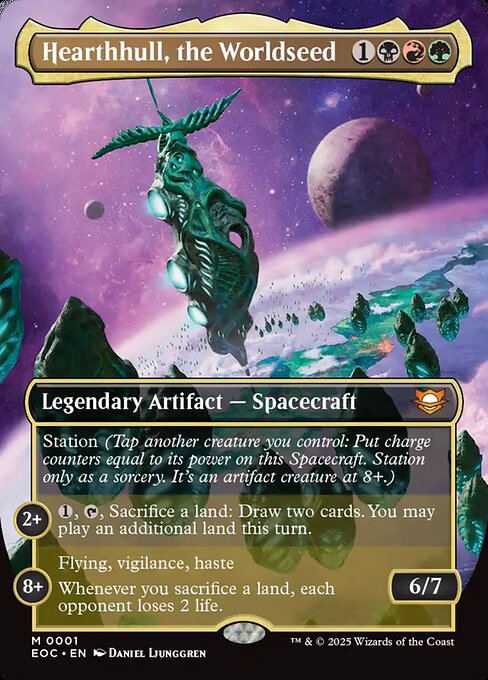
Legendary Artifact — Spacecraft
StationStation is an activated ability. “Station” means “Tap another untapped creature you control: Put a number of charge counters on this permanent equal to the tapped creature’s power. Activate only as a sorcery.”
Each card printed with a station ability is known as a station card. It has a nonstandard layout and includes station symbols that are themselves keyword abilities. See rule 721, “Station Cards.”
Static abilities may modify the result of a station ability by causing it to use a characteristic other than the tapped creature’s power to determine the number of counters placed on the permanent with the station ability. (CR 702.184) (TapTo tap a permanent, turn it sideways from an upright position. Only untapped permanents can be tapped. (CR 701.26) another creature you control: Put charge countersTo counter a spell or ability is to cancel it: remove it from the stack without resolving it. A counter on an object or player is instead a marker that changes characteristics or interacts with rules or abilities; for example, a +1/+1 counter modifies a creature’s power and toughness. (CR 701.6; 122.1) equal to its power on this Spacecraft. StationStation is an activated ability. “Station” means “Tap another untapped creature you control: Put a number of charge counters on this permanent equal to the tapped creature’s power. Activate only as a sorcery.”
Each card printed with a station ability is known as a station card. It has a nonstandard layout and includes station symbols that are themselves keyword abilities. See rule 721, “Station Cards.”
Static abilities may modify the result of a station ability by causing it to use a characteristic other than the tapped creature’s power to determine the number of counters placed on the permanent with the station ability. (CR 702.184) only as a sorcery. It's an artifact creature at 8+.)
2+ | , , SacrificeTo sacrifice a permanent, its controller moves it from the battlefield directly to its owner’s graveyard. A player can’t sacrifice something that isn’t a permanent, or something that’s a permanent they don’t control. Sacrificing a permanent doesn’t destroy it, so regeneration or other effects that replace destruction can’t affect this action. (CR 701.21) a land: Draw two cards. You may playTo play a land means to put it onto the battlefield from the zone it’s in (usually the hand). A player may play a land if they have priority, it’s the main phase of their turn, the stack is empty, and they haven’t played a land this turn. Playing a land is a special action (see rule 116), so it doesn’t use the stack; it simply happens. Putting a land onto the battlefield as the result of a spell or ability isn’t the same as playing a land. See rule 305, “Lands.”
To play a card means to play that card as a land or to cast that card as a spell, whichever is appropriate.
Some effects instruct a player to “play” with a certain aspect of the game changed, such as “Play with the top card of your library revealed.” “Play” in this sense means to play the Magic game.
Previously, the action of casting a spell, or casting a card as a spell, was referred to on cards as “playing” that spell or that card. Cards that were printed with that text have received errata in the Oracle card reference so they now refer to “casting” that spell or that card.
Previously, the action of using an activated ability was referred to on cards as “playing” that ability. Cards that were printed with that text have received errata in the Oracle card reference so they now refer to “activating” that ability. (CR 701.18) an additional land this turn.
8+ | FlyingFlying is an evasion ability.
A creature with flying can’t be blocked except by creatures with flying and/or reach. A creature with flying can block a creature with or without flying. (See rule 509, “Declare Blockers Step,” and rule 702.17, “Reach.”)
Multiple instances of flying on the same creature are redundant. (CR 702.9), vigilanceVigilance is a static ability that modifies the rules for the declare attackers step.
Attacking doesn’t cause creatures with vigilance to tap. (See rule 508, “Declare Attackers Step.”)
Multiple instances of vigilance on the same creature are redundant. (CR 702.20), hasteHaste is a static ability.
If a creature has haste, it can attack even if it hasn’t been controlled by its controller continuously since their most recent turn began. (See rule 302.6.)
If a creature has haste, its controller can activate its activated abilities whose cost includes the tap symbol or the untap symbol even if that creature hasn’t been controlled by that player continuously since their most recent turn began. (See rule 302.6.)
Multiple instances of haste on the same creature are redundant. (CR 702.10)
Whenever you sacrificeTo sacrifice a permanent, its controller moves it from the battlefield directly to its owner’s graveyard. A player can’t sacrifice something that isn’t a permanent, or something that’s a permanent they don’t control. Sacrificing a permanent doesn’t destroy it, so regeneration or other effects that replace destruction can’t affect this action. (CR 701.21) a land, each opponent loses 2 life.
$1.26
Commander: LegalModern: Not legal
Save this card
Log in to save cards to your lists.
Start a deck with this cardTags and classifications
Card attributes are distinct from extracted ability facts and inferred themes. AI themes and predicted tags are suggestions, not rules text.
Ability tags
Mana costs
Color identity
Keyword tags
Mana value
Theme tags
Timing tags
Type tags
Predicted tags are currently unavailable.