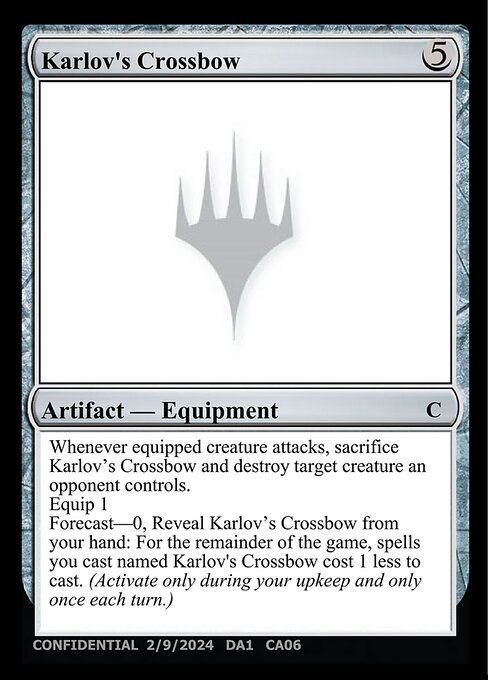
Artifact — Equipment
Whenever equipped creature attacks, sacrificeTo sacrifice a permanent, its controller moves it from the battlefield directly to its owner’s graveyard. A player can’t sacrifice something that isn’t a permanent, or something that’s a permanent they don’t control. Sacrificing a permanent doesn’t destroy it, so regeneration or other effects that replace destruction can’t affect this action. (CR 701.21) Karlov's Crossbow and destroyThe only ways a permanent can be destroyed are as a result of an effect that uses the word “destroy” or as a result of the state-based actions that check for lethal damage (see rule 704.5g) or damage from a source with deathtouch (see rule 704.5h). If a permanent is put into its owner’s graveyard for any other reason, it hasn’t been “destroyed.”
A regeneration effect replaces a destruction event. See rule 701.19, “Regenerate.” (CR 701.8) target creature an opponent controls.
EquipEquip is an activated ability of Equipment cards. “Equip [cost]” means “[Cost]: Attach this permanent to target creature you control. Activate only as a sorcery.”
For more information about Equipment, see rule 301, “Artifacts.”
Equip abilities may further restrict what creatures may be chosen as legal targets. Such restrictions usually appear in the form “Equip [quality]” or “Equip [quality] creature.” These equip abilities may legally target only a creature that’s controlled by the player activating the ability and that has the chosen quality. Additional restrictions for an equip ability don’t restrict what the Equipment may be attached to.
If a permanent has multiple equip abilities, any of its equip abilities may be activated.
“Equip planeswalker” is a variant of the equip ability. “Equip planeswalker [cost]” means “[Cost]: Attach this permanent to target planeswalker you control as though that planeswalker were a creature. Activate only as a sorcery.” (CR 702.6)
ForecastA forecast ability is an activated ability that can be activated only from a player’s hand. It’s written “Forecast — [Activated ability].”
A forecast ability may be activated only during the upkeep step of the card’s owner and only once each turn. The controller of the forecast ability reveals the card with that ability from their hand as the ability is activated. That player plays with that card revealed in their hand until it leaves the player’s hand or until a step or phase that isn’t an upkeep step begins, whichever comes first. (CR 702.57) — {0}, RevealTo reveal a card, show that card to all players for a brief time. If an effect causes a card to be revealed, it remains revealed for as long as necessary to complete the parts of the effect that card is relevant to. If the cost to cast a spell or activate an ability includes revealing a card, or if a card is revealed because an ability is activated from a hidden zone (see rule 602.2a), the card remains revealed from the time the spell or ability is announced until the time it leaves the stack. If revealing a card causes a triggered ability to trigger, the card remains revealed until that triggered ability leaves the stack. If that ability isn’t put onto the stack the next time a player would receive priority, the card ceases to be revealed.
Revealing a card doesn’t cause it to leave the zone it’s in.
A card that is currently revealed may be revealed again.
If cards in a player’s library are shuffled or otherwise reordered, any revealed cards that are reordered stop being revealed and become new objects.
Some effects instruct a player to look at one or more cards. Looking at a card follows the same rules as revealing a card, except that the card is shown only to the specified player. (CR 701.20) Karlov's Crossbow from your hand: For the remainder of the game, spells you castTo cast a spell is to take it from the zone it’s in (usually the hand), put it on the stack, and pay its costs, so that it will eventually resolve and have its effect. A player may cast a spell if they have priority. See rule 601, “Casting Spells.”
To cast a card is to cast it as a spell. (CR 701.5) named Karlov's Crossbow cost less to castTo cast a spell is to take it from the zone it’s in (usually the hand), put it on the stack, and pay its costs, so that it will eventually resolve and have its effect. A player may cast a spell if they have priority. See rule 601, “Casting Spells.”
To cast a card is to cast it as a spell. (CR 701.5). (ActivateTo activate an activated ability is to put it onto the stack and pay its costs, so that it will eventually resolve and have its effect. Only an object’s controller (or its owner, if it doesn’t have a controller) can activate its activated ability unless the object specifically says otherwise. A player may activate an ability if they have priority. See rule 602, “Activating Activated Abilities.” (CR 701.2) only during your upkeep and only once each turn.)
Price unavailable
Commander: Not legalModern: Not legal
Save this card
Log in to save cards to your lists.
Start a deck with this cardTags and classifications
Card attributes are distinct from extracted ability facts and inferred themes. AI themes and predicted tags are suggestions, not rules text.
Ability tags
Mana costs
Keyword tags
Mana value
Theme tags
Timing tags
Type tags
Predicted tags are currently unavailable.