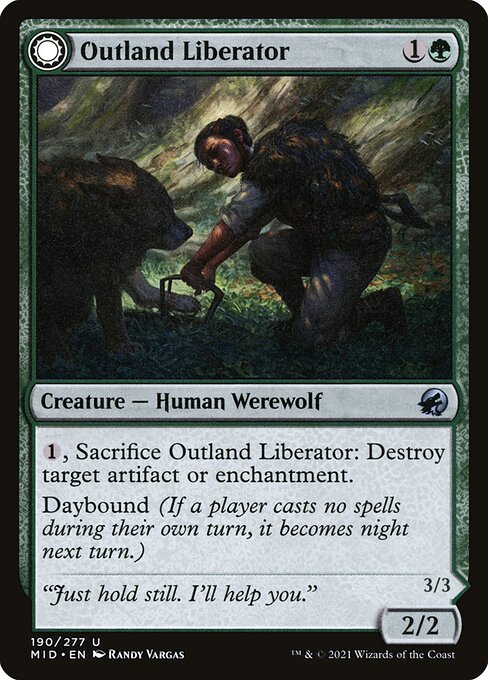
Creature — Human Werewolf // Creature — Werewolf
, SacrificeTo sacrifice a permanent, its controller moves it from the battlefield directly to its owner’s graveyard. A player can’t sacrifice something that isn’t a permanent, or something that’s a permanent they don’t control. Sacrificing a permanent doesn’t destroy it, so regeneration or other effects that replace destruction can’t affect this action. (CR 701.21) this creature: DestroyThe only ways a permanent can be destroyed are as a result of an effect that uses the word “destroy” or as a result of the state-based actions that check for lethal damage (see rule 704.5g) or damage from a source with deathtouch (see rule 704.5h). If a permanent is put into its owner’s graveyard for any other reason, it hasn’t been “destroyed.”
A regeneration effect replaces a destruction event. See rule 701.19, “Regenerate.” (CR 701.8) target artifact or enchantment.
DayboundDaybound and nightbound are found on opposite faces of some double-faced cards (see rule 712, “Double-Faced Cards”).
Daybound is found on the front faces of some double-faced cards and represents three static abilities. “Daybound” means “If it is night and this permanent is represented by a double-faced card, it enters transformed,” “As it becomes night, if this permanent is front face up, transform it,” and “This permanent can’t transform except due to its daybound ability.” See rule 731, “Day and Night.”
Any time a player controls a permanent that is front face up with daybound and it’s night, that player transforms that permanent. This happens immediately and isn’t a state-based action.
Any time a player controls a permanent with daybound, if it’s neither day nor night, it becomes day.
Nightbound is found on the back faces of some double-faced cards and represents two static abilities. “Nightbound” means “As it becomes day, if this permanent is back face up, transform it” and “This permanent can’t transform except due to its nightbound ability.”
Any time a player controls a permanent that is back face up with nightbound and it’s day, that player transforms that permanent. This happens immediately and isn’t a state-based action.
Any time a player controls a permanent with nightbound, if it’s neither day nor night and there are no permanents with daybound on the battlefield, it becomes night. (CR 702.145) (If a player casts no spells during their own turn, it becomes nightIf it’s night, and previous turn’s active player cast two or more spells during the previous turn, it becomes day. Multiplayer games using the shared team turns option (see rule 805) use a modified rule: if it’s night and any player from the previous turn’s active team cast two or more spells during that turn, it becomes day. (CR 731.2b) next turn.) // , SacrificeTo sacrifice a permanent, its controller moves it from the battlefield directly to its owner’s graveyard. A player can’t sacrifice something that isn’t a permanent, or something that’s a permanent they don’t control. Sacrificing a permanent doesn’t destroy it, so regeneration or other effects that replace destruction can’t affect this action. (CR 701.21) this creature: DestroyThe only ways a permanent can be destroyed are as a result of an effect that uses the word “destroy” or as a result of the state-based actions that check for lethal damage (see rule 704.5g) or damage from a source with deathtouch (see rule 704.5h). If a permanent is put into its owner’s graveyard for any other reason, it hasn’t been “destroyed.”
A regeneration effect replaces a destruction event. See rule 701.19, “Regenerate.” (CR 701.8) target artifact or enchantment.
Whenever this creature attacks, destroyThe only ways a permanent can be destroyed are as a result of an effect that uses the word “destroy” or as a result of the state-based actions that check for lethal damage (see rule 704.5g) or damage from a source with deathtouch (see rule 704.5h). If a permanent is put into its owner’s graveyard for any other reason, it hasn’t been “destroyed.”
A regeneration effect replaces a destruction event. See rule 701.19, “Regenerate.” (CR 701.8) target artifact or enchantment defending player controls.
NightboundDaybound and nightbound are found on opposite faces of some double-faced cards (see rule 712, “Double-Faced Cards”).
Daybound is found on the front faces of some double-faced cards and represents three static abilities. “Daybound” means “If it is night and this permanent is represented by a double-faced card, it enters transformed,” “As it becomes night, if this permanent is front face up, transform it,” and “This permanent can’t transform except due to its daybound ability.” See rule 731, “Day and Night.”
Any time a player controls a permanent that is front face up with daybound and it’s night, that player transforms that permanent. This happens immediately and isn’t a state-based action.
Any time a player controls a permanent with daybound, if it’s neither day nor night, it becomes day.
Nightbound is found on the back faces of some double-faced cards and represents two static abilities. “Nightbound” means “As it becomes day, if this permanent is back face up, transform it” and “This permanent can’t transform except due to its nightbound ability.”
Any time a player controls a permanent that is back face up with nightbound and it’s day, that player transforms that permanent. This happens immediately and isn’t a state-based action.
Any time a player controls a permanent with nightbound, if it’s neither day nor night and there are no permanents with daybound on the battlefield, it becomes night. (CR 702.145) (If a player casts at least two spells during their own turn, it becomes dayIf it’s day and the previous turn’s active player didn’t cast any spells during that turn, it becomes night. Multiplayer games using the shared team turns option (see rule 805) use a modified rule: if it’s day and no player from the previous turn’s active team cast a spell during that turn, it becomes night. (CR 731.2a) next turn.)
$0.38
Commander: LegalModern: Legal
Save this card
Log in to save cards to your lists.
Start a deck with this cardTags and classifications
Card attributes are distinct from extracted ability facts and inferred themes. AI themes and predicted tags are suggestions, not rules text.
Ability tags
Mana costs
Creature kinds
Color identity
Keyword tags
Mana value
Timing tags
Type tags
Predicted tags are currently unavailable.