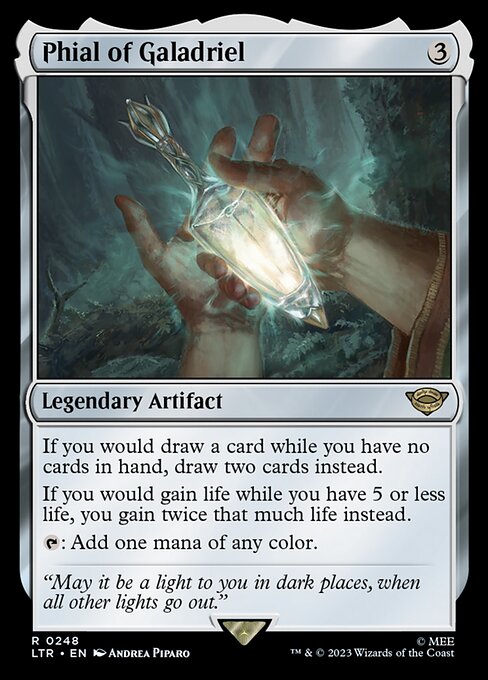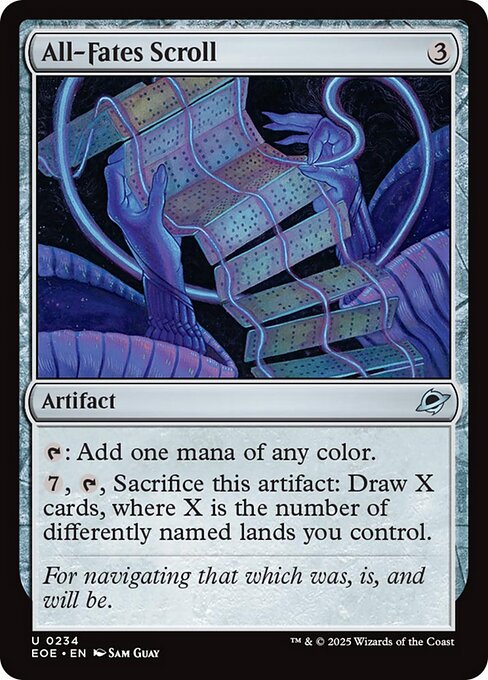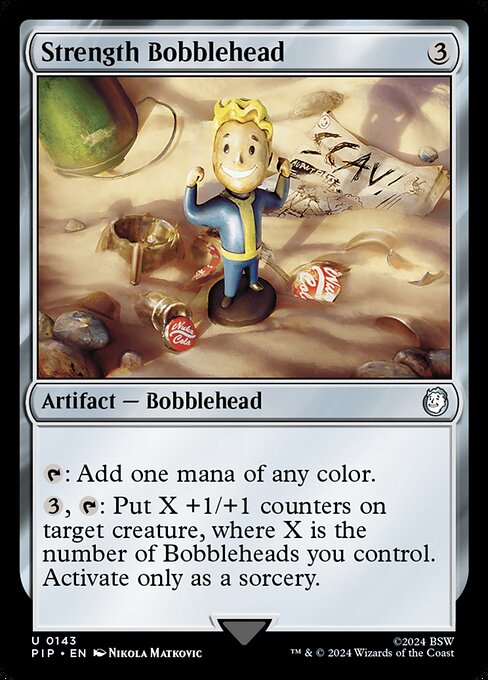
Legendary Artifact
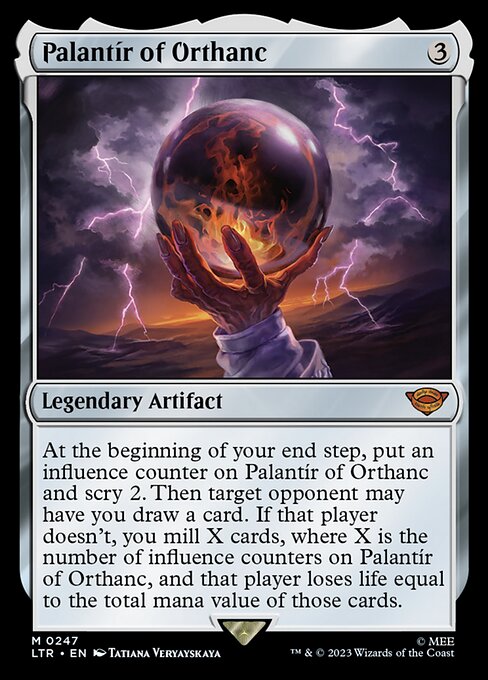
At the beginning of your end step, put an influence counterTo counter a spell or ability is to cancel it: remove it from the stack without resolving it. A counter on an object or player is instead a marker that changes characteristics or interacts with rules or abilities; for example, a +1/+1 counter modifies a creature’s power and toughness. (CR 701.6; 122.1) on Palantír of Orthanc and scryTo “scry N” means to look at the top N cards of your library, then put any number of them on the bottom of your library in any order and the rest on top of your library in any order.
If a player is instructed to scry 0, no scry event occurs. Abilities that trigger whenever a player scries won’t trigger.
If multiple players scry at once, each of those players looks at the top cards of their library at the same time. Those players decide in APNAP order (see rule 101.4) where to put those cards, then those cards move at the same time.
An ability that triggers whenever a player scries triggers after the process described in rule 701.22a is complete, even if some or all of those actions were impossible. (CR 701.22) 2. Then target opponent may have you draw a card. If that player doesn't, you millFor a player to mill a number of cards, that player puts that many cards from the top of their library into their graveyard.
A player can’t mill a number of cards greater than the number of cards in their library. If given the choice to do so, they can’t choose to take that action. If instructed to do so, they mill as many as possible. Similarly, the player can’t pay a cost that includes milling a number of cards greater than the number of cards in their library.
An effect that refers to a milled card can find that card in the zone it moved to from the library, as long as that zone is a public zone.
Some spells and abilities mill a single card and then ask for information about the milled card. If more than one card is milled due to replacement effects and the effect of a spell or ability asks for information about the milled card, such as a characteristic or mana value, it gets information from each milled card and will get multiple answers. If these answers are used to determine the value of a variable, the sum of the answers is used. If that effect grants a player permission to cast or play “that” card, the permission applies to each of the milled cards. If that effect performs any actions on “the” card, it performs that action on each milled card. If that effect performs any actions on “a” card, the controller of the spell or ability chooses which card is affected. (CR 701.17) X cards, where X is the number of influence countersTo counter a spell or ability is to cancel it: remove it from the stack without resolving it. A counter on an object or player is instead a marker that changes characteristics or interacts with rules or abilities; for example, a +1/+1 counter modifies a creature’s power and toughness. (CR 701.6; 122.1) on Palantír of Orthanc, and that player loses life equal to the total mana value of those cards.
$20.77
Commander: LegalModern: Legal
Save this card
Log in to save cards to your lists.
Start a deck with this cardTags and classifications
Card attributes are distinct from extracted ability facts and inferred themes. AI themes and predicted tags are suggestions, not rules text.
Ability tags
Mana costs
Keyword tags
Mana value
Timing tags
Type tags
Predicted tags are currently unavailable.