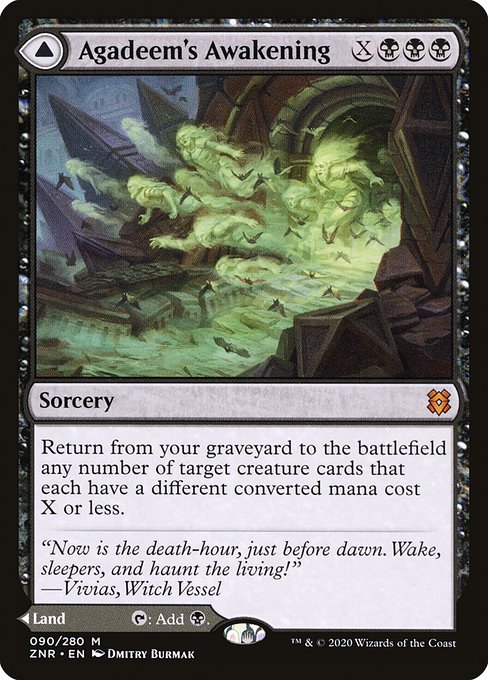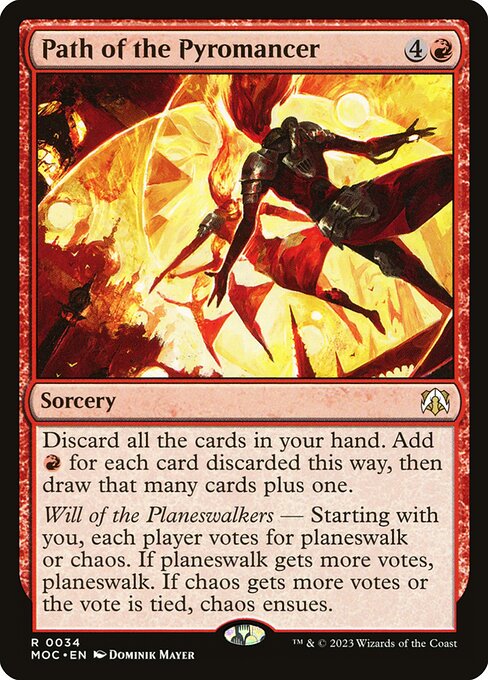
Sorcery
DiscardTo discard a card, move it from its owner’s hand to that player’s graveyard.
By default, effects that cause a player to discard a card allow the affected player to choose which card to discard. Some effects, however, require a random discard or allow another player to choose which card is discarded.
If a card is discarded, but an effect causes it to be put into a hidden zone instead of into its owner’s graveyard without being revealed, all values of that card’s characteristics are considered to be undefined. If a card is discarded this way to pay a cost that specifies a characteristic about the discarded card, that cost payment is illegal; the game returns to the moment before the cost was paid (see rule 733, “Handling Illegal Actions”). (CR 701.9) all the cards in your hand. Add for each card discarded this way, then draw that many cards plus one.
Will of the Planeswalkers — Starting with you, each player votes for planeswalkA player may planeswalk only during a Planechase game. Only the planar controller may planeswalk. See rule 901, “Planechase.”
To planeswalk is to put each face-up plane card and phenomenon card on the bottom of its owner’s planar deck face down, then move the top card of your planar deck off that planar deck and turn it face up.
A player may planeswalk as the result of the “planeswalking ability” (see rule 901.8), because the owner of a face-up plane card or phenomenon card leaves the game (see rule 901.10), or because a phenomenon’s triggered ability leaves the stack (see rule 704.6f). Abilities may also instruct a player to planeswalk.
The plane card that’s turned face up is the plane the player planeswalks to. The plane card that’s turned face down or that leaves the game is the plane the player planeswalks away from. The same is true with respect to phenomena. (CR 701.31) or chaos. If planeswalkA player may planeswalk only during a Planechase game. Only the planar controller may planeswalk. See rule 901, “Planechase.”
To planeswalk is to put each face-up plane card and phenomenon card on the bottom of its owner’s planar deck face down, then move the top card of your planar deck off that planar deck and turn it face up.
A player may planeswalk as the result of the “planeswalking ability” (see rule 901.8), because the owner of a face-up plane card or phenomenon card leaves the game (see rule 901.10), or because a phenomenon’s triggered ability leaves the stack (see rule 704.6f). Abilities may also instruct a player to planeswalk.
The plane card that’s turned face up is the plane the player planeswalks to. The plane card that’s turned face down or that leaves the game is the plane the player planeswalks away from. The same is true with respect to phenomena. (CR 701.31) gets more votes, planeswalkA player may planeswalk only during a Planechase game. Only the planar controller may planeswalk. See rule 901, “Planechase.”
To planeswalk is to put each face-up plane card and phenomenon card on the bottom of its owner’s planar deck face down, then move the top card of your planar deck off that planar deck and turn it face up.
A player may planeswalk as the result of the “planeswalking ability” (see rule 901.8), because the owner of a face-up plane card or phenomenon card leaves the game (see rule 901.10), or because a phenomenon’s triggered ability leaves the stack (see rule 704.6f). Abilities may also instruct a player to planeswalk.
The plane card that’s turned face up is the plane the player planeswalks to. The plane card that’s turned face down or that leaves the game is the plane the player planeswalks away from. The same is true with respect to phenomena. (CR 701.31). If chaos gets more votes or the voteSome spells and abilities instruct players to vote for one choice from a list of options to determine some aspect of the effect of that spell or ability. To vote, each player, starting with a specified player and proceeding in turn order, chooses one of those choices.
The listed choices may be objects, words with no rules meaning that are each connected to a different effect, or other variables relevant to the resolution of the spell or ability.
If the text of a spell or ability refers to “voting,” it refers only to an actual vote, not to any spell or ability that involves the players making choices or decisions without using the word “vote.”
If an effect gives a player multiple votes, those votes all happen at the same time the player would otherwise have voted. (CR 701.38) is tied, chaos ensues.
$4.12
Commander: LegalModern: Not legal
Save this card
Log in to save cards to your lists.
Start a deck with this cardTags and classifications
Card attributes are distinct from extracted ability facts and inferred themes. AI themes and predicted tags are suggestions, not rules text.
Ability tags
Mana costs
Color identity
Keyword tags
Mana value
Theme tags
Timing tags
Type tags
Predicted tags are currently unavailable.