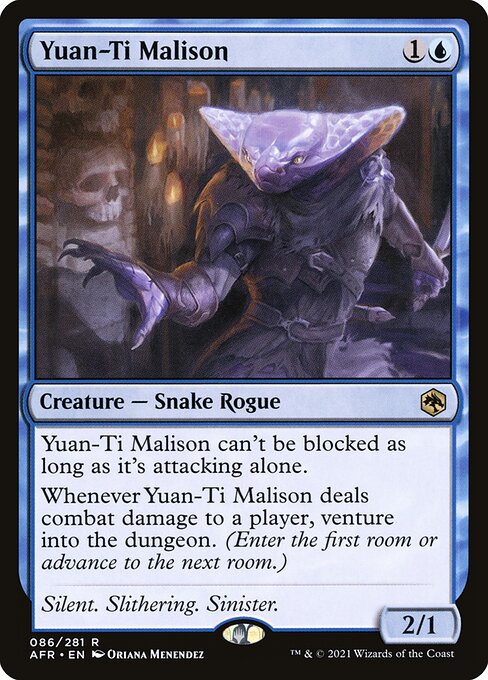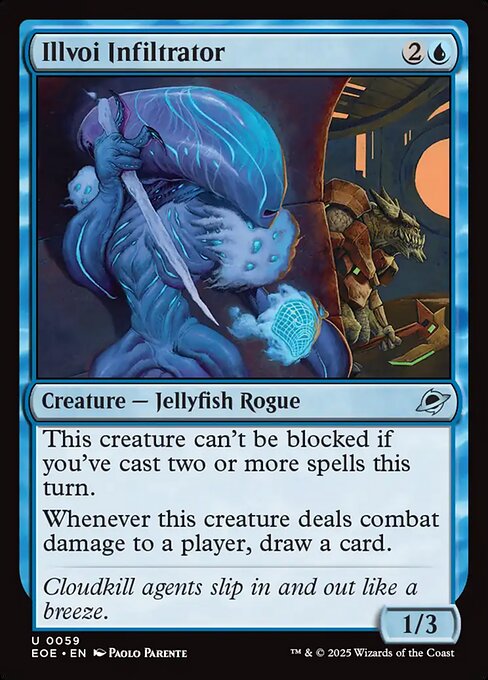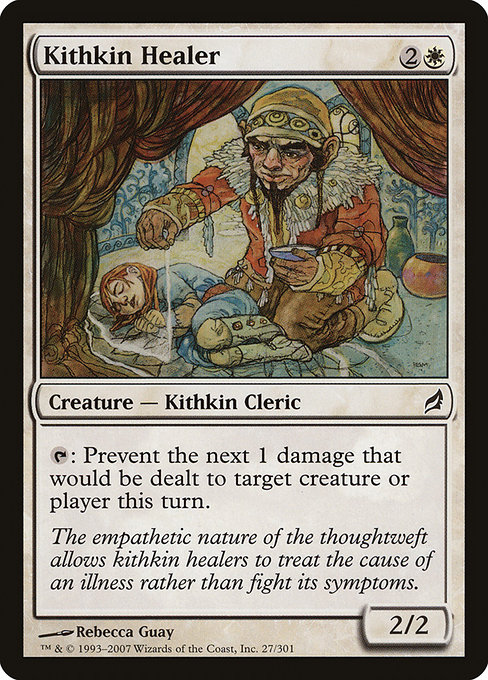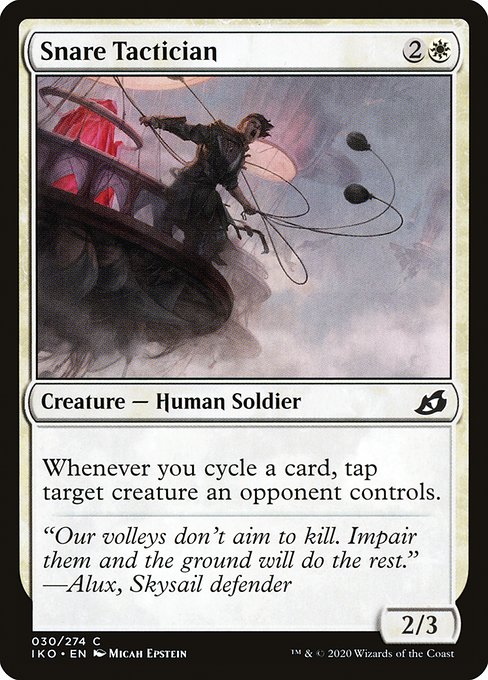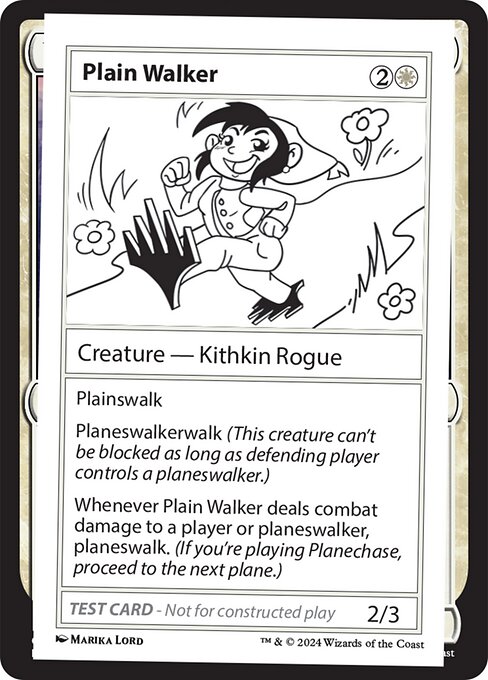
Creature — Kithkin Rogue
PlainswalkLandwalk is a generic term that appears within an object’s rules text as “[type]walk,” where [type] is usually a land type, but it can also be the card type land plus any combination of land types, card types, and/or supertypes.
Landwalk is an evasion ability.
A creature with landwalk can’t be blocked as long as the defending player controls at least one land with the specified land type (as in “islandwalk”), with the specified type or supertype (as in “artifact landwalk”), without the specified type or supertype (as in “nonbasic landwalk”), or with both the specified type or supertype and the specified subtype (as in “snow swampwalk”). (See rule 509, “Declare Blockers Step.”)
Landwalk abilities don’t “cancel” one another.
Multiple instances of the same kind of landwalk on the same creature are redundant. (CR 702.14)
Planeswalkerwalk (This creature can't be blocked as long as defending player controls a planeswalker.)
Whenever Plain Walker deals combat damage to a player or planeswalker, planeswalkA player may planeswalk only during a Planechase game. Only the planar controller may planeswalk. See rule 901, “Planechase.”
To planeswalk is to put each face-up plane card and phenomenon card on the bottom of its owner’s planar deck face down, then move the top card of your planar deck off that planar deck and turn it face up.
A player may planeswalk as the result of the “planeswalking ability” (see rule 901.8), because the owner of a face-up plane card or phenomenon card leaves the game (see rule 901.10), or because a phenomenon’s triggered ability leaves the stack (see rule 704.6f). Abilities may also instruct a player to planeswalk.
The plane card that’s turned face up is the plane the player planeswalks to. The plane card that’s turned face down or that leaves the game is the plane the player planeswalks away from. The same is true with respect to phenomena. (CR 701.31). (If you're playing Planechase, proceed to the next plane.)
$0.20
Commander: Not legalModern: Not legal
Save this card
Log in to save cards to your lists.
Start a deck with this cardTags and classifications
Card attributes are distinct from extracted ability facts and inferred themes. AI themes and predicted tags are suggestions, not rules text.
Ability tags
Mana costs
Creature kinds
Classes and roles
Color identity
Keyword tags
Mana value
Timing tags
Type tags
Predicted tags are currently unavailable.