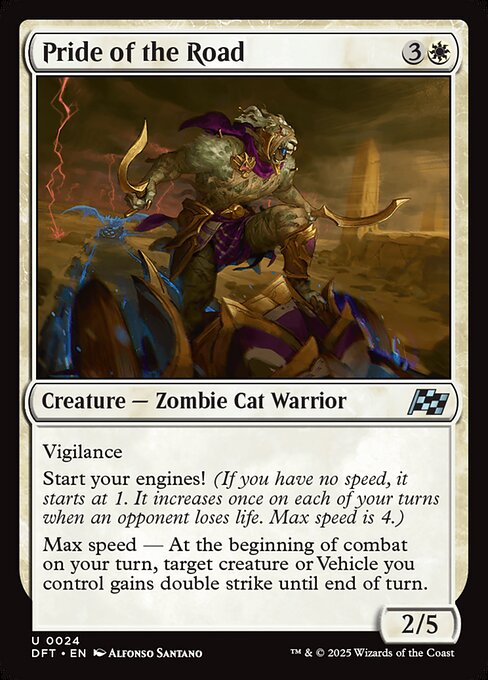
Creature — Zombie Cat Warrior
VigilanceVigilance is a static ability that modifies the rules for the declare attackers step.
Attacking doesn’t cause creatures with vigilance to tap. (See rule 508, “Declare Attackers Step.”)
Multiple instances of vigilance on the same creature are redundant. (CR 702.20)
Start your engines!Start your engines! is a static ability. If a player controls a permanent with start your engines! and that player has no speed, their speed becomes 1. This is a state-based action. See rule 704.
Players do not have speed until a rule or effect sets their speed to a specific value.
If a player has no speed and they are instructed to increase their speed by a certain value, their speed becomes that value.
There is an inherent triggered ability associated with a player having 1 or more speed. This ability has no source and is controlled by that player. That ability is “Whenever one or more opponents lose life during your turn, if your speed is less than 4, your speed increases by 1. This ability triggers only once each turn.”
Rules and effects may refer to whether a player has “max speed.” A player has max speed if their speed is 4.
Some effects refer to a player’s speed. If that player has no speed, their speed is 0 for the purpose of an effect that refers to speed. (CR 702.179) (If you have no speed, it starts at 1. It increases once on each of your turns when an opponent loses life. Max speedA max speed ability is a static ability. “Max speed — [Ability]” means “As long as your speed is 4, this object has ‘[Ability].’” See rule 702.179, “Start Your Engines!”
If an ability granted by a max speed ability states which zones it functions from, the max speed ability that grants that ability functions from those zones. (See rule 113.6c.) (CR 702.178) is 4.)
Max speedA max speed ability is a static ability. “Max speed — [Ability]” means “As long as your speed is 4, this object has ‘[Ability].’” See rule 702.179, “Start Your Engines!”
If an ability granted by a max speed ability states which zones it functions from, the max speed ability that grants that ability functions from those zones. (See rule 113.6c.) (CR 702.178) — At the beginning of combat on your turn, target creature or Vehicle you control gains double strikeDouble strike is a static ability that modifies the rules for the combat damage step. (See rule 510, “Combat Damage Step.”)
If at least one attacking or blocking creature has first strike (see rule 702.7) or double strike as the combat damage step begins, the only creatures that assign combat damage in that step are those with first strike or double strike. After that step, instead of proceeding to the end of combat step, the phase gets a second combat damage step. The only creatures that assign combat damage in that step are the remaining attackers and blockers that had neither first strike nor double strike as the first combat damage step began, as well as the remaining attackers and blockers that currently have double strike. After that step, the phase proceeds to the end of combat step.
Removing double strike from a creature during the first combat damage step will stop it from assigning combat damage in the second combat damage step.
Giving double strike to a creature with first strike after it has already dealt combat damage in the first combat damage step will allow the creature to assign combat damage in the second combat damage step.
Multiple instances of double strike on the same creature are redundant. (CR 702.4) until end of turn.
$0.22
Commander: LegalModern: Legal
Save this card
Log in to save cards to your lists.
Start a deck with this cardTags and classifications
Card attributes are distinct from extracted ability facts and inferred themes. AI themes and predicted tags are suggestions, not rules text.
Ability tags
Mana costs
Creature kinds
Classes and roles
Color identity
Keyword tags
Mana value
Timing tags
Type tags
Predicted tags are currently unavailable.