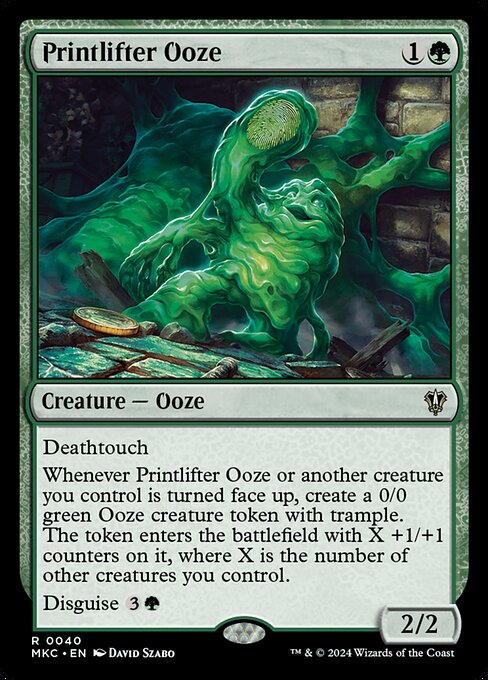
Creature — Ooze
DeathtouchDeathtouch is a static ability.
A creature with toughness greater than 0 that’s been dealt damage by a source with deathtouch since the last time state-based actions were checked is destroyed as a state-based action. See rule 704.
Any nonzero amount of combat damage assigned to a creature by a source with deathtouch is considered to be lethal damage for the purposes of determining if excess damage is being dealt.
The deathtouch rules function no matter what zone an object with deathtouch deals damage from.
If an object is no longer in the zone it’s expected to be in as an effect causes it to deal damage, its last known information is used to determine whether it had deathtouch.
Multiple instances of deathtouch on the same object are redundant. (CR 702.2)
Whenever this creature or another creature you control is turned face up, createTo create one or more tokens with certain characteristics, put the specified number of tokens with the specified characteristics onto the battlefield.
If a replacement effect applies to a token being created, that effect applies before considering any continuous effects that will modify the characteristics of that token. If a replacement effect applies to a token entering the battlefield, that effect applies after considering any continuous effects that will modify the characteristics of that token.
Previously, an effect that created tokens instructed a player to “put [those tokens] onto the battlefield.” Cards that were printed with that text have received errata in the Oracle card reference so they now “create” those tokens. (CR 701.7) a 0/0 green Ooze creature token with trampleTrample is a static ability that modifies the rules for assigning an attacking creature’s combat damage. The ability has no effect when a creature with trample is blocking or is dealing noncombat damage. (See rule 510, “Combat Damage Step.”)
The controller of an attacking creature with trample first assigns damage to the creature(s) blocking it. Once all those blocking creatures are assigned lethal damage, any excess damage is assigned as its controller chooses among those blocking creatures and the player, planeswalker, or battle the creature is attacking. When checking for assigned lethal damage, take into account damage already marked on the creature and damage from other creatures that’s being assigned during the same combat damage step, but not any abilities or effects that might change the amount of damage that’s actually dealt. The attacking creature’s controller need not assign lethal damage to all those blocking creatures but in that case can’t assign any damage to the player or planeswalker it’s attacking.
Trample over planeswalkers is a variant of trample that modifies the rules for assigning combat damage to planeswalkers. The controller of a creature with trample over planeswalkers assigns that creature’s combat damage as described in rule 702.19b, with one exception. If that creature is attacking a planeswalker, after lethal damage is assigned to all blocking creatures and damage at least equal to the loyalty of the planeswalker the creature is attacking is assigned to that planeswalker, further excess damage may be assigned as the attacking creature’s controller chooses among those blocking creatures, that planeswalker, and that planeswalker’s controller. When checking for assigned damage equal to a planeswalker’s loyalty, take into account damage from other creatures that’s being assigned during the same combat damage step, but not any abilities or effects that might change the amount of damage that’s actually dealt.
If an attacking creature with trample or trample over planeswalkers is blocked, but there are no creatures blocking it when damage is assigned, its damage is assigned to the defending player and/or planeswalker as though all blocking creatures have been assigned lethal damage.
If a creature with trample over planeswalkers is attacking a planeswalker and that planeswalker is removed from combat, the creature’s damage may be assigned to the defending player once all blocking creatures have been dealt lethal damage or, if there are no blocking creatures when damage is assigned, all its damage is assigned to the defending player. This is an exception to rule 506.4c, and it does not cause the creature to be attacking that player.
If a creature without trample over planeswalkers is attacking a planeswalker, none of its combat damage can be assigned to the defending player, even if that planeswalker has been removed from combat or the damage the attacking creature could assign is greater than the planeswalker’s loyalty.
Multiple instances of trample on the same creature are redundant. Multiple instances of trample over planeswalkers on the same creature are redundant. (CR 702.19). The token enters with X +1/+1 countersTo counter a spell or ability is to cancel it: remove it from the stack without resolving it. A counter on an object or player is instead a marker that changes characteristics or interacts with rules or abilities; for example, a +1/+1 counter modifies a creature’s power and toughness. (CR 701.6; 122.1) on it, where X is the number of other creatures you control.
DisguiseDisguise is a static ability that functions in any zone from which you could play the card it’s on, and the disguise effect works any time the card is face down. “Disguise [cost]” means “You may cast this card as a 2/2 face-down creature with ward , no name, no subtypes, and no mana cost by paying rather than paying its mana cost.” (See rule 708, “Face-Down Spells and Permanents.”)
To cast a card using its disguise ability, turn the card face down and announce that you are using a disguise ability. It becomes a 2/2 face-down creature card with ward , no name, no subtypes, and no mana cost. Any effects or prohibitions that would apply to casting a card with these characteristics (and not the face-up card’s characteristics) are applied to casting this card. These values are the copiable values of that object’s characteristics. (See rule 613, “Interaction of Continuous Effects,” and rule 707, “Copying Objects.”) Put it onto the stack (as a face-down spell with the same characteristics), and pay rather than pay its mana cost. This follows the rules for paying alternative costs. You can use a disguise ability to cast a card from any zone from which you could normally cast it. When the spell resolves, it enters the battlefield with the same characteristics the spell had. The disguise effect applies to the face-down object wherever it is, and it ends when the permanent is turned face up.
You can’t normally cast a card face down. A disguise ability allows you to do so.
Any time you have priority, you may turn a face-down permanent you control with a disguise ability face up. This is a special action; it doesn’t use the stack (see rule 116). To do this, show all players what the permanent’s disguise cost would be if it were face up, pay that cost, then turn the permanent face up. (If the permanent wouldn’t have a disguise cost if it were face up, it can’t be turned face up this way.) The disguise effect on it ends, and it regains its normal characteristics. Any abilities relating to the permanent entering the battlefield don’t trigger when it’s turned face up and don’t have any effect, because the permanent has already entered the battlefield.
If a permanent’s disguise cost includes X, other abilities of that permanent may also refer to X. The value of X in those abilities is equal to the value of X chosen as the disguise special action was taken.
See rule 708, “Face-Down Spells and Permanents,” for more information about how to cast cards with a disguise ability. (CR 702.168)
$0.29
Commander: LegalModern: Not legal
Save this card
Log in to save cards to your lists.
Start a deck with this cardTags and classifications
Card attributes are distinct from extracted ability facts and inferred themes. AI themes and predicted tags are suggestions, not rules text.
Ability tags
Mana costs
Creature kinds
Color identity
Keyword tags
Mana value
Timing tags
Type tags
Predicted tags are currently unavailable.