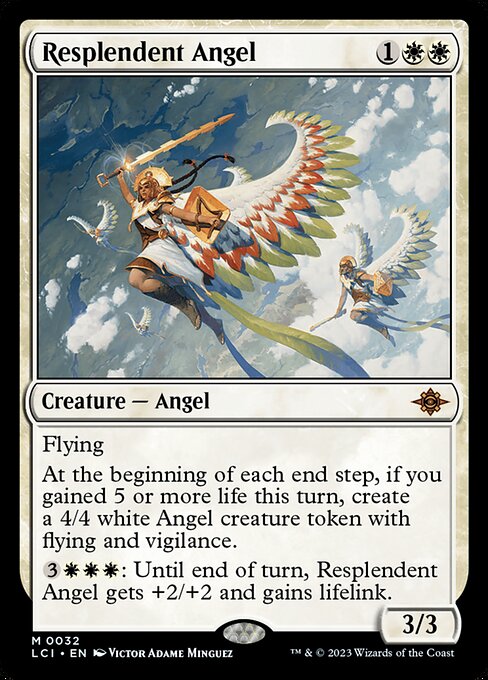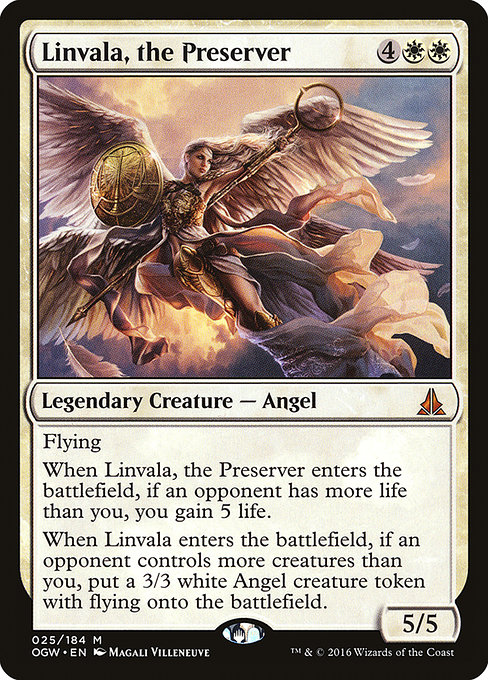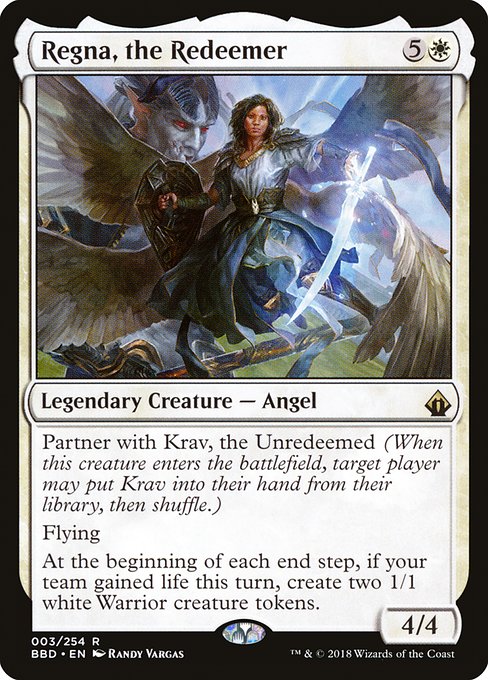
Legendary Creature — Angel
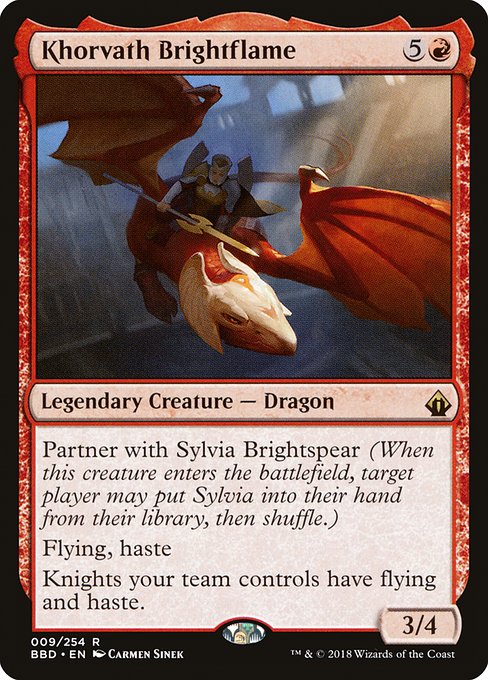
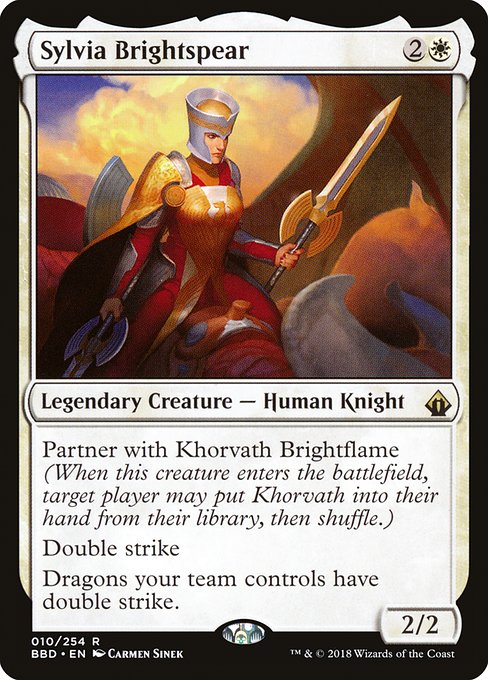
PartnerPartner abilities are keyword abilities that modify the rules for deck construction in the Commander variant (see rule 903), and they function before the game begins. Each partner ability allows you to designate two legendary cards as your commander rather than one. Each partner ability has its own requirements for those two commanders. The partner abilities are: partner, partner—[text], partner with [name], choose a Background, and Doctor’s companion.
Your deck must contain exactly 100 cards, including its two commanders. Both commanders begin the game in the command zone.
A rule or effect that refers to your commander’s color identity refers to the combined color identities of your two commanders. See rule 903.4.
Except for determining the color identity of your commander, the two commanders function independently. When casting a commander with partner, ignore how many times your other commander has been cast (see rule 903.8). When determining whether a player has been dealt 21 or more combat damage by the same commander, consider damage from each of your two commanders separately (see rule 903.10a).
If an effect refers to your commander while you have two commanders, it refers to either one. If an effect causes you to perform an action on your commander and it could affect both, you choose which it refers to at the time the effect is applied.
Different partner abilities are distinct from one another and cannot be combined. For example, you cannot designate two cards as your commander if one of them has “partner” and the other has “partner with [name].”
If a legendary card has more than one partner ability, you may choose which one to use when designating your commander, but you can’t use both. Notably, no partner ability or combination of partner abilities can ever let a player have more than two commanders.
“Partner” means “You may designate two legendary cards as your commander rather than one if each of them has partner.”
“Partner—[text]” means “You may designate two legendary cards as your commander rather than one if each of them has the same ‘partner—[text]’ ability.” The “partner—[text]” abilities are “partner—Character select,” “partner—Father & son,” “partner—Friends forever,” and “partner—Survivors.”
“Partner with [name]” represents two abilities. It means “You may designate two legendary cards as your commander rather than one if each has a ‘partner with [name]’ ability with the other’s name” and “When this permanent enters, target player may search their library for a card named [name], reveal it, put it into their hand, then shuffle.”
“Choose a Background” means “You may designate two cards as your commander rather than one if one of them is this card and the other is a legendary Background enchantment card.” You can’t designate two cards as your commander if one has a “choose a Background” ability and the other is not a legendary Background enchantment card, and legendary Background enchantment cards can’t be your commander unless you have also designated a commander with “choose a Background.”
“Doctor’s companion” means “You may designate two legendary creature cards as your commander rather than one if one of them is this card and the other is a legendary Time Lord Doctor creature card that has no other creature types.”
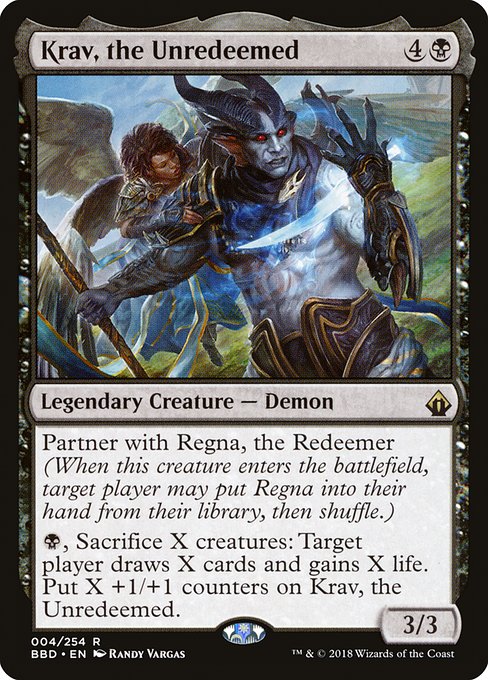
If an effect refers to a partner ability by name, it means only that partner ability and not any others. If an effect refers to the partner ability or cards with partner and doesn’t mention a specific variant of the partner ability by name, it is referring only to partner, partner—[text], partner with [name], or cards with any of those abilities, and it does not refer to any other partner variant. (CR 702.124) with Krav, the Unredeemed (When this creature enters, target player may put Krav into their hand from their library, then shuffleTo shuffle a library or a face-down pile of cards, randomize the cards within it so that no player knows their order.
Some effects cause a player to search a library for a card or cards, shuffle that library, then put some or all of the found cards into a different zone or in a certain position in that library. In such cases, the found cards aren’t included in the shuffle, even though they remain in the library at that time. Rather, all the cards in that library except those are shuffled. Abilities that trigger when a library is shuffled will still trigger. See also rule 401, “Library.”
If an effect would cause a player to shuffle one or more specific objects into a library, that library is shuffled even if none of those objects are in the zone they’re expected to be in or an effect causes all of those objects to be moved to another zone or remain in their current zone.
If an effect would cause a player to shuffle a set of objects into a library, that library is shuffled even if there are no objects in that set.
If an effect causes a player to shuffle a library containing zero or one cards, abilities that trigger when a library is shuffled will still trigger.
If two or more effects cause a library to be shuffled multiple times simultaneously, abilities that trigger when that library is shuffled will trigger that many times.
If an effect would cause a player to shuffle a library at the same time that an object would be put into a certain position in that library, the result is a shuffled library that’s randomized except that the object is in the specified position. (CR 701.24).)
FlyingFlying is an evasion ability.
A creature with flying can’t be blocked except by creatures with flying and/or reach. A creature with flying can block a creature with or without flying. (See rule 509, “Declare Blockers Step,” and rule 702.17, “Reach.”)
Multiple instances of flying on the same creature are redundant. (CR 702.9)
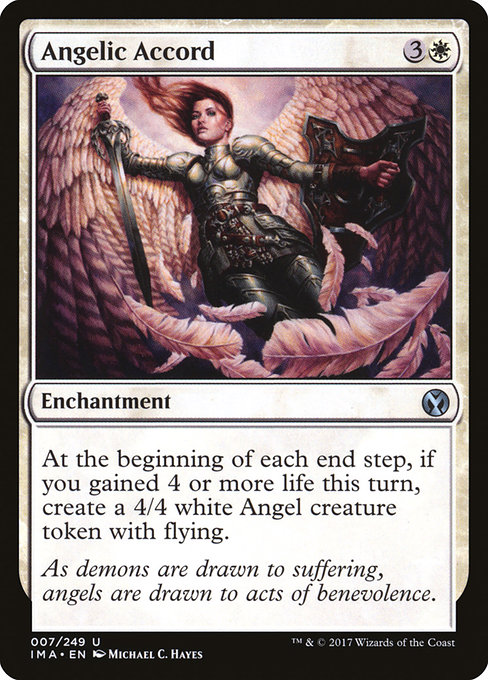
At the beginning of each end step, if your team gained life this turn, createTo create one or more tokens with certain characteristics, put the specified number of tokens with the specified characteristics onto the battlefield.
If a replacement effect applies to a token being created, that effect applies before considering any continuous effects that will modify the characteristics of that token. If a replacement effect applies to a token entering the battlefield, that effect applies after considering any continuous effects that will modify the characteristics of that token.
Previously, an effect that created tokens instructed a player to “put [those tokens] onto the battlefield.” Cards that were printed with that text have received errata in the Oracle card reference so they now “create” those tokens. (CR 701.7) two 1/1 white Warrior creature tokens.
$1.71
Commander: LegalModern: Not legal
Save this card
Log in to save cards to your lists.
Start a deck with this cardTags and classifications
Card attributes are distinct from extracted ability facts and inferred themes. AI themes and predicted tags are suggestions, not rules text.
Ability tags
Mana costs
Creature kinds
Color identity
Keyword tags
Mana value
Timing tags
Type tags
Predicted tags are currently unavailable.