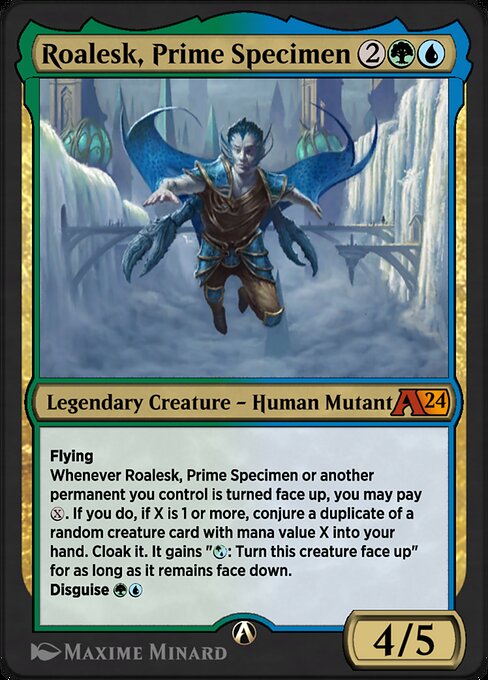
Legendary Creature — Human Mutant
FlyingFlying is an evasion ability.
A creature with flying can’t be blocked except by creatures with flying and/or reach. A creature with flying can block a creature with or without flying. (See rule 509, “Declare Blockers Step,” and rule 702.17, “Reach.”)
Multiple instances of flying on the same creature are redundant. (CR 702.9)
Whenever Roalesk, Prime Specimen or another permanent you control is turned face up, you may pay . If you do, if X is 1 or more, conjure a duplicate of a random creature card with mana value X into your hand. CloakTo cloak a card, turn it face down. It becomes a 2/2 face-down creature card with ward , no name, no subtypes, and no mana cost. Put that card onto the battlefield face down. That permanent is a cloaked permanent for as long as it remains face down. The effect defining its characteristics works while the card is face down and ends when it’s turned face up.
Any time you have priority, you may turn a cloaked permanent you control face up. This is a special action that doesn’t use the stack (see rule 116.2b). To do this, show all players that the card representing that permanent is a creature card and what that card’s mana cost is, pay that cost, then turn the permanent face up. The effect defining its characteristics while it was face down ends, and it regains its normal characteristics. (If the card representing that permanent isn’t a creature card or it doesn’t have a mana cost, it can’t be turned face up this way.)
If a card with morph is cloaked, its controller may turn that card face up using either the procedure described in rule 702.37e to turn a face-down permanent with morph face up or the procedure described above to turn a cloaked permanent face up.
If a card with disguise is cloaked, its controller may turn that card face up using either the procedure described in rule 702.168d to turn a face-down permanent with disguise face up or the procedure described above to turn a cloaked permanent face up.
If an effect instructs a player to cloak multiple cards from a single library, those cards are cloaked one at a time.
If an effect instructs a player to cloak a card and a rule or effect prohibits the face-down object from entering the battlefield, that card isn’t cloaked. Its characteristics remain unmodified and it remains in its previous zone. If it was face up, it remains face up.
If a cloaked permanent that’s represented by an instant or sorcery card would turn face up, its controller reveals it and leaves it face down. Abilities that trigger whenever a permanent is turned face up won’t trigger.
See rule 708, “Face-Down Spells and Permanents,” for more information. (CR 701.58) it. It gains ": Turn this creature face up" for as long as it remains face down.
DisguiseDisguise is a static ability that functions in any zone from which you could play the card it’s on, and the disguise effect works any time the card is face down. “Disguise [cost]” means “You may cast this card as a 2/2 face-down creature with ward , no name, no subtypes, and no mana cost by paying rather than paying its mana cost.” (See rule 708, “Face-Down Spells and Permanents.”)
To cast a card using its disguise ability, turn the card face down and announce that you are using a disguise ability. It becomes a 2/2 face-down creature card with ward , no name, no subtypes, and no mana cost. Any effects or prohibitions that would apply to casting a card with these characteristics (and not the face-up card’s characteristics) are applied to casting this card. These values are the copiable values of that object’s characteristics. (See rule 613, “Interaction of Continuous Effects,” and rule 707, “Copying Objects.”) Put it onto the stack (as a face-down spell with the same characteristics), and pay rather than pay its mana cost. This follows the rules for paying alternative costs. You can use a disguise ability to cast a card from any zone from which you could normally cast it. When the spell resolves, it enters the battlefield with the same characteristics the spell had. The disguise effect applies to the face-down object wherever it is, and it ends when the permanent is turned face up.
You can’t normally cast a card face down. A disguise ability allows you to do so.
Any time you have priority, you may turn a face-down permanent you control with a disguise ability face up. This is a special action; it doesn’t use the stack (see rule 116). To do this, show all players what the permanent’s disguise cost would be if it were face up, pay that cost, then turn the permanent face up. (If the permanent wouldn’t have a disguise cost if it were face up, it can’t be turned face up this way.) The disguise effect on it ends, and it regains its normal characteristics. Any abilities relating to the permanent entering the battlefield don’t trigger when it’s turned face up and don’t have any effect, because the permanent has already entered the battlefield.
If a permanent’s disguise cost includes X, other abilities of that permanent may also refer to X. The value of X in those abilities is equal to the value of X chosen as the disguise special action was taken.
See rule 708, “Face-Down Spells and Permanents,” for more information about how to cast cards with a disguise ability. (CR 702.168)
Price unavailable
Commander: Not legalModern: Not legal
Save this card
Log in to save cards to your lists.
Start a deck with this cardTags and classifications
Card attributes are distinct from extracted ability facts and inferred themes. AI themes and predicted tags are suggestions, not rules text.
Ability tags
Mana costs
Creature kinds
Color identity
Keyword tags
Mana value
Timing tags
Type tags
Predicted tags are currently unavailable.