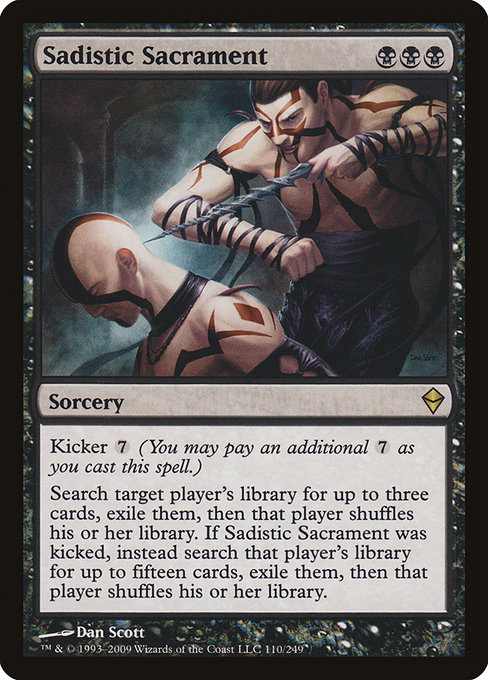
Sorcery
KickerKicker is a static ability that functions while the spell with kicker is on the stack. “Kicker [cost]” means “You may pay an additional [cost] as you cast this spell.” Paying a spell’s kicker cost(s) follows the rules for paying additional costs in rules 601.2b and 601.2f–h.
The phrase “Kicker [cost 1] and/or [cost 2]” means the same thing as “Kicker [cost 1], kicker [cost 2].”
Multikicker is a variant of the kicker ability. “Multikicker [cost]” means “You may pay an additional [cost] any number of times as you cast this spell.” A multikicker cost is a kicker cost.
If a spell’s controller declares the intention to pay any of that spell’s kicker costs, that spell has been “kicked.” If a spell has two kicker costs or has multikicker, it may be kicked multiple times. See rule 601.2b.
Objects with kicker or multikicker have additional abilities that specify what happens if they were kicked. These abilities are linked to the kicker or multikicker abilities printed on that object: they can refer only to those specific kicker or multikicker abilities. See rule 607, “Linked Abilities.”
Objects with more than one kicker cost may also have abilities that each correspond to a specific kicker cost. Those abilities contain the phrases “if it was kicked with its [A] kicker” and “if it was kicked with its [B] kicker,” where A and B are the first and second kicker costs listed on the card, respectively. Each of those abilities is linked to the appropriate kicker ability.
If part of a spell’s ability has its effect only if that spell was kicked, and that part of the ability includes any targets, the spell’s controller chooses those targets only if that spell was kicked. Otherwise, the spell is cast as if it did not have those targets. See rule 601.2c.
Sticker kicker is a keyword ability that represents a kicker ability and an ability that imposes an additional cost if the spell is kicked. “Sticker kicker [cost]” means “Kicker [cost]” and “As an additional cost to cast this spell, if it’s kicked, you get a ticket counter and you may put a sticker on this spell.” (CR 702.33) (You may pay an additional as you castTo cast a spell is to take it from the zone it’s in (usually the hand), put it on the stack, and pay its costs, so that it will eventually resolve and have its effect. A player may cast a spell if they have priority. See rule 601, “Casting Spells.”
To cast a card is to cast it as a spell. (CR 701.5) this spell.)
SearchTo search for a card in a zone, look at all cards in that zone (even if it’s a hidden zone) and find a card that matches the given description.
If a player is searching a hidden zone for cards with a stated quality, such as a card with a certain card type or color, that player isn’t required to find some or all of those cards even if they’re present in that zone.
If a player is instructed to search a hidden zone for cards that match an undefined quality, that player may still search that zone but can’t find any cards.
If a player is searching a hidden zone simply for a quantity of cards, such as “a card” or “three cards,” that player must find that many cards (or as many as possible, if the zone doesn’t contain enough cards).
If the effect that contains the search instruction doesn’t also contain instructions to reveal the found card(s), then they’re not revealed.
If searching a zone is replaced with searching a portion of that zone, any other instructions that refer to searching the zone still apply. Any abilities that trigger on a library being searched will trigger.
If an effect offers a player a choice to search a zone and take additional actions with the cards found, that player may choose to search even if the additional actions are illegal or impossible.
An effect may instruct a player to search a library for one or more cards more than once before instructing a player to shuffle that library. This is the same as a single instruction for that player to search that library for all those cards. The player searches that library only once.
If multiple players search at once, each of those players looks at the appropriate cards at the same time, then those players decide in APNAP order (see rule 101.4) which card to find.
If an effect instructs a player to search outside the game for a card, that player may choose an appropriate card they own from outside the game. (CR 701.23) target player's library for up to three cards, exileTo exile an object, move it to the exile zone from wherever it is. See rule 406, “Exile.” (CR 701.13) them, then that player shuffles. If this spell was kicked, instead searchTo search for a card in a zone, look at all cards in that zone (even if it’s a hidden zone) and find a card that matches the given description.
If a player is searching a hidden zone for cards with a stated quality, such as a card with a certain card type or color, that player isn’t required to find some or all of those cards even if they’re present in that zone.
If a player is instructed to search a hidden zone for cards that match an undefined quality, that player may still search that zone but can’t find any cards.
If a player is searching a hidden zone simply for a quantity of cards, such as “a card” or “three cards,” that player must find that many cards (or as many as possible, if the zone doesn’t contain enough cards).
If the effect that contains the search instruction doesn’t also contain instructions to reveal the found card(s), then they’re not revealed.
If searching a zone is replaced with searching a portion of that zone, any other instructions that refer to searching the zone still apply. Any abilities that trigger on a library being searched will trigger.
If an effect offers a player a choice to search a zone and take additional actions with the cards found, that player may choose to search even if the additional actions are illegal or impossible.
An effect may instruct a player to search a library for one or more cards more than once before instructing a player to shuffle that library. This is the same as a single instruction for that player to search that library for all those cards. The player searches that library only once.
If multiple players search at once, each of those players looks at the appropriate cards at the same time, then those players decide in APNAP order (see rule 101.4) which card to find.
If an effect instructs a player to search outside the game for a card, that player may choose an appropriate card they own from outside the game. (CR 701.23) that player's library for up to fifteen cards, exileTo exile an object, move it to the exile zone from wherever it is. See rule 406, “Exile.” (CR 701.13) them, then that player shuffles.
$0.76
Commander: LegalModern: Legal
Save this card
Log in to save cards to your lists.
Start a deck with this cardTags and classifications
Card attributes are distinct from extracted ability facts and inferred themes. AI themes and predicted tags are suggestions, not rules text.
Ability tags
Mana costs
Color identity
Keyword tags
Mana value
Timing tags
Type tags
Predicted tags are currently unavailable.