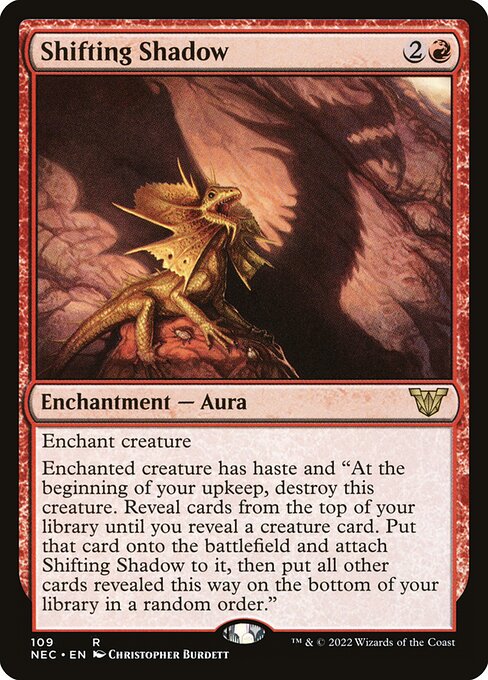
Enchantment — Aura
EnchantEnchant is a static ability, written “Enchant [object or player].” The enchant ability restricts what an Aura spell can target and what an Aura can enchant.
For more information about Auras, see rule 303, “Enchantments.”
If an Aura has multiple instances of enchant, all of them apply. The Aura’s target must follow the restrictions from all the instances of enchant. The Aura can enchant only objects or players that match all of its enchant abilities.
Auras that can enchant a player can target and be attached to players. Such Auras can’t target permanents and can’t be attached to permanents. (CR 702.5) creature
Enchanted creature has hasteHaste is a static ability.
If a creature has haste, it can attack even if it hasn’t been controlled by its controller continuously since their most recent turn began. (See rule 302.6.)
If a creature has haste, its controller can activate its activated abilities whose cost includes the tap symbol or the untap symbol even if that creature hasn’t been controlled by that player continuously since their most recent turn began. (See rule 302.6.)
Multiple instances of haste on the same creature are redundant. (CR 702.10) and "At the beginning of your upkeep, destroyThe only ways a permanent can be destroyed are as a result of an effect that uses the word “destroy” or as a result of the state-based actions that check for lethal damage (see rule 704.5g) or damage from a source with deathtouch (see rule 704.5h). If a permanent is put into its owner’s graveyard for any other reason, it hasn’t been “destroyed.”
A regeneration effect replaces a destruction event. See rule 701.19, “Regenerate.” (CR 701.8) this creature. RevealTo reveal a card, show that card to all players for a brief time. If an effect causes a card to be revealed, it remains revealed for as long as necessary to complete the parts of the effect that card is relevant to. If the cost to cast a spell or activate an ability includes revealing a card, or if a card is revealed because an ability is activated from a hidden zone (see rule 602.2a), the card remains revealed from the time the spell or ability is announced until the time it leaves the stack. If revealing a card causes a triggered ability to trigger, the card remains revealed until that triggered ability leaves the stack. If that ability isn’t put onto the stack the next time a player would receive priority, the card ceases to be revealed.
Revealing a card doesn’t cause it to leave the zone it’s in.
A card that is currently revealed may be revealed again.
If cards in a player’s library are shuffled or otherwise reordered, any revealed cards that are reordered stop being revealed and become new objects.
Some effects instruct a player to look at one or more cards. Looking at a card follows the same rules as revealing a card, except that the card is shown only to the specified player. (CR 701.20) cards from the top of your library until you revealTo reveal a card, show that card to all players for a brief time. If an effect causes a card to be revealed, it remains revealed for as long as necessary to complete the parts of the effect that card is relevant to. If the cost to cast a spell or activate an ability includes revealing a card, or if a card is revealed because an ability is activated from a hidden zone (see rule 602.2a), the card remains revealed from the time the spell or ability is announced until the time it leaves the stack. If revealing a card causes a triggered ability to trigger, the card remains revealed until that triggered ability leaves the stack. If that ability isn’t put onto the stack the next time a player would receive priority, the card ceases to be revealed.
Revealing a card doesn’t cause it to leave the zone it’s in.
A card that is currently revealed may be revealed again.
If cards in a player’s library are shuffled or otherwise reordered, any revealed cards that are reordered stop being revealed and become new objects.
Some effects instruct a player to look at one or more cards. Looking at a card follows the same rules as revealing a card, except that the card is shown only to the specified player. (CR 701.20) a creature card. Put that card onto the battlefield and attachTo attach an Aura, Equipment, or Fortification to an object or player means to take it from where it currently is and put it onto that object or player. If something is attached to a permanent on the battlefield, it’s customary to place it so that it’s physically touching the permanent. An Aura, Equipment, or Fortification can’t be attached to an object or player it couldn’t enchant, equip, or fortify, respectively.
If an effect tries to attach an Aura, Equipment, or Fortification to an object or player it can’t be attached to, the Aura, Equipment, or Fortification doesn’t move. If an effect tries to attach an Aura, Equipment, or Fortification to the object or player it’s already attached to, the effect does nothing. If an effect tries to attach an object that isn’t an Aura, Equipment, or Fortification to another object or player, the effect does nothing and the first object doesn’t move.
Attaching an Aura, Equipment, or Fortification on the battlefield to a different object or player causes the Aura, Equipment, or Fortification to receive a new timestamp.
To “unattach” an Equipment from a creature means to move it away from that creature so the Equipment is on the battlefield but is not equipping anything. It should no longer be physically touching any creature. If an Aura, Equipment, or Fortification that was attached to an object or player ceases to be attached to it, that counts as “becoming unattached [from that object or player]”; this includes if that Aura, Equipment, or Fortification leaves the battlefield, the object leaves the zone it was in, or that player leaves the game. (CR 701.3) Shifting Shadow to it, then put all other cards revealed this way on the bottom of your library in a random order."
$0.33
Commander: LegalModern: Not legal
Save this card
Log in to save cards to your lists.
Start a deck with this cardTags and classifications
Card attributes are distinct from extracted ability facts and inferred themes. AI themes and predicted tags are suggestions, not rules text.
Ability tags
Mana costs
Color identity
Keyword tags
Mana value
Timing tags
Type tags
Predicted tags are currently unavailable.