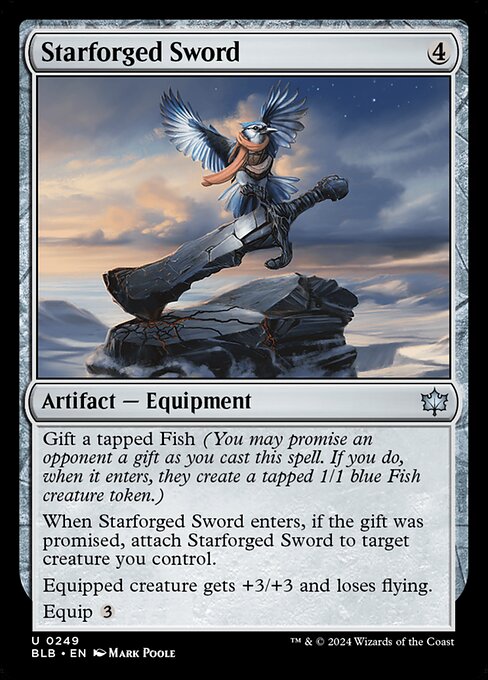
Artifact — Equipment
GiftGift is a keyword that represents two abilities. It is written “Gift a [something].” The first ability is a static ability that functions while the card with gift is on the stack, and the second is either an ability that functions while the card with gift is on the stack or a triggered ability that functions while the card with gift is on the battlefield. The first ability is always “As an additional cost to cast this spell, you may choose an opponent.” Paying a spell’s gift cost follows the rules for paying additional costs in rules 601.2b and 601.2f–h. The second ability depends on the [something] listed as well as whether the object with the ability is a permanent or an instant or sorcery spell.
On a permanent, the second ability represented by gift is “When this permanent enters, if its gift cost was paid, [effect].” On an instant or sorcery spell, the second ability represented by gift is “If this spell’s gift cost was paid, [effect].” The specific effect is defined by the [something] listed.
Some effects trigger whenever a player gives a gift. Such an ability triggers whenever an instant or sorcery spell that player controls whose gift cost was paid resolves. It also triggers whenever the gift triggered ability of a permanent that player controls resolves.
“Gift a Food” means the effect is “The chosen player creates a Food token.”
“Gift a card” means the effect is “The chosen player draws a card.”
“Gift a tapped Fish” means the effect is “The chosen player creates a tapped 1/1 blue Fish creature token.”
“Gift an extra turn” means the effect is “The chosen player takes an extra turn after this one.”
“Gift a Treasure” means the effect is “The chosen player creates a Treasure token.”
“Gift an Octopus” means the effect is “The chosen player creates an 8/8 blue Octopus creature token.”
For instant and sorcery spells, the effect of a gift ability always happens before any other spell abilities of the card. If the spell is countered or otherwise leaves the stack before resolving, the gift effect doesn’t happen.
If a spell’s controller declares the intention to pay a spell’s gift cost, that spell’s gift was promised.
If part of a spell’s ability has its effect only if its gift was promised, and that part of the ability includes any targets, the spell’s controller chooses those targets only if the gift was promised. (CR 702.174) a tapped Fish (You may promise an opponent a giftGift is a keyword that represents two abilities. It is written “Gift a [something].” The first ability is a static ability that functions while the card with gift is on the stack, and the second is either an ability that functions while the card with gift is on the stack or a triggered ability that functions while the card with gift is on the battlefield. The first ability is always “As an additional cost to cast this spell, you may choose an opponent.” Paying a spell’s gift cost follows the rules for paying additional costs in rules 601.2b and 601.2f–h. The second ability depends on the [something] listed as well as whether the object with the ability is a permanent or an instant or sorcery spell.
On a permanent, the second ability represented by gift is “When this permanent enters, if its gift cost was paid, [effect].” On an instant or sorcery spell, the second ability represented by gift is “If this spell’s gift cost was paid, [effect].” The specific effect is defined by the [something] listed.
Some effects trigger whenever a player gives a gift. Such an ability triggers whenever an instant or sorcery spell that player controls whose gift cost was paid resolves. It also triggers whenever the gift triggered ability of a permanent that player controls resolves.
“Gift a Food” means the effect is “The chosen player creates a Food token.”
“Gift a card” means the effect is “The chosen player draws a card.”
“Gift a tapped Fish” means the effect is “The chosen player creates a tapped 1/1 blue Fish creature token.”
“Gift an extra turn” means the effect is “The chosen player takes an extra turn after this one.”
“Gift a Treasure” means the effect is “The chosen player creates a Treasure token.”
“Gift an Octopus” means the effect is “The chosen player creates an 8/8 blue Octopus creature token.”
For instant and sorcery spells, the effect of a gift ability always happens before any other spell abilities of the card. If the spell is countered or otherwise leaves the stack before resolving, the gift effect doesn’t happen.
If a spell’s controller declares the intention to pay a spell’s gift cost, that spell’s gift was promised.
If part of a spell’s ability has its effect only if its gift was promised, and that part of the ability includes any targets, the spell’s controller chooses those targets only if the gift was promised. (CR 702.174) as you castTo cast a spell is to take it from the zone it’s in (usually the hand), put it on the stack, and pay its costs, so that it will eventually resolve and have its effect. A player may cast a spell if they have priority. See rule 601, “Casting Spells.”
To cast a card is to cast it as a spell. (CR 701.5) this spell. If you do, when it enters, they createTo create one or more tokens with certain characteristics, put the specified number of tokens with the specified characteristics onto the battlefield.
If a replacement effect applies to a token being created, that effect applies before considering any continuous effects that will modify the characteristics of that token. If a replacement effect applies to a token entering the battlefield, that effect applies after considering any continuous effects that will modify the characteristics of that token.
Previously, an effect that created tokens instructed a player to “put [those tokens] onto the battlefield.” Cards that were printed with that text have received errata in the Oracle card reference so they now “create” those tokens. (CR 701.7) a tapped 1/1 blue Fish creature token.)
When this Equipment enters, if the giftGift is a keyword that represents two abilities. It is written “Gift a [something].” The first ability is a static ability that functions while the card with gift is on the stack, and the second is either an ability that functions while the card with gift is on the stack or a triggered ability that functions while the card with gift is on the battlefield. The first ability is always “As an additional cost to cast this spell, you may choose an opponent.” Paying a spell’s gift cost follows the rules for paying additional costs in rules 601.2b and 601.2f–h. The second ability depends on the [something] listed as well as whether the object with the ability is a permanent or an instant or sorcery spell.
On a permanent, the second ability represented by gift is “When this permanent enters, if its gift cost was paid, [effect].” On an instant or sorcery spell, the second ability represented by gift is “If this spell’s gift cost was paid, [effect].” The specific effect is defined by the [something] listed.
Some effects trigger whenever a player gives a gift. Such an ability triggers whenever an instant or sorcery spell that player controls whose gift cost was paid resolves. It also triggers whenever the gift triggered ability of a permanent that player controls resolves.
“Gift a Food” means the effect is “The chosen player creates a Food token.”
“Gift a card” means the effect is “The chosen player draws a card.”
“Gift a tapped Fish” means the effect is “The chosen player creates a tapped 1/1 blue Fish creature token.”
“Gift an extra turn” means the effect is “The chosen player takes an extra turn after this one.”
“Gift a Treasure” means the effect is “The chosen player creates a Treasure token.”
“Gift an Octopus” means the effect is “The chosen player creates an 8/8 blue Octopus creature token.”
For instant and sorcery spells, the effect of a gift ability always happens before any other spell abilities of the card. If the spell is countered or otherwise leaves the stack before resolving, the gift effect doesn’t happen.
If a spell’s controller declares the intention to pay a spell’s gift cost, that spell’s gift was promised.
If part of a spell’s ability has its effect only if its gift was promised, and that part of the ability includes any targets, the spell’s controller chooses those targets only if the gift was promised. (CR 702.174) was promised, attachTo attach an Aura, Equipment, or Fortification to an object or player means to take it from where it currently is and put it onto that object or player. If something is attached to a permanent on the battlefield, it’s customary to place it so that it’s physically touching the permanent. An Aura, Equipment, or Fortification can’t be attached to an object or player it couldn’t enchant, equip, or fortify, respectively.
If an effect tries to attach an Aura, Equipment, or Fortification to an object or player it can’t be attached to, the Aura, Equipment, or Fortification doesn’t move. If an effect tries to attach an Aura, Equipment, or Fortification to the object or player it’s already attached to, the effect does nothing. If an effect tries to attach an object that isn’t an Aura, Equipment, or Fortification to another object or player, the effect does nothing and the first object doesn’t move.
Attaching an Aura, Equipment, or Fortification on the battlefield to a different object or player causes the Aura, Equipment, or Fortification to receive a new timestamp.
To “unattach” an Equipment from a creature means to move it away from that creature so the Equipment is on the battlefield but is not equipping anything. It should no longer be physically touching any creature. If an Aura, Equipment, or Fortification that was attached to an object or player ceases to be attached to it, that counts as “becoming unattached [from that object or player]”; this includes if that Aura, Equipment, or Fortification leaves the battlefield, the object leaves the zone it was in, or that player leaves the game. (CR 701.3) this Equipment to target creature you control.
Equipped creature gets +3/+3 and loses flyingFlying is an evasion ability.
A creature with flying can’t be blocked except by creatures with flying and/or reach. A creature with flying can block a creature with or without flying. (See rule 509, “Declare Blockers Step,” and rule 702.17, “Reach.”)
Multiple instances of flying on the same creature are redundant. (CR 702.9).
EquipEquip is an activated ability of Equipment cards. “Equip [cost]” means “[Cost]: Attach this permanent to target creature you control. Activate only as a sorcery.”
For more information about Equipment, see rule 301, “Artifacts.”
Equip abilities may further restrict what creatures may be chosen as legal targets. Such restrictions usually appear in the form “Equip [quality]” or “Equip [quality] creature.” These equip abilities may legally target only a creature that’s controlled by the player activating the ability and that has the chosen quality. Additional restrictions for an equip ability don’t restrict what the Equipment may be attached to.
If a permanent has multiple equip abilities, any of its equip abilities may be activated.
“Equip planeswalker” is a variant of the equip ability. “Equip planeswalker [cost]” means “[Cost]: Attach this permanent to target planeswalker you control as though that planeswalker were a creature. Activate only as a sorcery.” (CR 702.6)
$0.14
Commander: LegalModern: Legal
Save this card
Log in to save cards to your lists.
Start a deck with this cardTags and classifications
Card attributes are distinct from extracted ability facts and inferred themes. AI themes and predicted tags are suggestions, not rules text.
Ability tags
Mana costs
Keyword tags
Mana value
Theme tags
Timing tags
Type tags
Predicted tags are currently unavailable.