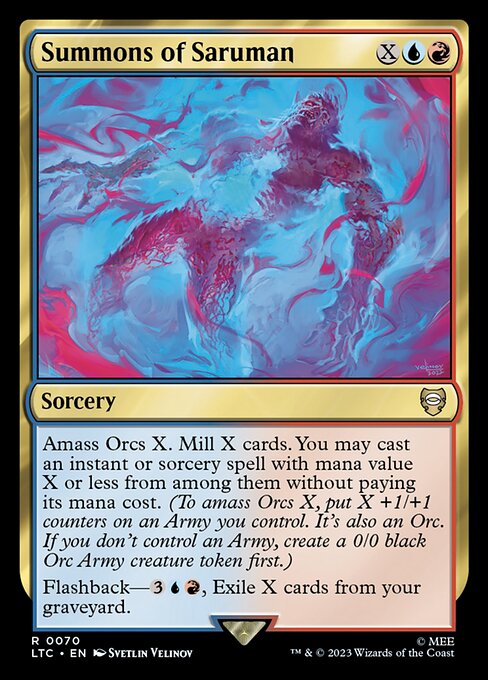
Sorcery
AmassTo amass [subtype] N means “If you don’t control an Army creature, create a 0/0 black [subtype] Army creature token. Choose an Army creature you control. Put N +1/+1 counters on that creature. If it isn’t a [subtype], it becomes a [subtype] in addition to its other types.”
A player “amassed” after the process described in rule 701.47a is complete, even if some or all of those actions were impossible.
The phrases “the Army you amassed” and “the amassed Army” refer to the creature you chose, whether or not it received counters.
Some older cards were printed with amass N without including a subtype. Those cards have received errata in the Oracle card reference so that they read “amass Zombies N.” (CR 701.47) Orcs X. MillFor a player to mill a number of cards, that player puts that many cards from the top of their library into their graveyard.
A player can’t mill a number of cards greater than the number of cards in their library. If given the choice to do so, they can’t choose to take that action. If instructed to do so, they mill as many as possible. Similarly, the player can’t pay a cost that includes milling a number of cards greater than the number of cards in their library.
An effect that refers to a milled card can find that card in the zone it moved to from the library, as long as that zone is a public zone.
Some spells and abilities mill a single card and then ask for information about the milled card. If more than one card is milled due to replacement effects and the effect of a spell or ability asks for information about the milled card, such as a characteristic or mana value, it gets information from each milled card and will get multiple answers. If these answers are used to determine the value of a variable, the sum of the answers is used. If that effect grants a player permission to cast or play “that” card, the permission applies to each of the milled cards. If that effect performs any actions on “the” card, it performs that action on each milled card. If that effect performs any actions on “a” card, the controller of the spell or ability chooses which card is affected. (CR 701.17) X cards. You may castTo cast a spell is to take it from the zone it’s in (usually the hand), put it on the stack, and pay its costs, so that it will eventually resolve and have its effect. A player may cast a spell if they have priority. See rule 601, “Casting Spells.”
To cast a card is to cast it as a spell. (CR 701.5) an instant or sorcery spell with mana value X or less from among them without paying its mana cost. (To amassTo amass [subtype] N means “If you don’t control an Army creature, create a 0/0 black [subtype] Army creature token. Choose an Army creature you control. Put N +1/+1 counters on that creature. If it isn’t a [subtype], it becomes a [subtype] in addition to its other types.”
A player “amassed” after the process described in rule 701.47a is complete, even if some or all of those actions were impossible.
The phrases “the Army you amassed” and “the amassed Army” refer to the creature you chose, whether or not it received counters.
Some older cards were printed with amass N without including a subtype. Those cards have received errata in the Oracle card reference so that they read “amass Zombies N.” (CR 701.47) Orcs X, put X +1/+1 countersTo counter a spell or ability is to cancel it: remove it from the stack without resolving it. A counter on an object or player is instead a marker that changes characteristics or interacts with rules or abilities; for example, a +1/+1 counter modifies a creature’s power and toughness. (CR 701.6; 122.1) on an Army you control. It's also an Orc. If you don't control an Army, createTo create one or more tokens with certain characteristics, put the specified number of tokens with the specified characteristics onto the battlefield.
If a replacement effect applies to a token being created, that effect applies before considering any continuous effects that will modify the characteristics of that token. If a replacement effect applies to a token entering the battlefield, that effect applies after considering any continuous effects that will modify the characteristics of that token.
Previously, an effect that created tokens instructed a player to “put [those tokens] onto the battlefield.” Cards that were printed with that text have received errata in the Oracle card reference so they now “create” those tokens. (CR 701.7) a 0/0 black Orc Army creature token first.)
FlashbackFlashback appears on some instants and sorceries. It represents two static abilities: one that functions while the card is in a player’s graveyard and another that functions while the card is on the stack. “Flashback [cost]” means “You may cast this card from your graveyard if the resulting spell is an instant or sorcery spell by paying [cost] rather than paying its mana cost” and “If the flashback cost was paid, exile this card instead of putting it anywhere else any time it would leave the stack.” Casting a spell using its flashback ability follows the rules for paying alternative costs in rules 601.2b and 601.2f–h. (CR 702.34)—, ExileTo exile an object, move it to the exile zone from wherever it is. See rule 406, “Exile.” (CR 701.13) X cards from your graveyard.
$0.34
Commander: LegalModern: Not legal
Save this card
Log in to save cards to your lists.
Start a deck with this cardTags and classifications
Card attributes are distinct from extracted ability facts and inferred themes. AI themes and predicted tags are suggestions, not rules text.
Ability tags
Mana costs
Hates tags
Color identity
Keyword tags
Mana value
Theme tags
Timing tags
Type tags
Predicted tags are currently unavailable.