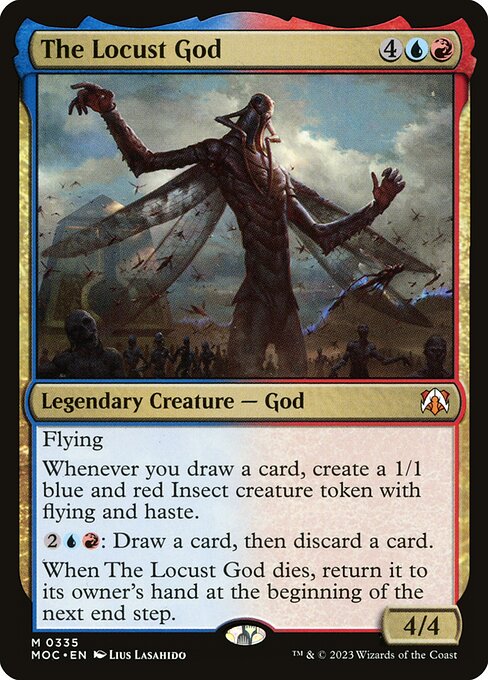
Legendary Creature — God
FlyingFlying is an evasion ability.
A creature with flying can’t be blocked except by creatures with flying and/or reach. A creature with flying can block a creature with or without flying. (See rule 509, “Declare Blockers Step,” and rule 702.17, “Reach.”)
Multiple instances of flying on the same creature are redundant. (CR 702.9)
Whenever you draw a card, createTo create one or more tokens with certain characteristics, put the specified number of tokens with the specified characteristics onto the battlefield.
If a replacement effect applies to a token being created, that effect applies before considering any continuous effects that will modify the characteristics of that token. If a replacement effect applies to a token entering the battlefield, that effect applies after considering any continuous effects that will modify the characteristics of that token.
Previously, an effect that created tokens instructed a player to “put [those tokens] onto the battlefield.” Cards that were printed with that text have received errata in the Oracle card reference so they now “create” those tokens. (CR 701.7) a 1/1 blue and red Insect creature token with flyingFlying is an evasion ability.
A creature with flying can’t be blocked except by creatures with flying and/or reach. A creature with flying can block a creature with or without flying. (See rule 509, “Declare Blockers Step,” and rule 702.17, “Reach.”)
Multiple instances of flying on the same creature are redundant. (CR 702.9) and hasteHaste is a static ability.
If a creature has haste, it can attack even if it hasn’t been controlled by its controller continuously since their most recent turn began. (See rule 302.6.)
If a creature has haste, its controller can activate its activated abilities whose cost includes the tap symbol or the untap symbol even if that creature hasn’t been controlled by that player continuously since their most recent turn began. (See rule 302.6.)
Multiple instances of haste on the same creature are redundant. (CR 702.10).
: Draw a card, then discardTo discard a card, move it from its owner’s hand to that player’s graveyard.
By default, effects that cause a player to discard a card allow the affected player to choose which card to discard. Some effects, however, require a random discard or allow another player to choose which card is discarded.
If a card is discarded, but an effect causes it to be put into a hidden zone instead of into its owner’s graveyard without being revealed, all values of that card’s characteristics are considered to be undefined. If a card is discarded this way to pay a cost that specifies a characteristic about the discarded card, that cost payment is illegal; the game returns to the moment before the cost was paid (see rule 733, “Handling Illegal Actions”). (CR 701.9) a card.
When The Locust God diesIs put into a graveyard from the battlefield. (CR 700.4), return it to its owner's hand at the beginning of the next end step.
$7.65
Commander: LegalModern: Legal
Save this card
Log in to save cards to your lists.
Start a deck with this cardTags and classifications
Card attributes are distinct from extracted ability facts and inferred themes. AI themes and predicted tags are suggestions, not rules text.
Ability tags
Mana costs
Creature kinds
Color identity
Keyword tags
Mana value
Theme tags
Timing tags
Type tags
Predicted tags are currently unavailable.