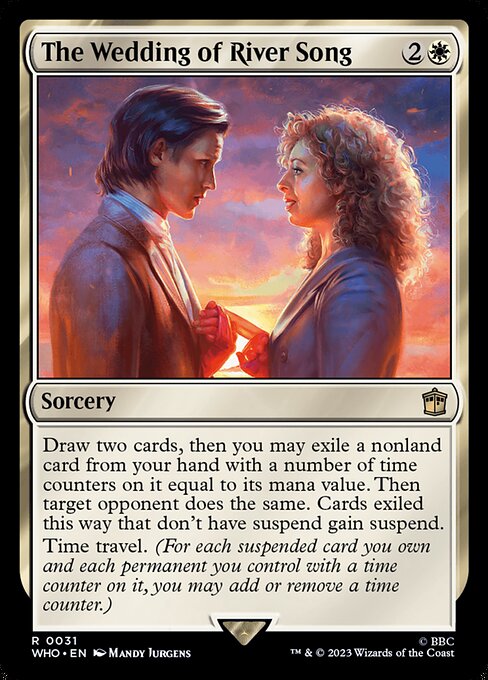
Sorcery
Draw two cards, then you may exileTo exile an object, move it to the exile zone from wherever it is. See rule 406, “Exile.” (CR 701.13) a nonland card from your hand with a number of time countersTo counter a spell or ability is to cancel it: remove it from the stack without resolving it. A counter on an object or player is instead a marker that changes characteristics or interacts with rules or abilities; for example, a +1/+1 counter modifies a creature’s power and toughness. (CR 701.6; 122.1) on it equal to its mana value. Then target opponent does the same. Cards exiled this way that don't have suspendSuspend is a keyword that represents three abilities. The first is a static ability that functions while the card with suspend is in a player’s hand. The second and third are triggered abilities that function in the exile zone. “Suspend N—[cost]” means “If you could begin to cast this card by putting it onto the stack from your hand, you may pay [cost] and exile it with N time counters on it. This action doesn’t use the stack,” and “At the beginning of your upkeep, if this card is suspended, remove a time counter from it,” and “When the last time counter is removed from this card, if it’s exiled, you may play it without paying its mana cost if able. If you don’t, it remains exiled. If you cast a creature spell this way, it gains haste until you lose control of the spell or the permanent it becomes.”
A card is “suspended” if it’s in the exile zone, has suspend, and has a time counter on it.
While determining if you could begin to cast a card with suspend, take into consideration any effects that would prohibit that card from being cast.
Casting a spell as an effect of its suspend ability follows the rules for paying alternative costs in rules 601.2b and 601.2f–h. (CR 702.62) gain suspendSuspend is a keyword that represents three abilities. The first is a static ability that functions while the card with suspend is in a player’s hand. The second and third are triggered abilities that function in the exile zone. “Suspend N—[cost]” means “If you could begin to cast this card by putting it onto the stack from your hand, you may pay [cost] and exile it with N time counters on it. This action doesn’t use the stack,” and “At the beginning of your upkeep, if this card is suspended, remove a time counter from it,” and “When the last time counter is removed from this card, if it’s exiled, you may play it without paying its mana cost if able. If you don’t, it remains exiled. If you cast a creature spell this way, it gains haste until you lose control of the spell or the permanent it becomes.”
A card is “suspended” if it’s in the exile zone, has suspend, and has a time counter on it.
While determining if you could begin to cast a card with suspend, take into consideration any effects that would prohibit that card from being cast.
Casting a spell as an effect of its suspend ability follows the rules for paying alternative costs in rules 601.2b and 601.2f–h. (CR 702.62).
Time travelTo time travel means to choose any number of permanents you control with one or more time counters on them and/or suspended cards you own in exile with one or more time counters on them and, for each of those objects, put a time counter on it or remove a time counter from it. See rule 702.62, “Suspend.” (CR 701.56). (For each suspended card you own and each permanent you control with a time counterTo counter a spell or ability is to cancel it: remove it from the stack without resolving it. A counter on an object or player is instead a marker that changes characteristics or interacts with rules or abilities; for example, a +1/+1 counter modifies a creature’s power and toughness. (CR 701.6; 122.1) on it, you may add or remove a time counterTo counter a spell or ability is to cancel it: remove it from the stack without resolving it. A counter on an object or player is instead a marker that changes characteristics or interacts with rules or abilities; for example, a +1/+1 counter modifies a creature’s power and toughness. (CR 701.6; 122.1).)
$0.24
Commander: LegalModern: Not legal
Save this card
Log in to save cards to your lists.
Start a deck with this cardTags and classifications
Card attributes are distinct from extracted ability facts and inferred themes. AI themes and predicted tags are suggestions, not rules text.
Ability tags
Mana costs
Color identity
Keyword tags
Mana value
Timing tags
Type tags
Predicted tags are currently unavailable.