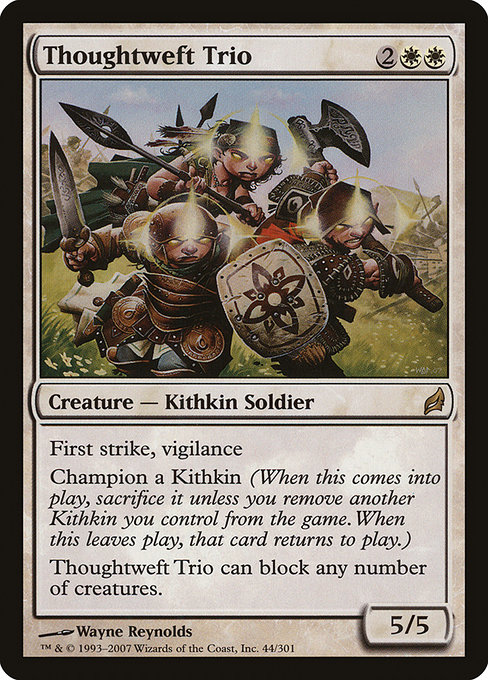
Creature — Kithkin Soldier
First strikeFirst strike is a static ability that modifies the rules for the combat damage step. (See rule 510, “Combat Damage Step.”)
If at least one attacking or blocking creature has first strike or double strike (see rule 702.4) as the combat damage step begins, the only creatures that assign combat damage in that step are those with first strike or double strike. After that step, instead of proceeding to the end of combat step, the phase gets a second combat damage step. The only creatures that assign combat damage in that step are the remaining attackers and blockers that had neither first strike nor double strike as the first combat damage step began, as well as the remaining attackers and blockers that currently have double strike. After that step, the phase proceeds to the end of combat step.
Giving first strike to a creature without it after combat damage has already been dealt in the first combat damage step won’t preclude that creature from assigning combat damage in the second combat damage step. Removing first strike from a creature after it has already dealt combat damage in the first combat damage step won’t allow it to also assign combat damage in the second combat damage step (unless the creature has double strike).
Multiple instances of first strike on the same creature are redundant. (CR 702.7), vigilanceVigilance is a static ability that modifies the rules for the declare attackers step.
Attacking doesn’t cause creatures with vigilance to tap. (See rule 508, “Declare Attackers Step.”)
Multiple instances of vigilance on the same creature are redundant. (CR 702.20)
ChampionChampion represents two triggered abilities. “Champion an [object]” means “When this permanent enters, sacrifice it unless you exile another [object] you control” and “When this permanent leaves the battlefield, return the exiled card to the battlefield under its owner’s control.”
The two abilities represented by champion are linked. See rule 607, “Linked Abilities.”
A permanent is “championed” by another permanent if the latter exiles the former as the direct result of a champion ability. (CR 702.72) a Kithkin (When this enters, sacrificeTo sacrifice a permanent, its controller moves it from the battlefield directly to its owner’s graveyard. A player can’t sacrifice something that isn’t a permanent, or something that’s a permanent they don’t control. Sacrificing a permanent doesn’t destroy it, so regeneration or other effects that replace destruction can’t affect this action. (CR 701.21) it unless you exileTo exile an object, move it to the exile zone from wherever it is. See rule 406, “Exile.” (CR 701.13) another Kithkin you control. When this leaves the battlefield, that card returns to the battlefield.)
This creature can block any number of creatures.
$0.60
Commander: LegalModern: Legal
Save this card
Log in to save cards to your lists.
Start a deck with this cardTags and classifications
Card attributes are distinct from extracted ability facts and inferred themes. AI themes and predicted tags are suggestions, not rules text.
Ability tags
Mana costs
Creature kinds
Classes and roles
Color identity
Keyword tags
Mana value
Timing tags
Type tags
Predicted tags are currently unavailable.