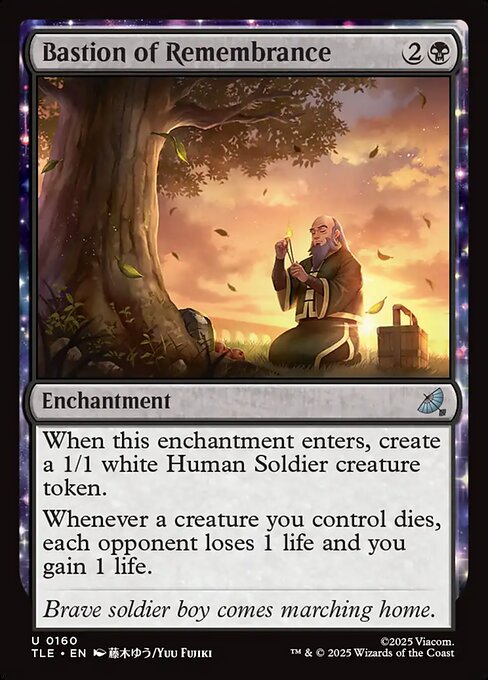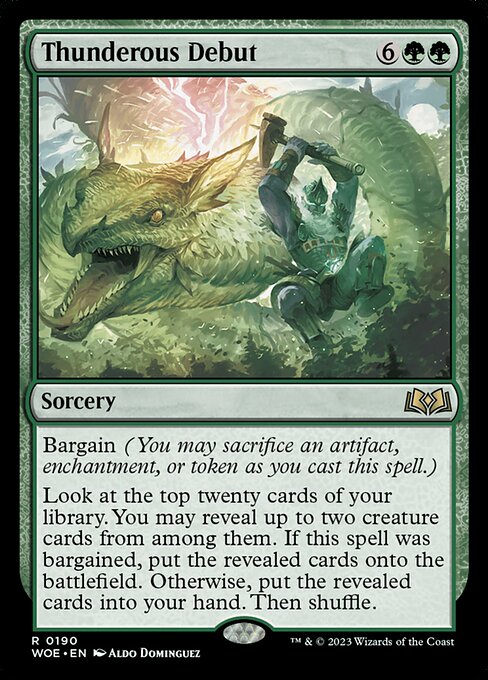
Sorcery
BargainBargain is a static ability that functions while the spell with bargain is on the stack. “Bargain” means “As an additional cost to cast this spell, you may sacrifice an artifact, enchantment, or token.” Paying a spell’s bargain cost follows the rules for paying additional costs in rules 601.2b and 601.2f–h.
If a spell’s controller declares the intention to pay that spell’s bargain cost, that spell has been “bargained.” See rule 601.2b.
Objects with bargain have additional abilities that specify what happens if they were bargained. These abilities are linked to the bargain ability printed on that object: they can refer only to that specific bargain ability. See rule 607, “Linked Abilities.”
If part of a spell’s ability has its effect only if that spell was bargained and that part of the ability includes any targets, the spell’s controller chooses those targets only if that spell was bargained. Otherwise, the spell is cast as if it did not have those targets. See rule 601.2c. (CR 702.166) (You may sacrificeTo sacrifice a permanent, its controller moves it from the battlefield directly to its owner’s graveyard. A player can’t sacrifice something that isn’t a permanent, or something that’s a permanent they don’t control. Sacrificing a permanent doesn’t destroy it, so regeneration or other effects that replace destruction can’t affect this action. (CR 701.21) an artifact, enchantment, or token as you castTo cast a spell is to take it from the zone it’s in (usually the hand), put it on the stack, and pay its costs, so that it will eventually resolve and have its effect. A player may cast a spell if they have priority. See rule 601, “Casting Spells.”
To cast a card is to cast it as a spell. (CR 701.5) this spell.)
Look at the top twenty cards of your library. You may revealTo reveal a card, show that card to all players for a brief time. If an effect causes a card to be revealed, it remains revealed for as long as necessary to complete the parts of the effect that card is relevant to. If the cost to cast a spell or activate an ability includes revealing a card, or if a card is revealed because an ability is activated from a hidden zone (see rule 602.2a), the card remains revealed from the time the spell or ability is announced until the time it leaves the stack. If revealing a card causes a triggered ability to trigger, the card remains revealed until that triggered ability leaves the stack. If that ability isn’t put onto the stack the next time a player would receive priority, the card ceases to be revealed.
Revealing a card doesn’t cause it to leave the zone it’s in.
A card that is currently revealed may be revealed again.
If cards in a player’s library are shuffled or otherwise reordered, any revealed cards that are reordered stop being revealed and become new objects.
Some effects instruct a player to look at one or more cards. Looking at a card follows the same rules as revealing a card, except that the card is shown only to the specified player. (CR 701.20) up to two creature cards from among them. If this spell was bargained, put the revealed cards onto the battlefield. Otherwise, put the revealed cards into your hand. Then shuffleTo shuffle a library or a face-down pile of cards, randomize the cards within it so that no player knows their order.
Some effects cause a player to search a library for a card or cards, shuffle that library, then put some or all of the found cards into a different zone or in a certain position in that library. In such cases, the found cards aren’t included in the shuffle, even though they remain in the library at that time. Rather, all the cards in that library except those are shuffled. Abilities that trigger when a library is shuffled will still trigger. See also rule 401, “Library.”
If an effect would cause a player to shuffle one or more specific objects into a library, that library is shuffled even if none of those objects are in the zone they’re expected to be in or an effect causes all of those objects to be moved to another zone or remain in their current zone.
If an effect would cause a player to shuffle a set of objects into a library, that library is shuffled even if there are no objects in that set.
If an effect causes a player to shuffle a library containing zero or one cards, abilities that trigger when a library is shuffled will still trigger.
If two or more effects cause a library to be shuffled multiple times simultaneously, abilities that trigger when that library is shuffled will trigger that many times.
If an effect would cause a player to shuffle a library at the same time that an object would be put into a certain position in that library, the result is a shuffled library that’s randomized except that the object is in the specified position. (CR 701.24).
$0.29
Commander: LegalModern: Legal
Save this card
Log in to save cards to your lists.
Start a deck with this cardTags and classifications
Card attributes are distinct from extracted ability facts and inferred themes. AI themes and predicted tags are suggestions, not rules text.
Ability tags
Mana costs
Color identity
Keyword tags
Mana value
Theme tags
Timing tags
Type tags
Predicted tags are currently unavailable.