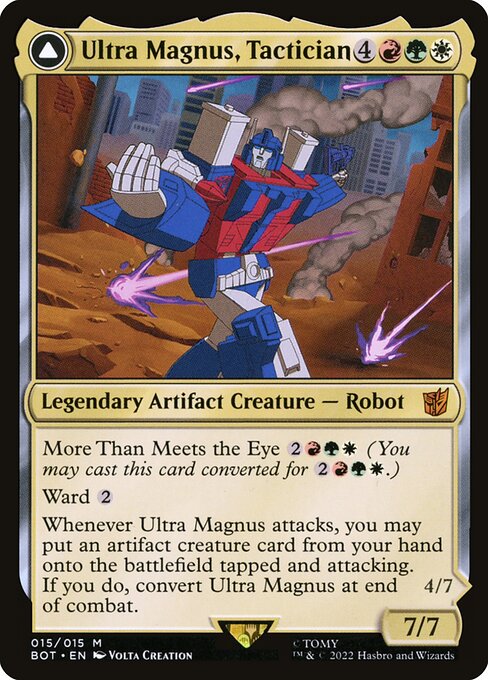
Legendary Artifact Creature — Robot // Legendary Artifact — Vehicle
More Than Meets the EyeMore Than Meets the Eye represents a static ability that functions in any zone from which the spell may be cast. “More Than Meets the Eye [cost]” means “You may cast this card converted by paying [cost] rather than its mana cost.” Casting a spell using its More Than Meets the Eye ability follows the rules for paying alternative costs (see 601.2b and 601.2f–h). See rule 701.28, “Convert.” (CR 702.162) (You may castTo cast a spell is to take it from the zone it’s in (usually the hand), put it on the stack, and pay its costs, so that it will eventually resolve and have its effect. A player may cast a spell if they have priority. See rule 601, “Casting Spells.”
To cast a card is to cast it as a spell. (CR 701.5) this card converted for .)
Ward Ward is a triggered ability. Ward [cost] means “Whenever this permanent becomes the target of a spell or ability an opponent controls, counter that spell or ability unless that player pays [cost].”
Some ward abilities include an X in their cost and state what X is equal to. This value is determined at the time the ability resolves, not locked in as the ability triggers. (CR 702.21)
Whenever Ultra Magnus attacks, you may put an artifact creature card from your hand onto the battlefield tapped and attacking. If you do, convertTo convert a permanent, turn it so that its other face is up. This follows rules 701.27a–f, 712.9–10, and 712.18. Those rules apply to converting a permanent just as they apply to transforming a permanent.
Although converting a permanent uses the same physical action as turning a permanent face up or face down, they are different game actions. Abilities that trigger when a permanent is turned face down won’t trigger when that permanent converts, and so on.
If a spell or ability instructs a player to convert a permanent that isn’t represented by a double-faced token or a double-faced card, nothing happens.
If a spell or ability instructs a player to convert a permanent, and the face that permanent would convert into is an instant or sorcery face, nothing happens.
If an activated or triggered ability of a permanent that isn’t a delayed triggered ability of that permanent tries to convert it, the permanent does so only if it hasn’t converted or transformed since the ability was put onto the stack. If a delayed triggered ability of a permanent tries to convert that permanent, the permanent does so only if it hasn’t converted or transformed since that delayed triggered ability was created. In both cases, if the permanent has already transformed or converted, an instruction to do either is ignored.
If a spell or ability states that a permanent can’t transform, that permanent also can’t convert. (CR 701.28) Ultra Magnus at end of combat. // Living metalLiving metal is a keyword ability found on some Vehicles. “Living metal” means “During your turn, this permanent is an artifact creature in addition to its other types.” (CR 702.161) (During your turn, this Vehicle is also a creature.)
HasteHaste is a static ability.
If a creature has haste, it can attack even if it hasn’t been controlled by its controller continuously since their most recent turn began. (See rule 302.6.)
If a creature has haste, its controller can activate its activated abilities whose cost includes the tap symbol or the untap symbol even if that creature hasn’t been controlled by that player continuously since their most recent turn began. (See rule 302.6.)
Multiple instances of haste on the same creature are redundant. (CR 702.10)
FormidableAn ability word has no rules meaning of its own. It groups abilities with similar themes; the text following it explains this card’s effect. (CR 207.2c) — Whenever Ultra Magnus attacks, attacking creatures you control gain indestructibleIndestructible is a static ability.
A permanent with indestructible can’t be destroyed. Such permanents aren’t destroyed by lethal damage, and they ignore the state-based action that checks for lethal damage (see rule 704.5g).
Multiple instances of indestructible on the same permanent are redundant. (CR 702.12) until end of turn. If those creatures have total power 8 or greater, convertTo convert a permanent, turn it so that its other face is up. This follows rules 701.27a–f, 712.9–10, and 712.18. Those rules apply to converting a permanent just as they apply to transforming a permanent.
Although converting a permanent uses the same physical action as turning a permanent face up or face down, they are different game actions. Abilities that trigger when a permanent is turned face down won’t trigger when that permanent converts, and so on.
If a spell or ability instructs a player to convert a permanent that isn’t represented by a double-faced token or a double-faced card, nothing happens.
If a spell or ability instructs a player to convert a permanent, and the face that permanent would convert into is an instant or sorcery face, nothing happens.
If an activated or triggered ability of a permanent that isn’t a delayed triggered ability of that permanent tries to convert it, the permanent does so only if it hasn’t converted or transformed since the ability was put onto the stack. If a delayed triggered ability of a permanent tries to convert that permanent, the permanent does so only if it hasn’t converted or transformed since that delayed triggered ability was created. In both cases, if the permanent has already transformed or converted, an instruction to do either is ignored.
If a spell or ability states that a permanent can’t transform, that permanent also can’t convert. (CR 701.28) Ultra Magnus.
$0.76
Commander: LegalModern: Not legal
Save this card
Log in to save cards to your lists.
Start a deck with this cardTags and classifications
Card attributes are distinct from extracted ability facts and inferred themes. AI themes and predicted tags are suggestions, not rules text.
Ability tags
Mana costs
Creature kinds
Color identity
Keyword tags
Mana value
Timing tags
Type tags
Predicted tags are currently unavailable.