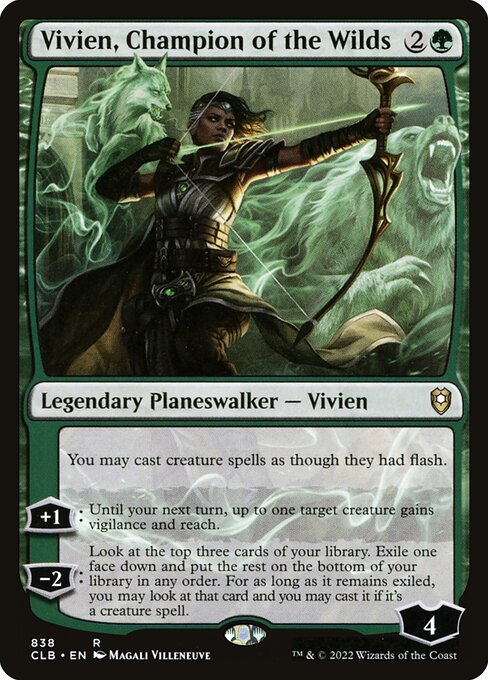
Legendary Planeswalker — Vivien
You may castTo cast a spell is to take it from the zone it’s in (usually the hand), put it on the stack, and pay its costs, so that it will eventually resolve and have its effect. A player may cast a spell if they have priority. See rule 601, “Casting Spells.”
To cast a card is to cast it as a spell. (CR 701.5) creature spells as though they had flashFlash is a static ability that functions in any zone from which you could play the card it’s on. “Flash” means “You may play this card any time you could cast an instant.”
Multiple instances of flash on the same object are redundant. (CR 702.8).
+1: Until your next turn, up to one target creature gains reachReach is a static ability.
A creature with flying can’t be blocked except by creatures with flying and/or reach. (See rule 509, “Declare Blockers Step,” and rule 702.9, “Flying.”)
Multiple instances of reach on the same creature are redundant. (CR 702.17) and vigilanceVigilance is a static ability that modifies the rules for the declare attackers step.
Attacking doesn’t cause creatures with vigilance to tap. (See rule 508, “Declare Attackers Step.”)
Multiple instances of vigilance on the same creature are redundant. (CR 702.20).
−2: Look at the top three cards of your library. ExileTo exile an object, move it to the exile zone from wherever it is. See rule 406, “Exile.” (CR 701.13) one face down and put the rest on the bottom of your library in any order. For as long as it remains exiled, you may castTo cast a spell is to take it from the zone it’s in (usually the hand), put it on the stack, and pay its costs, so that it will eventually resolve and have its effect. A player may cast a spell if they have priority. See rule 601, “Casting Spells.”
To cast a card is to cast it as a spell. (CR 701.5) it if it's a creature spell.
$0.93
Commander: LegalModern: Legal
Save this card
Log in to save cards to your lists.
Start a deck with this cardTags and classifications
Card attributes are distinct from extracted ability facts and inferred themes. AI themes and predicted tags are suggestions, not rules text.
Predicted tags are currently unavailable.