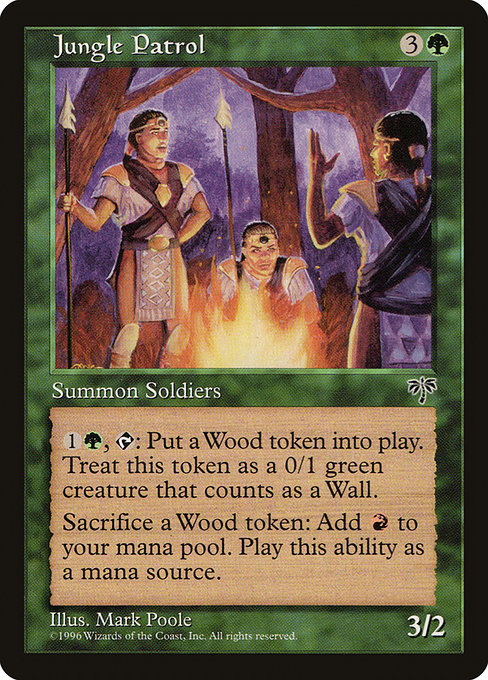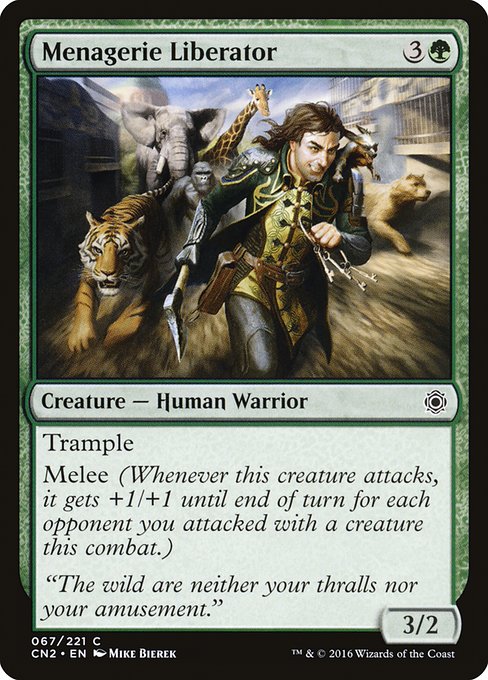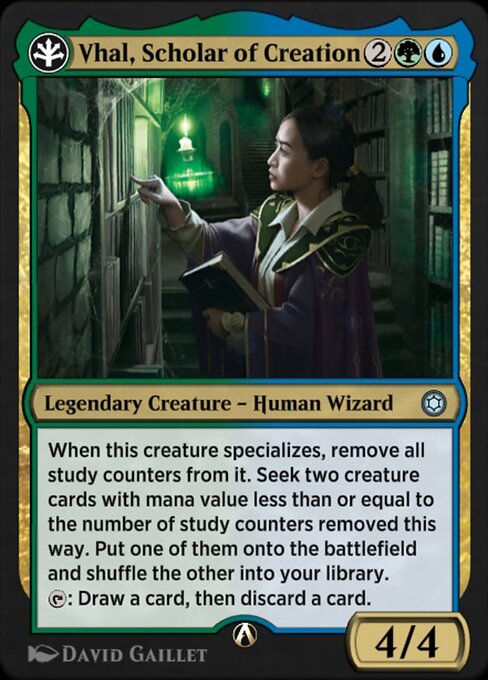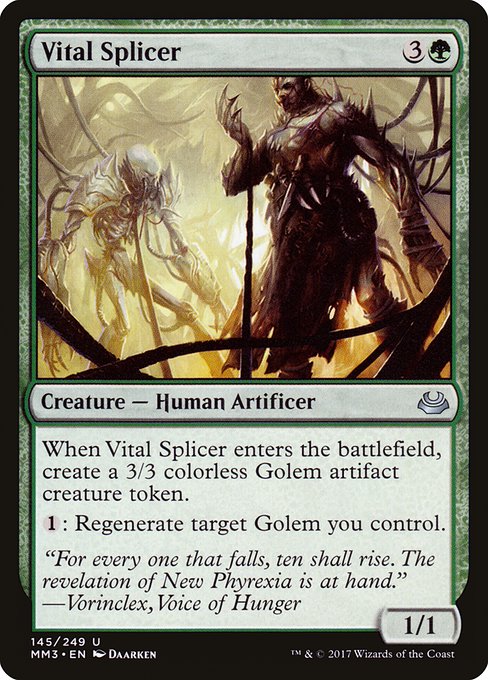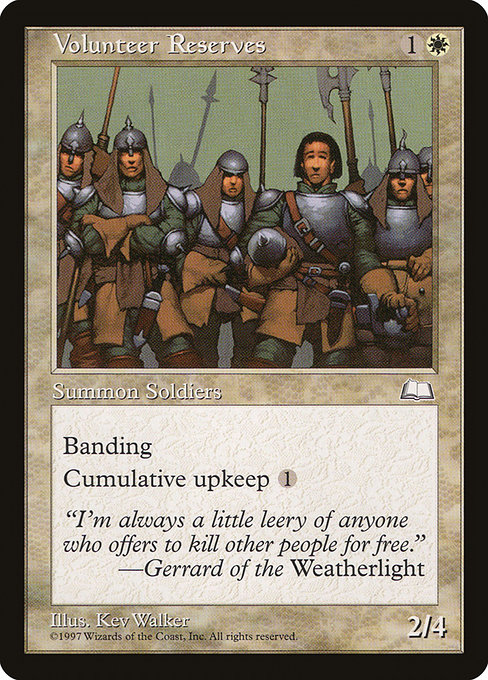
Creature — Human Soldier
BandingBanding is a static ability that modifies the rules for combat.
“Bands with other” is a special form of banding. If an effect causes a permanent to lose banding, the permanent loses all “bands with other” abilities as well.
As a player declares attackers, they may declare that one or more attacking creatures with banding and up to one attacking creature without banding (even if it has “bands with other”) are all in a “band.” They may also declare that one or more attacking [quality] creatures with “bands with other [quality]” and any number of other attacking [quality] creatures are all in a band. A player may declare as many attacking bands as they want, but each creature may be a member of only one of them. (Defending players can’t declare bands but may use banding in a different way; see rule 702.22j.)
All creatures in an attacking band must attack the same player, planeswalker, or battle.
Once an attacking band has been announced, it lasts for the rest of combat, even if something later removes banding or “bands with other” from one or more of the creatures in the band.
An attacking creature that’s removed from combat is also removed from the band it was in.
Banding doesn’t cause attacking creatures to share abilities, nor does it remove any abilities. The attacking creatures in a band are separate permanents.
If an attacking creature becomes blocked by a creature, each other creature in the same band as the attacking creature becomes blocked by that same blocking creature.
If one member of a band would become blocked due to an effect, the entire band becomes blocked.
During the combat damage step, if an attacking creature is being blocked by a creature with banding, or by both a [quality] creature with “bands with other [quality]” and another [quality] creature, the defending player (rather than the active player) chooses how the attacking creature’s damage is assigned. That player can divide that creature’s combat damage as they choose among any creatures blocking it. This is an exception to the procedure described in rule 510.1c.
During the combat damage step, if a blocking creature is blocking a creature with banding, or both a [quality] creature with “bands with other [quality]” and another [quality] creature, the active player (rather than the defending player) chooses how the blocking creature’s damage is assigned. That player can divide that creature’s combat damage as they choose among any creatures it’s blocking. This is an exception to the procedure described in rule 510.1d.
Multiple instances of banding on the same creature are redundant. Multiple instances of “bands with other” of the same kind on the same creature are redundant. (CR 702.22) (Any creatures with bandingBanding is a static ability that modifies the rules for combat.
“Bands with other” is a special form of banding. If an effect causes a permanent to lose banding, the permanent loses all “bands with other” abilities as well.
As a player declares attackers, they may declare that one or more attacking creatures with banding and up to one attacking creature without banding (even if it has “bands with other”) are all in a “band.” They may also declare that one or more attacking [quality] creatures with “bands with other [quality]” and any number of other attacking [quality] creatures are all in a band. A player may declare as many attacking bands as they want, but each creature may be a member of only one of them. (Defending players can’t declare bands but may use banding in a different way; see rule 702.22j.)
All creatures in an attacking band must attack the same player, planeswalker, or battle.
Once an attacking band has been announced, it lasts for the rest of combat, even if something later removes banding or “bands with other” from one or more of the creatures in the band.
An attacking creature that’s removed from combat is also removed from the band it was in.
Banding doesn’t cause attacking creatures to share abilities, nor does it remove any abilities. The attacking creatures in a band are separate permanents.
If an attacking creature becomes blocked by a creature, each other creature in the same band as the attacking creature becomes blocked by that same blocking creature.
If one member of a band would become blocked due to an effect, the entire band becomes blocked.
During the combat damage step, if an attacking creature is being blocked by a creature with banding, or by both a [quality] creature with “bands with other [quality]” and another [quality] creature, the defending player (rather than the active player) chooses how the attacking creature’s damage is assigned. That player can divide that creature’s combat damage as they choose among any creatures blocking it. This is an exception to the procedure described in rule 510.1c.
During the combat damage step, if a blocking creature is blocking a creature with banding, or both a [quality] creature with “bands with other [quality]” and another [quality] creature, the active player (rather than the defending player) chooses how the blocking creature’s damage is assigned. That player can divide that creature’s combat damage as they choose among any creatures it’s blocking. This is an exception to the procedure described in rule 510.1d.
Multiple instances of banding on the same creature are redundant. Multiple instances of “bands with other” of the same kind on the same creature are redundant. (CR 702.22), and up to one without, can attack in a band. Bands are blocked as a group. If any creatures with bandingBanding is a static ability that modifies the rules for combat.
“Bands with other” is a special form of banding. If an effect causes a permanent to lose banding, the permanent loses all “bands with other” abilities as well.
As a player declares attackers, they may declare that one or more attacking creatures with banding and up to one attacking creature without banding (even if it has “bands with other”) are all in a “band.” They may also declare that one or more attacking [quality] creatures with “bands with other [quality]” and any number of other attacking [quality] creatures are all in a band. A player may declare as many attacking bands as they want, but each creature may be a member of only one of them. (Defending players can’t declare bands but may use banding in a different way; see rule 702.22j.)
All creatures in an attacking band must attack the same player, planeswalker, or battle.
Once an attacking band has been announced, it lasts for the rest of combat, even if something later removes banding or “bands with other” from one or more of the creatures in the band.
An attacking creature that’s removed from combat is also removed from the band it was in.
Banding doesn’t cause attacking creatures to share abilities, nor does it remove any abilities. The attacking creatures in a band are separate permanents.
If an attacking creature becomes blocked by a creature, each other creature in the same band as the attacking creature becomes blocked by that same blocking creature.
If one member of a band would become blocked due to an effect, the entire band becomes blocked.
During the combat damage step, if an attacking creature is being blocked by a creature with banding, or by both a [quality] creature with “bands with other [quality]” and another [quality] creature, the defending player (rather than the active player) chooses how the attacking creature’s damage is assigned. That player can divide that creature’s combat damage as they choose among any creatures blocking it. This is an exception to the procedure described in rule 510.1c.
During the combat damage step, if a blocking creature is blocking a creature with banding, or both a [quality] creature with “bands with other [quality]” and another [quality] creature, the active player (rather than the defending player) chooses how the blocking creature’s damage is assigned. That player can divide that creature’s combat damage as they choose among any creatures it’s blocking. This is an exception to the procedure described in rule 510.1d.
Multiple instances of banding on the same creature are redundant. Multiple instances of “bands with other” of the same kind on the same creature are redundant. (CR 702.22) you control are blocking or being blocked by a creature, you divide that creature's combat damage, not its controller, among any of the creatures it's being blocked by or is blocking.)
Cumulative upkeepCumulative upkeep is a triggered ability that imposes an increasing cost on a permanent. “Cumulative upkeep [cost]” means “At the beginning of your upkeep, if this permanent is on the battlefield, put an age counter on this permanent. Then you may pay [cost] for each age counter on it. If you don’t, sacrifice it.” If [cost] has choices associated with it, each choice is made separately for each age counter, then either the entire set of costs is paid, or none of them is paid. Partial payments aren’t allowed.
If a permanent has multiple instances of cumulative upkeep, each triggers separately. However, the age counters are not connected to any particular ability; each cumulative upkeep ability will count the total number of age counters on the permanent at the time that ability resolves. (CR 702.24) (At the beginning of your upkeep, put an age counterTo counter a spell or ability is to cancel it: remove it from the stack without resolving it. A counter on an object or player is instead a marker that changes characteristics or interacts with rules or abilities; for example, a +1/+1 counter modifies a creature’s power and toughness. (CR 701.6; 122.1) on this permanent, then sacrificeTo sacrifice a permanent, its controller moves it from the battlefield directly to its owner’s graveyard. A player can’t sacrifice something that isn’t a permanent, or something that’s a permanent they don’t control. Sacrificing a permanent doesn’t destroy it, so regeneration or other effects that replace destruction can’t affect this action. (CR 701.21) it unless you pay its upkeep cost for each age counterTo counter a spell or ability is to cancel it: remove it from the stack without resolving it. A counter on an object or player is instead a marker that changes characteristics or interacts with rules or abilities; for example, a +1/+1 counter modifies a creature’s power and toughness. (CR 701.6; 122.1) on it.)
$0.24
Commander: LegalModern: Not legal
Save this card
Log in to save cards to your lists.
Start a deck with this cardTags and classifications
Card attributes are distinct from extracted ability facts and inferred themes. AI themes and predicted tags are suggestions, not rules text.
Ability tags
Mana costs
Creature kinds
Classes and roles
Color identity
Keyword tags
Mana value
Timing tags
Type tags
Predicted tags are currently unavailable.