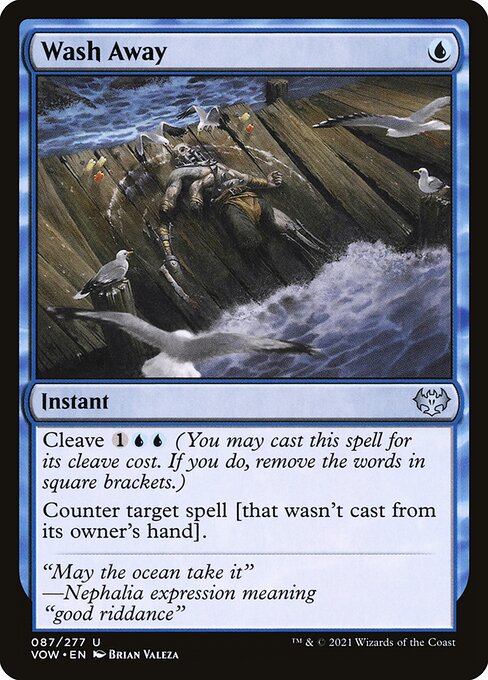
Instant
CleaveCleave is a keyword that represents two static abilities that function while a spell with cleave is on the stack. “Cleave [cost]” means “You may cast this spell by paying [cost] rather than paying its mana cost” and “If this spell’s cleave cost was paid, change its text by removing all text found within square brackets in the spell’s rules text.” Casting a spell for its cleave cost follows the rules for paying alternative costs in rules 601.2b and 601.2f–h.
Cleave’s second ability is a text-changing effect. See rule 612, “Text-Changing Effects.” (CR 702.148) (You may castTo cast a spell is to take it from the zone it’s in (usually the hand), put it on the stack, and pay its costs, so that it will eventually resolve and have its effect. A player may cast a spell if they have priority. See rule 601, “Casting Spells.”
To cast a card is to cast it as a spell. (CR 701.5) this spell for its cleaveCleave is a keyword that represents two static abilities that function while a spell with cleave is on the stack. “Cleave [cost]” means “You may cast this spell by paying [cost] rather than paying its mana cost” and “If this spell’s cleave cost was paid, change its text by removing all text found within square brackets in the spell’s rules text.” Casting a spell for its cleave cost follows the rules for paying alternative costs in rules 601.2b and 601.2f–h.
Cleave’s second ability is a text-changing effect. See rule 612, “Text-Changing Effects.” (CR 702.148) cost. If you do, remove the words in square brackets.)
CounterTo counter a spell or ability is to cancel it: remove it from the stack without resolving it. A counter on an object or player is instead a marker that changes characteristics or interacts with rules or abilities; for example, a +1/+1 counter modifies a creature’s power and toughness. (CR 701.6; 122.1) target spell [that wasn't castTo cast a spell is to take it from the zone it’s in (usually the hand), put it on the stack, and pay its costs, so that it will eventually resolve and have its effect. A player may cast a spell if they have priority. See rule 601, “Casting Spells.”
To cast a card is to cast it as a spell. (CR 701.5) from its owner's hand].
$0.65
Commander: LegalModern: Legal
Save this card
Log in to save cards to your lists.
Start a deck with this cardTags and classifications
Card attributes are distinct from extracted ability facts and inferred themes. AI themes and predicted tags are suggestions, not rules text.
Ability tags
Mana costs
Color identity
Keyword tags
Mana value
Timing tags
Type tags
Predicted tags are currently unavailable.