Instant
TeamworkTeamwork represents a static ability that functions while the spell with teamwork is on the stack. “Teamwork N” means “As an additional cost to cast this spell, you may tap any number of creatures you control with total power N or more.” Paying a spell’s teamwork cost follows the rules for paying additional costs in rules 601.2b and 601.2f–h.
Abilities may refer to a spell cast “using teamwork” or similar. Such phrases refer to whether the player who cast the spell declared the intention to pay the spell’s teamwork cost as they cast that spell.
If part of a spell’s ability has its effect only if teamwork was used to cast it, and that part of the ability includes any targets, the spell’s controller chooses those targets only if teamwork was used to cast that spell. Otherwise, the spell is cast as if it did not have those targets. See rule 601.2c. (CR 702.194) 3 (As an additional cost to castTo cast a spell is to take it from the zone it’s in (usually the hand), put it on the stack, and pay its costs, so that it will eventually resolve and have its effect. A player may cast a spell if they have priority. See rule 601, “Casting Spells.”
To cast a card is to cast it as a spell. (CR 701.5) this spell, you may tapTo tap a permanent, turn it sideways from an upright position. Only untapped permanents can be tapped. (CR 701.26) any number of creatures you control with total power 3 or more.)
Choose one. If this spell was castTo cast a spell is to take it from the zone it’s in (usually the hand), put it on the stack, and pay its costs, so that it will eventually resolve and have its effect. A player may cast a spell if they have priority. See rule 601, “Casting Spells.”
To cast a card is to cast it as a spell. (CR 701.5) using teamworkTeamwork represents a static ability that functions while the spell with teamwork is on the stack. “Teamwork N” means “As an additional cost to cast this spell, you may tap any number of creatures you control with total power N or more.” Paying a spell’s teamwork cost follows the rules for paying additional costs in rules 601.2b and 601.2f–h.
Abilities may refer to a spell cast “using teamwork” or similar. Such phrases refer to whether the player who cast the spell declared the intention to pay the spell’s teamwork cost as they cast that spell.
If part of a spell’s ability has its effect only if teamwork was used to cast it, and that part of the ability includes any targets, the spell’s controller chooses those targets only if teamwork was used to cast that spell. Otherwise, the spell is cast as if it did not have those targets. See rule 601.2c. (CR 702.194), choose both instead.
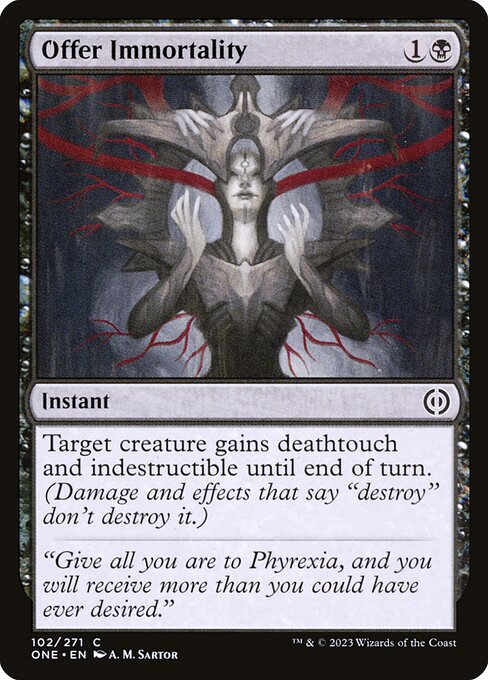
• Target creature gains deathtouchDeathtouch is a static ability.
A creature with toughness greater than 0 that’s been dealt damage by a source with deathtouch since the last time state-based actions were checked is destroyed as a state-based action. See rule 704.
Any nonzero amount of combat damage assigned to a creature by a source with deathtouch is considered to be lethal damage for the purposes of determining if excess damage is being dealt.
The deathtouch rules function no matter what zone an object with deathtouch deals damage from.
If an object is no longer in the zone it’s expected to be in as an effect causes it to deal damage, its last known information is used to determine whether it had deathtouch.
Multiple instances of deathtouch on the same object are redundant. (CR 702.2) until end of turn.
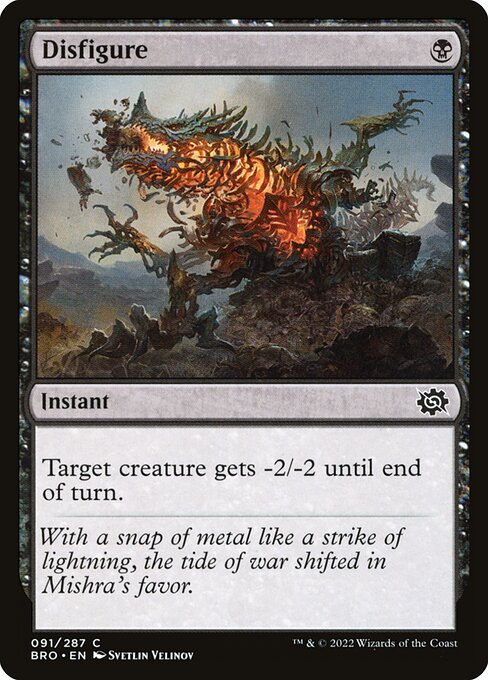
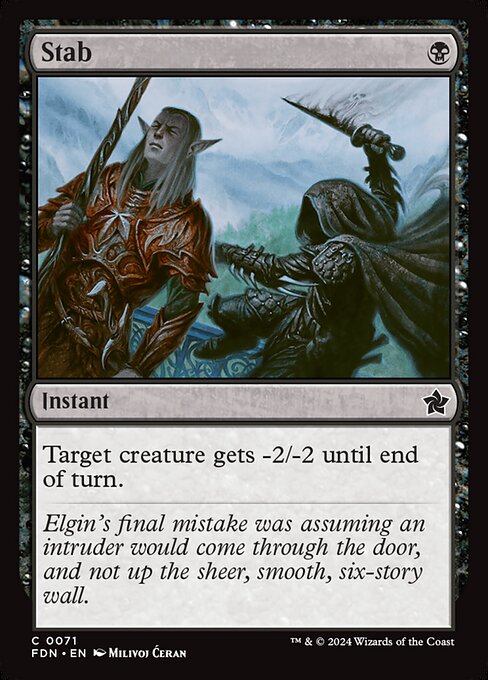
• Target creature gets -2/-2 until end of turn.
$0.13
Commander: LegalModern: Legal
Save this card
Log in to save cards to your lists.
Start a deck with this cardTags and classifications
Card attributes are distinct from extracted ability facts and inferred themes. AI themes and predicted tags are suggestions, not rules text.
Ability tags
Mana costs
Color identity
Keyword tags
Mana value
Timing tags
Type tags
Predicted tags are currently unavailable.