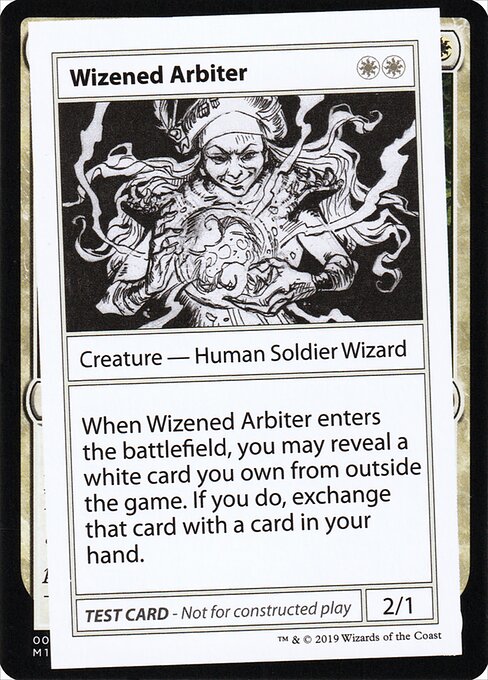
Creature — Human Soldier Wizard
When Wizened Arbiter enters, you may revealTo reveal a card, show that card to all players for a brief time. If an effect causes a card to be revealed, it remains revealed for as long as necessary to complete the parts of the effect that card is relevant to. If the cost to cast a spell or activate an ability includes revealing a card, or if a card is revealed because an ability is activated from a hidden zone (see rule 602.2a), the card remains revealed from the time the spell or ability is announced until the time it leaves the stack. If revealing a card causes a triggered ability to trigger, the card remains revealed until that triggered ability leaves the stack. If that ability isn’t put onto the stack the next time a player would receive priority, the card ceases to be revealed.
Revealing a card doesn’t cause it to leave the zone it’s in.
A card that is currently revealed may be revealed again.
If cards in a player’s library are shuffled or otherwise reordered, any revealed cards that are reordered stop being revealed and become new objects.
Some effects instruct a player to look at one or more cards. Looking at a card follows the same rules as revealing a card, except that the card is shown only to the specified player. (CR 701.20) a white card you own from outside the game. If you do, exchangeA spell or ability may instruct players to exchange something (for example, life totals or control of two permanents) as part of its resolution. When such a spell or ability resolves, if the entire exchange can’t be completed, no part of the exchange occurs.
When control of two permanents is exchanged, if those permanents are controlled by different players, each of those players simultaneously gains control of the permanent that was controlled by the other player. If, on the other hand, those permanents are controlled by the same player, the exchange effect does nothing.
When life totals are exchanged, each player gains or loses the amount of life necessary to equal the other player’s previous life total. Replacement effects may modify these gains and losses, and triggered abilities may trigger on them. A player who can’t gain life can’t be given a higher life total this way, and a player who can’t lose life can’t be given a lower life total this way (see rules 119.7–8).
Some spells or abilities may instruct a player to exchange cards in one zone with cards in a different zone (for example, exiled cards and cards in a player’s hand). These spells and abilities work the same as other “exchange” spells and abilities, except they can exchange the cards only if all the cards are owned by the same player, and they can exchange the cards even if one zone is empty.
If a card in one zone is exchanged with a card in a different zone, and either of them is attached to an object, that card stops being attached to that object and the other card becomes attached to that object.
If a spell or ability instructs a player to simply exchange two zones, and one of the zones is empty, the cards in the zones are still exchanged.
A spell or ability may instruct a player to exchange two numerical values. In such an exchange, each value becomes equal to the previous value of the other. If either of those values is a life total, the affected player gains or loses the amount of life necessary to equal the other value. Replacement effects may modify this gain or loss, and triggered abilities may trigger on it. A player who can’t gain life can’t be given a higher life total this way, and a player who can’t lose life can’t be given a lower life total this way (see rules 119.7–8). If either of those values is a power or toughness, a continuous effect is created setting that power or toughness to the other value (see rule 613.4b). This rule does not apply to spells and abilities that switch a creature’s power and toughness.
One card (Exchange of Words) instructs a player to exchange the text boxes of two creatures. This creates a text-changing effect (see rule 612, “Text-Changing Effects”). In such an exchange, the rules text of each permanent becomes the previous rules text of the other. (CR 701.12) that card with a card in your hand.
$0.19
Commander: Not legalModern: Not legal
Save this card
Log in to save cards to your lists.
Start a deck with this cardTags and classifications
Card attributes are distinct from extracted ability facts and inferred themes. AI themes and predicted tags are suggestions, not rules text.
Ability tags
Mana costs
Creature kinds
Classes and roles
Color identity
Mana value
Timing tags
Type tags
Predicted tags are currently unavailable.