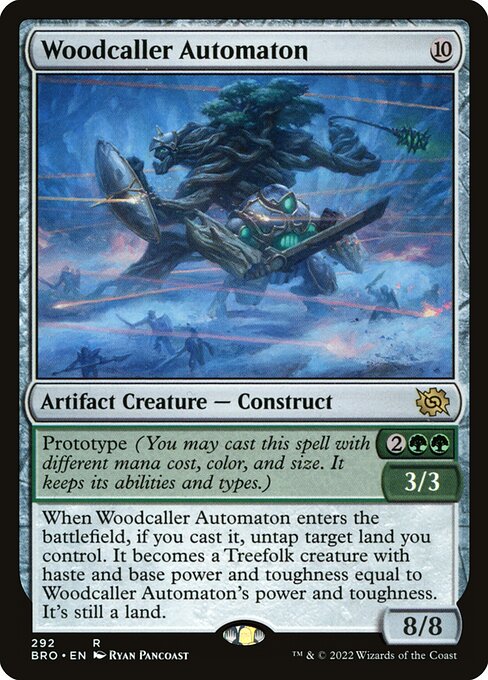
Artifact Creature — Construct
PrototypePrototype is a static ability that appears on prototype cards that have a secondary set of power, toughness, and mana cost characteristics. A player who casts a spell with prototype can choose to cast that card “prototyped.” If they do, the alternative set of its power, toughness, and mana cost characteristics are used. See 718, “Prototype Cards.” (CR 702.160) — 3/3 (You may castTo cast a spell is to take it from the zone it’s in (usually the hand), put it on the stack, and pay its costs, so that it will eventually resolve and have its effect. A player may cast a spell if they have priority. See rule 601, “Casting Spells.”
To cast a card is to cast it as a spell. (CR 701.5) this spell with different mana cost, color, and size. It keeps its abilities and types.)
When this creature enters, if you castTo cast a spell is to take it from the zone it’s in (usually the hand), put it on the stack, and pay its costs, so that it will eventually resolve and have its effect. A player may cast a spell if they have priority. See rule 601, “Casting Spells.”
To cast a card is to cast it as a spell. (CR 701.5) it, untapTo untap a permanent, rotate it back to the upright position from a sideways position. Only tapped permanents can be untapped. (CR 701.26) target land you control. It becomes a Treefolk creature with hasteHaste is a static ability.
If a creature has haste, it can attack even if it hasn’t been controlled by its controller continuously since their most recent turn began. (See rule 302.6.)
If a creature has haste, its controller can activate its activated abilities whose cost includes the tap symbol or the untap symbol even if that creature hasn’t been controlled by that player continuously since their most recent turn began. (See rule 302.6.)
Multiple instances of haste on the same creature are redundant. (CR 702.10) and base power and toughness equal to this creature's power and toughness. It's still a land.
$0.23
Commander: LegalModern: Legal
Save this card
Log in to save cards to your lists.
Start a deck with this cardTags and classifications
Card attributes are distinct from extracted ability facts and inferred themes. AI themes and predicted tags are suggestions, not rules text.
Ability tags
Mana costs
Creature kinds
Color identity
Keyword tags
Mana value
Theme tags
Timing tags
Type tags
Predicted tags are currently unavailable.