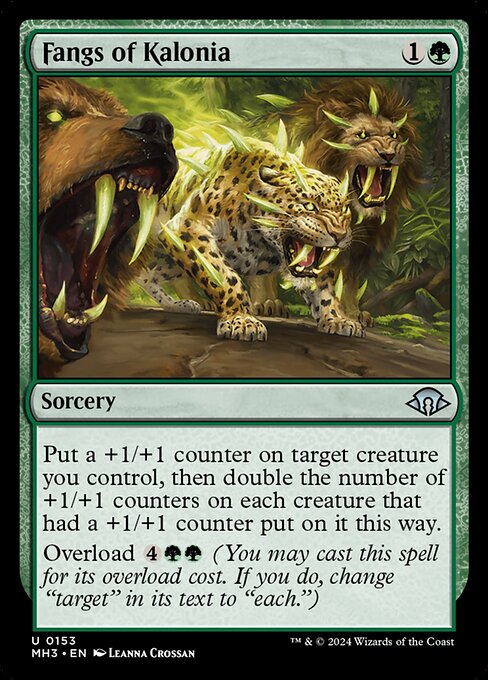
Sorcery
Put a +1/+1 counterTo counter a spell or ability is to cancel it: remove it from the stack without resolving it. A counter on an object or player is instead a marker that changes characteristics or interacts with rules or abilities; for example, a +1/+1 counter modifies a creature’s power and toughness. (CR 701.6; 122.1) on target creature you control, then doubleDoubling a creature’s power and/or toughness creates a continuous effect. This effect modifies that creature’s power and/or toughness but doesn’t set those characteristics to a specific value. See rule 613.4c.
To double a creature’s power, that creature gets +X/+0, where X is that creature’s power as the spell or ability that doubles its power resolves. Similarly, an effect that doubles a creature’s toughness gives it +0/+X, where X is that creature’s toughness. Doubling a creature’s power and toughness gives it +X/+Y, where X is its power and Y is its toughness.
If a creature’s power is less than 0 when it’s doubled, doubling that creature’s power instead means that the creature gets -X/-0, where X is the difference between 0 and its power. Similarly, if its toughness is less than 0 when doubled, it gets -0/-X. If one characteristic’s value is negative but the other isn’t when both are doubled, it gets -X/+Y or +X/-Y, as appropriate.
To double a player’s life total, the player gains or loses an amount of life such that their new life total is twice its current value.
To double the number of a kind of counters on a player or permanent, give that player or permanent as many of those counters as that player or permanent already has.
To double the amount of a type of mana in a player’s mana pool, that player adds an amount of mana of that type equal to the amount they already have.
To double an amount of damage a source would deal, that source instead deals twice that much damage. This is a replacement effect. (CR 701.10) the number of +1/+1 countersTo counter a spell or ability is to cancel it: remove it from the stack without resolving it. A counter on an object or player is instead a marker that changes characteristics or interacts with rules or abilities; for example, a +1/+1 counter modifies a creature’s power and toughness. (CR 701.6; 122.1) on each creature that had a +1/+1 counterTo counter a spell or ability is to cancel it: remove it from the stack without resolving it. A counter on an object or player is instead a marker that changes characteristics or interacts with rules or abilities; for example, a +1/+1 counter modifies a creature’s power and toughness. (CR 701.6; 122.1) put on it this way.
OverloadOverload is a keyword that represents two static abilities that function while the spell with overload is on the stack. Overload [cost] means “You may choose to pay [cost] rather than pay this spell’s mana cost” and “If you chose to pay this spell’s overload cost, change its text by replacing all instances of the word ‘target’ with the word ‘each.’” Casting a spell using its overload ability follows the rules for paying alternative costs in rules 601.2b and 601.2f–h.
If a player chooses to pay the overload cost of a spell, that spell won’t require any targets. It may affect objects that couldn’t be chosen as legal targets if the spell were cast without its overload cost being paid.
Overload’s second ability creates a text-changing effect. See rule 612, “Text-Changing Effects.” (CR 702.96) (You may castTo cast a spell is to take it from the zone it’s in (usually the hand), put it on the stack, and pay its costs, so that it will eventually resolve and have its effect. A player may cast a spell if they have priority. See rule 601, “Casting Spells.”
To cast a card is to cast it as a spell. (CR 701.5) this spell for its overloadOverload is a keyword that represents two static abilities that function while the spell with overload is on the stack. Overload [cost] means “You may choose to pay [cost] rather than pay this spell’s mana cost” and “If you chose to pay this spell’s overload cost, change its text by replacing all instances of the word ‘target’ with the word ‘each.’” Casting a spell using its overload ability follows the rules for paying alternative costs in rules 601.2b and 601.2f–h.
If a player chooses to pay the overload cost of a spell, that spell won’t require any targets. It may affect objects that couldn’t be chosen as legal targets if the spell were cast without its overload cost being paid.
Overload’s second ability creates a text-changing effect. See rule 612, “Text-Changing Effects.” (CR 702.96) cost. If you do, change "target" in its text to "each.")
$0.34
Commander: LegalModern: Legal
Save this card
Log in to save cards to your lists.
Start a deck with this cardTags and classifications
Card attributes are distinct from extracted ability facts and inferred themes. AI themes and predicted tags are suggestions, not rules text.
Ability tags
Mana costs
Color identity
Keyword tags
Mana value
Theme tags
Timing tags
Type tags
Predicted tags are currently unavailable.