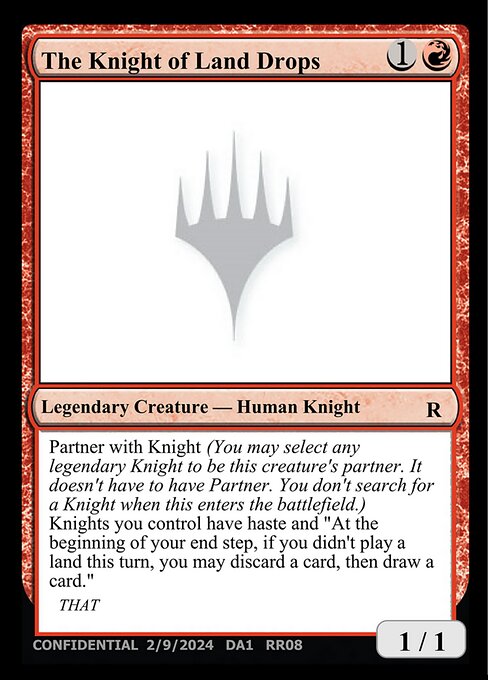
Legendary Creature — Human Knight
PartnerPartner abilities are keyword abilities that modify the rules for deck construction in the Commander variant (see rule 903), and they function before the game begins. Each partner ability allows you to designate two legendary cards as your commander rather than one. Each partner ability has its own requirements for those two commanders. The partner abilities are: partner, partner—[text], partner with [name], choose a Background, and Doctor’s companion.
Your deck must contain exactly 100 cards, including its two commanders. Both commanders begin the game in the command zone.
A rule or effect that refers to your commander’s color identity refers to the combined color identities of your two commanders. See rule 903.4.
Except for determining the color identity of your commander, the two commanders function independently. When casting a commander with partner, ignore how many times your other commander has been cast (see rule 903.8). When determining whether a player has been dealt 21 or more combat damage by the same commander, consider damage from each of your two commanders separately (see rule 903.10a).
If an effect refers to your commander while you have two commanders, it refers to either one. If an effect causes you to perform an action on your commander and it could affect both, you choose which it refers to at the time the effect is applied.
Different partner abilities are distinct from one another and cannot be combined. For example, you cannot designate two cards as your commander if one of them has “partner” and the other has “partner with [name].”
If a legendary card has more than one partner ability, you may choose which one to use when designating your commander, but you can’t use both. Notably, no partner ability or combination of partner abilities can ever let a player have more than two commanders.
“Partner” means “You may designate two legendary cards as your commander rather than one if each of them has partner.”
“Partner—[text]” means “You may designate two legendary cards as your commander rather than one if each of them has the same ‘partner—[text]’ ability.” The “partner—[text]” abilities are “partner—Character select,” “partner—Father & son,” “partner—Friends forever,” and “partner—Survivors.”
“Partner with [name]” represents two abilities. It means “You may designate two legendary cards as your commander rather than one if each has a ‘partner with [name]’ ability with the other’s name” and “When this permanent enters, target player may search their library for a card named [name], reveal it, put it into their hand, then shuffle.”
“Choose a Background” means “You may designate two cards as your commander rather than one if one of them is this card and the other is a legendary Background enchantment card.” You can’t designate two cards as your commander if one has a “choose a Background” ability and the other is not a legendary Background enchantment card, and legendary Background enchantment cards can’t be your commander unless you have also designated a commander with “choose a Background.”
“Doctor’s companion” means “You may designate two legendary creature cards as your commander rather than one if one of them is this card and the other is a legendary Time Lord Doctor creature card that has no other creature types.”
If an effect refers to a partner ability by name, it means only that partner ability and not any others. If an effect refers to the partner ability or cards with partner and doesn’t mention a specific variant of the partner ability by name, it is referring only to partner, partner—[text], partner with [name], or cards with any of those abilities, and it does not refer to any other partner variant. (CR 702.124) with Knight (You may select any legendary Knight to be this creature's partnerPartner abilities are keyword abilities that modify the rules for deck construction in the Commander variant (see rule 903), and they function before the game begins. Each partner ability allows you to designate two legendary cards as your commander rather than one. Each partner ability has its own requirements for those two commanders. The partner abilities are: partner, partner—[text], partner with [name], choose a Background, and Doctor’s companion.
Your deck must contain exactly 100 cards, including its two commanders. Both commanders begin the game in the command zone.
A rule or effect that refers to your commander’s color identity refers to the combined color identities of your two commanders. See rule 903.4.
Except for determining the color identity of your commander, the two commanders function independently. When casting a commander with partner, ignore how many times your other commander has been cast (see rule 903.8). When determining whether a player has been dealt 21 or more combat damage by the same commander, consider damage from each of your two commanders separately (see rule 903.10a).
If an effect refers to your commander while you have two commanders, it refers to either one. If an effect causes you to perform an action on your commander and it could affect both, you choose which it refers to at the time the effect is applied.
Different partner abilities are distinct from one another and cannot be combined. For example, you cannot designate two cards as your commander if one of them has “partner” and the other has “partner with [name].”
If a legendary card has more than one partner ability, you may choose which one to use when designating your commander, but you can’t use both. Notably, no partner ability or combination of partner abilities can ever let a player have more than two commanders.
“Partner” means “You may designate two legendary cards as your commander rather than one if each of them has partner.”
“Partner—[text]” means “You may designate two legendary cards as your commander rather than one if each of them has the same ‘partner—[text]’ ability.” The “partner—[text]” abilities are “partner—Character select,” “partner—Father & son,” “partner—Friends forever,” and “partner—Survivors.”
“Partner with [name]” represents two abilities. It means “You may designate two legendary cards as your commander rather than one if each has a ‘partner with [name]’ ability with the other’s name” and “When this permanent enters, target player may search their library for a card named [name], reveal it, put it into their hand, then shuffle.”
“Choose a Background” means “You may designate two cards as your commander rather than one if one of them is this card and the other is a legendary Background enchantment card.” You can’t designate two cards as your commander if one has a “choose a Background” ability and the other is not a legendary Background enchantment card, and legendary Background enchantment cards can’t be your commander unless you have also designated a commander with “choose a Background.”
“Doctor’s companion” means “You may designate two legendary creature cards as your commander rather than one if one of them is this card and the other is a legendary Time Lord Doctor creature card that has no other creature types.”
If an effect refers to a partner ability by name, it means only that partner ability and not any others. If an effect refers to the partner ability or cards with partner and doesn’t mention a specific variant of the partner ability by name, it is referring only to partner, partner—[text], partner with [name], or cards with any of those abilities, and it does not refer to any other partner variant. (CR 702.124). It doesn't have to have PartnerPartner abilities are keyword abilities that modify the rules for deck construction in the Commander variant (see rule 903), and they function before the game begins. Each partner ability allows you to designate two legendary cards as your commander rather than one. Each partner ability has its own requirements for those two commanders. The partner abilities are: partner, partner—[text], partner with [name], choose a Background, and Doctor’s companion.
Your deck must contain exactly 100 cards, including its two commanders. Both commanders begin the game in the command zone.
A rule or effect that refers to your commander’s color identity refers to the combined color identities of your two commanders. See rule 903.4.
Except for determining the color identity of your commander, the two commanders function independently. When casting a commander with partner, ignore how many times your other commander has been cast (see rule 903.8). When determining whether a player has been dealt 21 or more combat damage by the same commander, consider damage from each of your two commanders separately (see rule 903.10a).
If an effect refers to your commander while you have two commanders, it refers to either one. If an effect causes you to perform an action on your commander and it could affect both, you choose which it refers to at the time the effect is applied.
Different partner abilities are distinct from one another and cannot be combined. For example, you cannot designate two cards as your commander if one of them has “partner” and the other has “partner with [name].”
If a legendary card has more than one partner ability, you may choose which one to use when designating your commander, but you can’t use both. Notably, no partner ability or combination of partner abilities can ever let a player have more than two commanders.
“Partner” means “You may designate two legendary cards as your commander rather than one if each of them has partner.”
“Partner—[text]” means “You may designate two legendary cards as your commander rather than one if each of them has the same ‘partner—[text]’ ability.” The “partner—[text]” abilities are “partner—Character select,” “partner—Father & son,” “partner—Friends forever,” and “partner—Survivors.”
“Partner with [name]” represents two abilities. It means “You may designate two legendary cards as your commander rather than one if each has a ‘partner with [name]’ ability with the other’s name” and “When this permanent enters, target player may search their library for a card named [name], reveal it, put it into their hand, then shuffle.”
“Choose a Background” means “You may designate two cards as your commander rather than one if one of them is this card and the other is a legendary Background enchantment card.” You can’t designate two cards as your commander if one has a “choose a Background” ability and the other is not a legendary Background enchantment card, and legendary Background enchantment cards can’t be your commander unless you have also designated a commander with “choose a Background.”
“Doctor’s companion” means “You may designate two legendary creature cards as your commander rather than one if one of them is this card and the other is a legendary Time Lord Doctor creature card that has no other creature types.”
If an effect refers to a partner ability by name, it means only that partner ability and not any others. If an effect refers to the partner ability or cards with partner and doesn’t mention a specific variant of the partner ability by name, it is referring only to partner, partner—[text], partner with [name], or cards with any of those abilities, and it does not refer to any other partner variant. (CR 702.124). You don't searchTo search for a card in a zone, look at all cards in that zone (even if it’s a hidden zone) and find a card that matches the given description.
If a player is searching a hidden zone for cards with a stated quality, such as a card with a certain card type or color, that player isn’t required to find some or all of those cards even if they’re present in that zone.
If a player is instructed to search a hidden zone for cards that match an undefined quality, that player may still search that zone but can’t find any cards.
If a player is searching a hidden zone simply for a quantity of cards, such as “a card” or “three cards,” that player must find that many cards (or as many as possible, if the zone doesn’t contain enough cards).
If the effect that contains the search instruction doesn’t also contain instructions to reveal the found card(s), then they’re not revealed.
If searching a zone is replaced with searching a portion of that zone, any other instructions that refer to searching the zone still apply. Any abilities that trigger on a library being searched will trigger.
If an effect offers a player a choice to search a zone and take additional actions with the cards found, that player may choose to search even if the additional actions are illegal or impossible.
An effect may instruct a player to search a library for one or more cards more than once before instructing a player to shuffle that library. This is the same as a single instruction for that player to search that library for all those cards. The player searches that library only once.
If multiple players search at once, each of those players looks at the appropriate cards at the same time, then those players decide in APNAP order (see rule 101.4) which card to find.
If an effect instructs a player to search outside the game for a card, that player may choose an appropriate card they own from outside the game. (CR 701.23) for a Knight when this enters the battlefieldShort for entering the battlefield. (CR 700.15).)
Knights you control have hasteHaste is a static ability.
If a creature has haste, it can attack even if it hasn’t been controlled by its controller continuously since their most recent turn began. (See rule 302.6.)
If a creature has haste, its controller can activate its activated abilities whose cost includes the tap symbol or the untap symbol even if that creature hasn’t been controlled by that player continuously since their most recent turn began. (See rule 302.6.)
Multiple instances of haste on the same creature are redundant. (CR 702.10) and "At the beginning of your end step, if you didn't playTo play a land means to put it onto the battlefield from the zone it’s in (usually the hand). A player may play a land if they have priority, it’s the main phase of their turn, the stack is empty, and they haven’t played a land this turn. Playing a land is a special action (see rule 116), so it doesn’t use the stack; it simply happens. Putting a land onto the battlefield as the result of a spell or ability isn’t the same as playing a land. See rule 305, “Lands.”
To play a card means to play that card as a land or to cast that card as a spell, whichever is appropriate.
Some effects instruct a player to “play” with a certain aspect of the game changed, such as “Play with the top card of your library revealed.” “Play” in this sense means to play the Magic game.
Previously, the action of casting a spell, or casting a card as a spell, was referred to on cards as “playing” that spell or that card. Cards that were printed with that text have received errata in the Oracle card reference so they now refer to “casting” that spell or that card.
Previously, the action of using an activated ability was referred to on cards as “playing” that ability. Cards that were printed with that text have received errata in the Oracle card reference so they now refer to “activating” that ability. (CR 701.18) a land this turn, you may discardTo discard a card, move it from its owner’s hand to that player’s graveyard.
By default, effects that cause a player to discard a card allow the affected player to choose which card to discard. Some effects, however, require a random discard or allow another player to choose which card is discarded.
If a card is discarded, but an effect causes it to be put into a hidden zone instead of into its owner’s graveyard without being revealed, all values of that card’s characteristics are considered to be undefined. If a card is discarded this way to pay a cost that specifies a characteristic about the discarded card, that cost payment is illegal; the game returns to the moment before the cost was paid (see rule 733, “Handling Illegal Actions”). (CR 701.9) a card, then draw a card."
$19.63
Commander: Not legalModern: Not legal
Save this card
Log in to save cards to your lists.
Start a deck with this cardTags and classifications
Card attributes are distinct from extracted ability facts and inferred themes. AI themes and predicted tags are suggestions, not rules text.
Ability tags
Mana costs
Creature kinds
Classes and roles
Color identity
Keyword tags
Mana value
Theme tags
Timing tags
Type tags
Predicted tags are currently unavailable.